Of Nature, Art and Grace: On Norman Maclean’s A River Runs Through It
James K. Chandler Remembers a Seminal Work of Autobiographical Fiction on Its 50th Anniversary
Norman Maclean’s A River Runs Through It turns fifty this year. Its author was a retired English professor from the University of Chicago who, at the point late in life when he began work on the book, had published only a handful of essays in literary criticism. The University of Chicago Press took a flier on a manuscript set in Western Montana that, as the legend goes, was turned down by several major New York publishers because it had “trees in it.”
The book got an early boost when it was reviewed by Roger Sale in The New York Review of Books together with Bill Bradley’s basketball memoir, Life on the Run. But that scarcely explains the success that followed, even before Robert Redford recruited the young Brad Pitt to play Norman’s charismatic and self-destructive younger brother Paul in the 1992 film.
The grace with which Paul catches a big trout in a challenging hole becomes the subject to which Norman brings the grace of his own developed craft as a writer.
I can’t claim to have a critic’s distance on the story. A couple of years before its publication, after dinner with Norman in the apartment where he wrote the book, I heard him read the first fifteen pages of it from a handwritten draft on a yellow legal pad. I had known him for a few years at that point, but our conversation had mainly focused on sports, the University of Chicago, and the poet Wordsworth, for whom he had a lifelong passion. He’d told me a little about his book-in-progress, but I honestly had no idea what to expect that evening. He was tired after a long day of writing. He cleared his throat and began with the now-famous opening sentence: “In my family there was no clear line between religion and fly-fishing.”
My initial sense of relief quickly gave way to joy that these pages offered such a brilliant start to his project. When Norman had earlier read an essay of mine about Wordsworth, he wrote on it that my style was “cluttered with the refuse of platitudes.” I could tell right away that his own style in A River Runs Through It avoided all such clutter.
The voice of Norman’s narrator is part of what has made this story so immensely winning for so many generations of readers, but for me, even after the passage of half a century, that narrator still has the somewhat high-pitched tone and strained timbre of Norman’s actual speaking voice. Ultimately, though, a writer’s voice is more than a physical sound. It becomes audible on the page by way of literary elements such as syntax, diction, and, especially for this story, rhythm. Norman’s attention to those elements in A River Runs Through It matters not only to its success but also to its very meaning. For him, there was no clear line between content and form.
His time at the University of Chicago overlapped with a generation of critics—and indeed a school of criticism—associated with the recovery of Aristotelian poetics, and Norman’s critical writings appeared alongside theirs in a voluminous manifesto, Critics and Criticism (1948). Although Norman did not share his colleagues’ taste for systematic literary theory, he did accept a neo-Aristotelian emphasis on techné—artistic craft.
It was a commitment he never abandoned. Soon after A River Runs Through It was published, Norman gave a talk the Modern Language Association’s annual convention in which he lamented the decline in teaching technical aspects of writing: “Go to a baseball game, and ask the fans sitting around you to explain the difference between a hit-and-run and a run-and-hit, and most of them will give you the right answer, but ask students in a contemporary poetry classroom to explain the difference between iambic pentameter and dactylic hexameter and you’ll be met with blank stares: I don’t think the knowledge of an American baseball fan should be too high a standard for us teachers of literature.”
In A River Runs Through It, the announced overlap between religion and fly-fishing in the Maclean household is quickly filled in with an account of what Norman and his brother Paul learned from their Presbyterian-minister father about both Calvinist theology and the use of a fly rod—an instrument never to be confused with a fishing pole. Theology at first seems to dominate the boys’ time with their father, and the story’s interest, until we reach the understated punchline: “Even so, in a typical week of our childhood Paul and I probably received as many hours of instruction in fly fishing as we did in all other spiritual matters.” Other is a typical witty touch in that sentence. This particular spiritual matter—instruction in fly-fishing—then unfolds for pages with an extraordinary degree of technical detail:
The four-count rhythm, of course, is functional. The one count takes the line, leader, and fly off the water; the two count tosses them seemingly straight into the sky; the three count was my father’s way of saying that at the top the leader and fly have to be given a little beat of time to get behind the line as it is starting forward; the four count means put on the power and throw the line into the rod until you reach ten o’clock—then check-cast, let the fly and leader get ahead of the line, and coast to a soft and perfect landing.
Such extended technical exposition might well try the patience of a reader eager to learn the fate of Paul, whom, as the narrator intimates early on, Norman could not ultimately save from self-destruction. But it turns out that techné itself is redemptive in Norman’s world.
In the end, it is story about nature, art, and grace. Nature is the place where we recharge our souls.
One of the finest sentences in A River Runs Through It delivers a sentiment that Norman clearly took to heart: “If my father had his way, no one who did not know how to fish would be allowed to disgrace a fish by catching him.” In the end, it is story about nature, art, and grace. Nature is the place where we recharge our souls, as Norman says his father does on Sundays between sermons in Missoula, but only by finding a way to be graceful in it. And grace is won only by art, which requires hard-won craft: know-how.
Norman is the brother who worked in summers, fighting fires for the Forest Service. Paul, he tells us, lived by two principles, fishing and not working. But this does not make him irredeemable. The effort Paul invested in perfecting his craft as a fisherman in his days as a Helena reporter makes possible the grace he shows on the river in the climactic moment of the story, which takes place on the Big Blackfoot River in 1937. The grace with which Paul catches a big trout in a challenging hole becomes the subject to which Norman brings the grace of his own developed craft as a writer.
The transcendence of this Wordsworthian “spot of time” makes of Paul’s fatal beating in a Southside Chicago alley a year later seem almost—almost—a casual aftermath of art triumphant. Like the book itself, this spot of time performs a double redemption: of Paul, for a life cut short by addiction, and of Norman, for the catastrophe that occurred on his watch when Paul fled Montana to join him in Chicago.
A few months before the release of Redford’s film in 1992, I was taken by Norman’s daughter Jean and her husband, Joel Snyder, to view an early cut of the film—just the three of us in a small Chicago screening room. There was much to admire about the film, even before it took final shape, not least Pitt’s performance as Paul, but at the close, after we see the elderly Norman fishing the river alone, with the voiceover of the beautiful concluding paragraph (“I am haunted by waters”), I found myself in tears. For me, the film was emotionally devastating in a way that the book had never been. It brought to the surface what the book had so artfully sublimated: all the pain and guilt that Norman had been carrying around with him for almost fifty years until, in old age, he found the grace to shape it into his story.
__________________________________
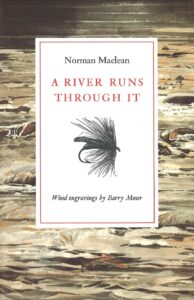
A River Runs Through It by Norman Maclean is available from University of Chicago Press.

James K. Chandler
James K. Chandler is the William B. Ogden Distinguished Service Professor in the Department of English, Department of Cinema and Media Studies, and the College at the University of Chicago.