Ocean Vuong: Photographer First, Writer Second?
Sarah Moroz on a Recent Exhibition of the Poet-Turned-Novelist Who’s Always Had a in Camera Hand
“Unlike writing, which is a vocation mired with maybes, the camera, for all of its complex mechanisms, can only say yes,” Ocean Vuong wrote. “Photography is, for me, a medium of unanimous affirmation.” The embrace of such affirmation is made manifest at CPW in Kingston, New York at the author’s first exhibition highlighting his visual practice: Ocean Vuong: Sống (until May 10, 2026). He joins a rarefied legacy of writers-turned-photographers, like the French queer icon Hervé Guibert or the Nigerian-American novelist Teju Cole.
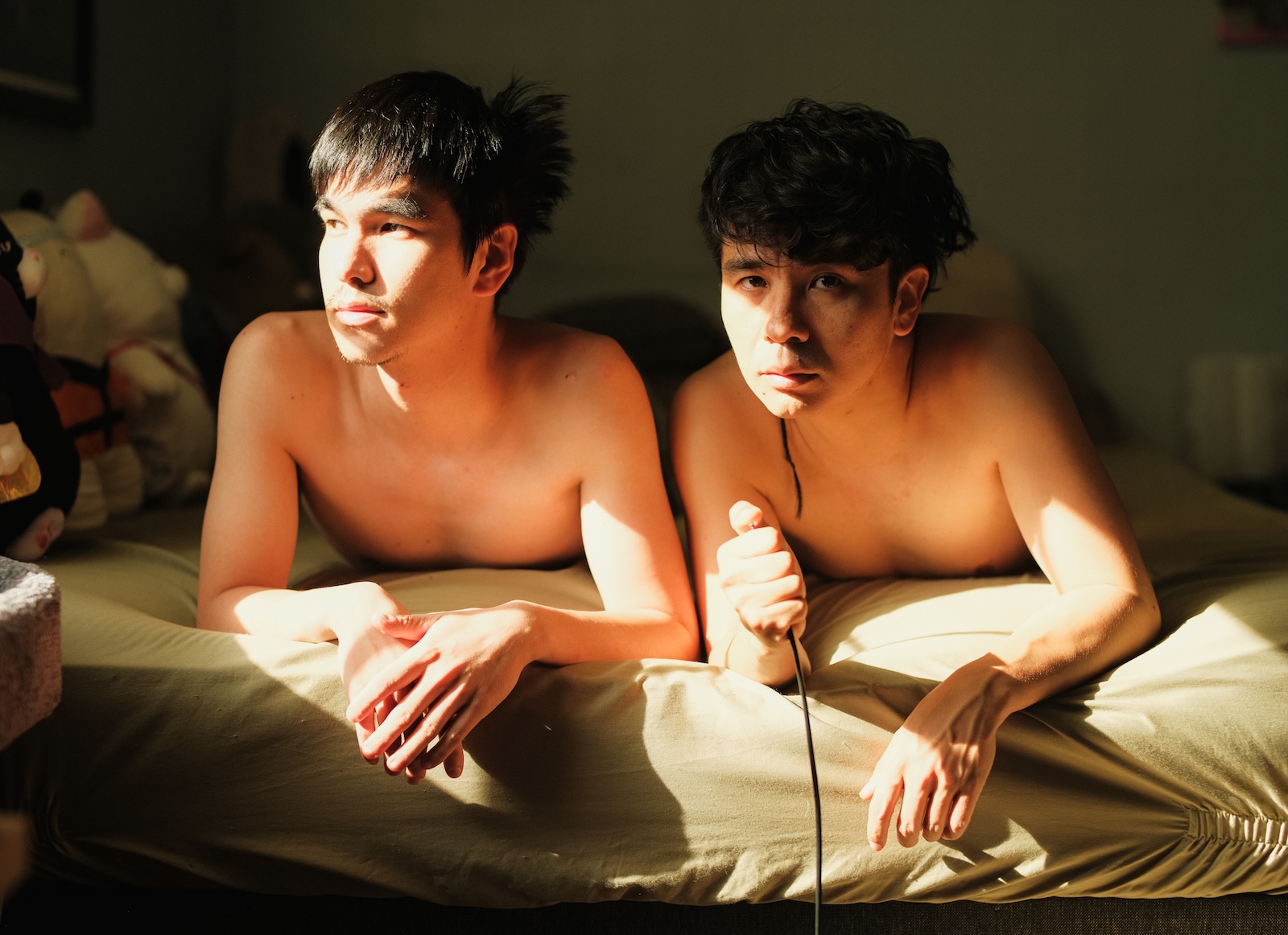
Displaying some 40 photographs, primarily inkjet prints, these images span moments from 2009, when Vuong first borrowed a friend’s Nikon, to pictures snapped as recently as 2025. CPW produced the exhibition in-house; it grew from a June 2025 New York Times Opinion piece, “My Brother’s Keeper,” which introduced Vuong’s photographs to the public for the first time. The article explored the poignant sibling renaissance between Vuong and his younger brother Nicky after the death of their mother; the decade-wide gulf between their life experiences became less notable as the process of bereavement threw them together with great intensity.
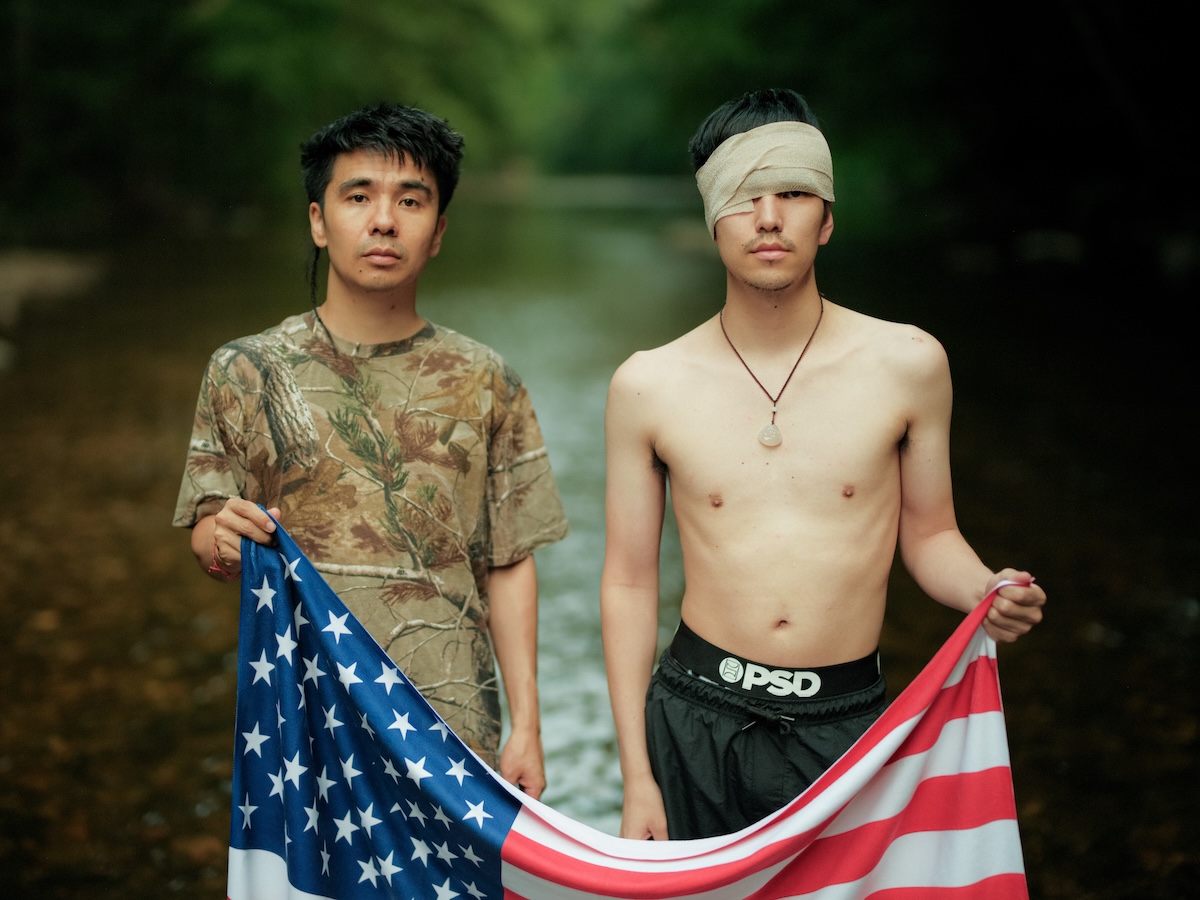 “American brothers” (2024)
Dispossession is a creative impetus for Vuong: “I make things out of loss,” he wrote. These photographs of shared grief and love between brothers were joined by ones Vuong had taken in his mother’s nail salon over the course of a single day—a series he had intended to return to, but never did before she ultimately sold the business. Co-curators Marina Chao and Adam Ryan reached out to Vuong with the idea of “activating these two different bodies” as “this collision of two projects.” Chao pointed out that Vuong has, in fact, been photographing since before he was a writer. “He was talking about exhibitions being really iterative… He was describing exhibitions as—in his mind—like readings,” she said. Ryan added: “What connects the writing with the photographs is that both are intensely honest—and that, for me at least, is where a lot of their power comes from.”
Those who have pored over Vuong’s novels or poems will find a connection with his practice as a visual storyteller, although Chao noted his skill is clear to those who are not devotees—“even if you know nothing, even if you didn’t read the text.” His readership is spliced along a generational divide, and Chao noted how, when the exhibition opened, an elderly couple who had never heard of Vuong-as-writer reacted emotionally to his work purely as a photographer.
Vuong’s mother got a chance to see him as a successful writer, not as an emerging photographer.
“He’s very respectful of the medium and its history and people who have studied it or work with it,” Chao said. The team published a companion artist book, which reproduces the opinion piece in a deconstructed fashion alongside re-sequenced images; the cover photograph is of a blueberry farmer from Massachusetts who had a pebble in his shoe and was taking it out.
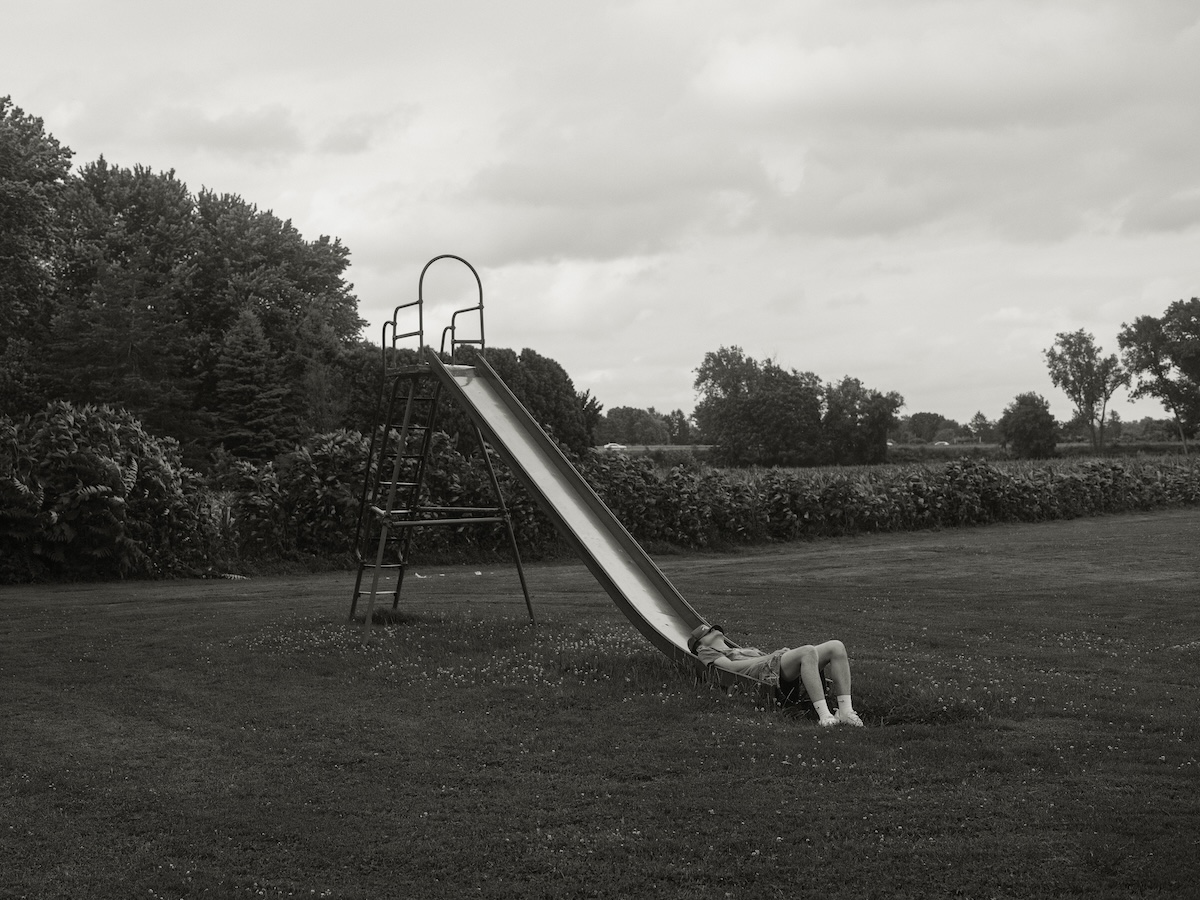 “Nicky (slide)” (2025)
The exhibition’s first wall presents a large photograph of Nicky holding their mother’s urn to set the scene. Chao said: “Ocean’s natural inclination would maybe have been… to kind of mix more”—which the curators did on the last wall—“all these things coming together less linearly.” Vuong collected quotes from his brother, articulated in cut vinyl above some of the photographs. “Ocean was very insistent that he wanted Nicky’s voice to be in the show, to the extent that he was seen as a collaborator, not merely his subject.”
This line between subject/collaborator is a tricky one to satisfy. In the initial article, when Vuong recounted showing images of the nail salon to his mother—bubblegum-pink walls, black leather chairs, exposed calves—she responded: “I just… I just didn’t know our life was so damn sad.” The images read differently, necessarily, in a gallery setting: a quotidian reality to contemplate, rather than a chronicle of professional obligation. Where Vuong grew up in New England, the idea of the future was narrowed into very few paths forward, mainly joining the military, being an employee at the Samuel Colt armory, or working at a nail salon.
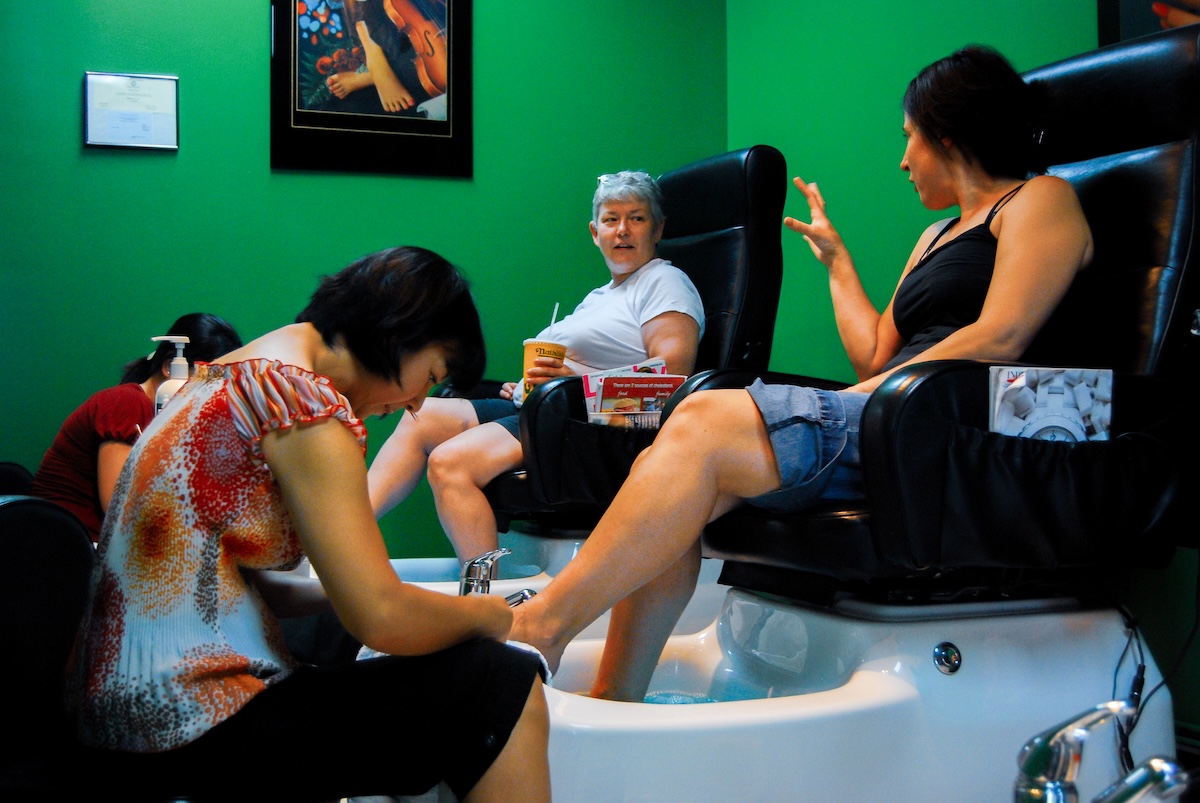 “Nicky (slide)” (2025)
“I think it’s something a lot of artists struggle with, where your parents aren’t really gonna fully get it,” Ryan noted. Vuong’s mother got a chance to see him as a successful writer, not as an emerging photographer. But even being supportive of him when he first got published in a regional journal—one she couldn’t read—“there’s this barrier she can’t cross to join him to really see the extent of his creativity,” Ryan acknowledged. “And I had to imagine there may have been something like that with his photographs as well, where there’s a place that she could not go in seeing the pictures.” Inherent in Vuong’s approach, however, is that things can contain both beauty and ugliness at once, without falling into a binary. He sees power, and potential subversion, within moments of commonplace.
“I never felt I write about marginal people,” Vuong stated during a talk. “Marginal to whom?” he challenged. He described centering his world on people for whom white picket fence Americana is exotic, and violent rupture is more common, especially as tied to immigrant experience and diaspora. Chao noted how many Asian Americans’ experiences resonate within his pictures: the way Vuong grew up in a nail salon, others grew up in, say, a restaurant, or orbited around their parents’ business in a formative way. “Most of our parents came here working in those kinds of jobs,” Chao remarked. Given this, photographs of his brother were a way of “seeing the Asian body at rest, as opposed to the way that it’s been depicted in the United States historically, as often a beast of burden,” Ryan said.
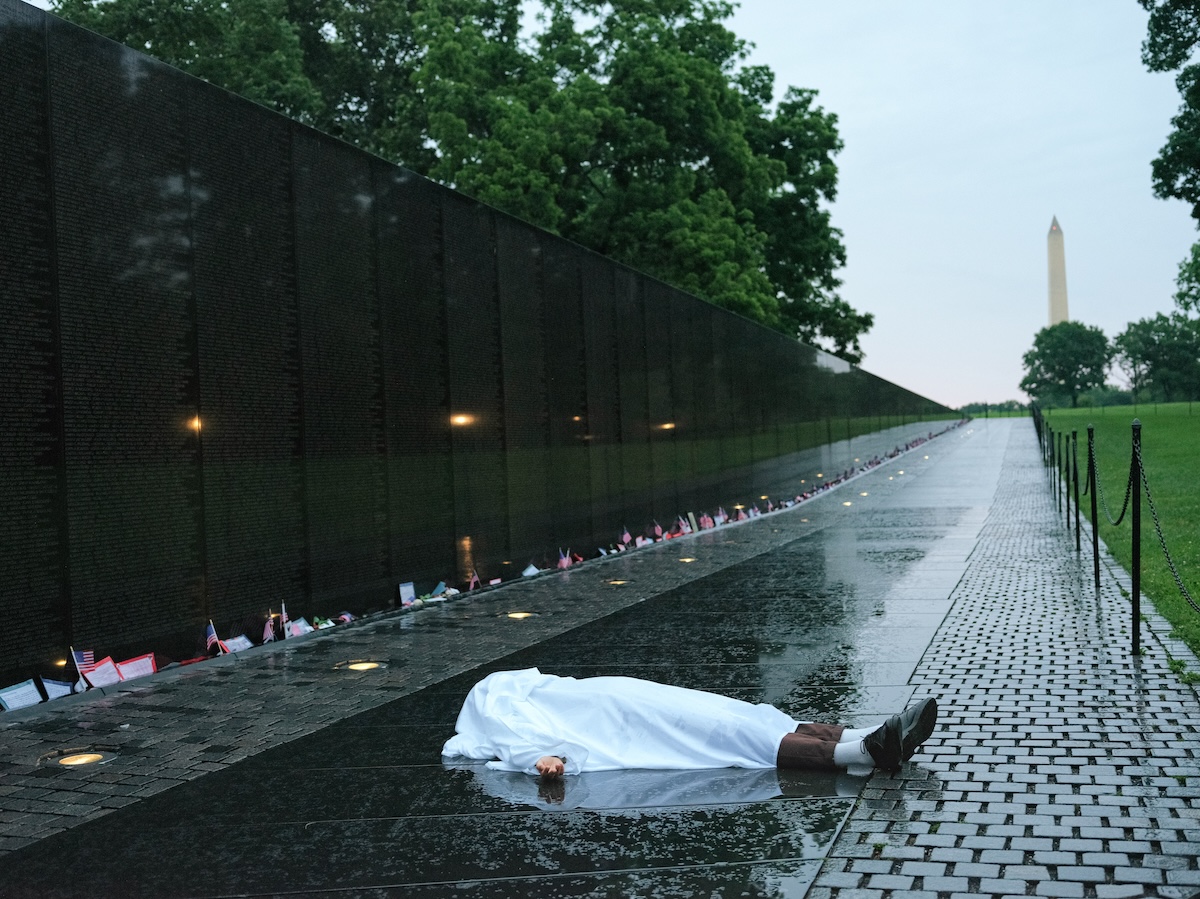 “Memorial” (2023)
Moreover, Vuong is devoted to the medium beyond mere document or testament: in his text, he references Nicéphore Niépce’s 19th-century camera obscura and cites Garry Winogrand, situating his work in a larger photographic history. Nan Goldin was a big influence on him, and though she’s not mentioned in his text, he has pictures from 2022 of them sitting and laughing together on his Instagram, captioned “Nan being Nan.” He started by photographing basement punk shows in Hartford, Connecticut inspired by her raw approach.
Ryan noted: “I see him within a continuum of people who use the camera as a tool of self investigation. … It’s a kind of self-documentary. And that’s probably true of his writing as well.” He added: “I think he’s just a deeply sensitive person, and I think that’s what maybe comes through the most in the photographs: an ineffable thing where you’re so in tune with and still curious about your own reactions to things.” It’s perhaps no surprise that Vuong’s intention is to publish a monograph down the line.
Chao noted that he has the “thing” that always charms her about photographers: “When you’re out with them, you’re walking past something, and they stop. You’re just walking on the street, you’re having a chat, and you’re not even taking in, really, everything that’s going on around you. And then they stop for a second, and they saw whatever—a door, you know? Everything is information. Everything is coming at you, and you’re feeling it, and you’re translating it.”
Featured image: “Nicky and Ocean in bed” (2025)

Sarah Moroz
Sarah Moroz is a freelance writer. She grew up in New York City, and since then has zig-zagged between Montreal, Edinburgh, and Paris (where she currently resides). She contributes to the New York Times travel blog, NYLON Magazine, Hint Magazine, and Publishers Weekly.