Now and Then, Mothers and Daughters, Sonnets and Sequences: Seven Poetry Books to Read This Month
Craig Morgan Teicher Recommends Samuel Amadon, Erin Belieu, Tina Chang, and More
The present moment is brief and sudden, and it’s really all we have: the feel of our feet on the ground, the endless stream of thoughts in our heads, and the visions before our eyes. We live in this messed up world, in all its stunning beauty, though in order to understand it, we must look to the past. That, it seems to me, is what the poets I read this month are up to: searching memory and history to figure out how we got here, and where exactly we are.
Tina Chang, Brenda Hillman and Layli Long Soldier consider what mothers pass along to their daughters, a dark dangerous world lit by small, luminous acts of love. Erin Belieu weighs a lifetime of memories and finds flexible footing in the uncertainty of this moment. Samuel Amadon electrifies the ordinary with words. Two translations—of poems by the Indian mystic Mirabai and the contemporary Romanian poet Radu Vancu—seek to inhabit and transcend the history that holds up the present.
“Be all-in, body and soul,” wrote Mirabai over five hundred years ago (with a little lexical update from translator Chloe Martinez); she’s right, she always was: we have to show up for this moment, no matter how dark and insane it may be. These poets are here to help.
*
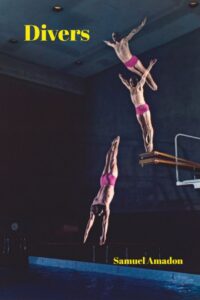
Samuel Amadon, Divers
Amadon makes of the sonnet an exuberant, spring-loaded, sonically awake check-in poem, an argument in favor of paying attention to the nearby world of “Pollen settled on the paint of my porch” and to the language that describes and transforms it: “I find these words/ Real beautiful.” Seeking to reveal a Stevensian “order” that animates a suburban world in which “cars/ Curve out of driveways in quiet arcs,” these poems gently aestheticize the every day. The collection is also a seasonal day book, tracing a year of temperature changes, blooms, and dyings-off. Nothing startling happens yet so many things startle.
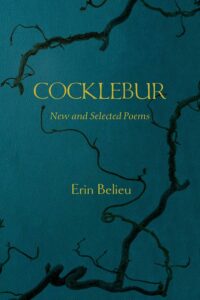
Erin Belieu, Cocklebur: New and Selected Poems
This beautiful retrospective volume shows a poet developing steadily, from the graceful descriptions and encoded trauma of the poems from the 1990s through the loosening music and political engagement of the books of the last ten years. Throughout, shoots of sarcasm (“the prairie sulks/ like an ex-husband”) blossom from a dire sort of contemporary earthiness that grounds these lines. Belieu’s poems take place in the unfailingly disappointing real world, lit by the beauty of compromises and transgressions. The new poems—open, uncertain, slowly unfurling—are quietly thrilling, haunted by how “The stories we’re told/as children reside/ permanently inside us.// like measuring cups,// one fear sits snuggly/ inside the next, teaching/ us to tidy our darkness// into the smallest/ amount of space.”
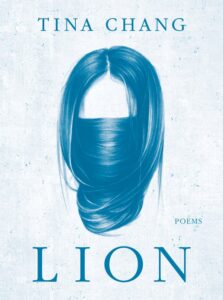
Tina Chang, Lion
“I am destined to be brutally seen,” writes Chang in her formally varied fourth collection, which meditates on what is passed between mothers and daughters, on visual art and myth, and especially on the threats posed to Asian American women during and since the pandemic. Not being seen is also dangerous: “If only my people were not dying from being invisible.” The sacrifices of the poet’s mother (“She offered it all to me. I took and took”) ultimately protect the poet’s daughter, “a tender shoot,/ mothered, until she is an orchestra of light.” An extended meditation on the 2022 murder of Michelle Alyssa Go, who was pushed in front of an oncoming train, opens into a keening lament for violence against many others: “I struggle to live. I carry time that falls/ like chandeliers around me.” Though poetry can’t really protect anyone, Chang’s meets danger with extraordinary empathy: “Each time another woman died, I buried myself/ next to her, more of another world than here.”
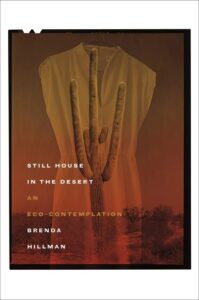
Brenda Hillman, Still House in the Desert
In her most intimate and revealing book, and one of her best, Hillman applies her atomizing approach to the years and details of her mother’s life and her own childhood and youth. These short lyrics in series and billowing extended pieces draw much of their imagery and subject matter from the recent past, starting with the 1950s, “When nuclear testing began north of love/ & the Remington computer was placed in office use.” Hillman locates geological and human history relative to these personally significant dates: “It is half a century before you will mourn your mother.” But as the poems zoom in literally to the atomic level, a different sense of time is revealed: “The dot/ paused in the pencil// but emerged when/ light offered/ support for the dot.” Hillman sweeps across time (“Trees emerged in the Devonian/ Period when Gondwana was a continent”) and reclaims the perspective of a child who “does not fear death,// she hasn’t read enough yet.” What emerges in this strange and masterful book is an expression of grief under a microscope: everything lost is still very much alive.
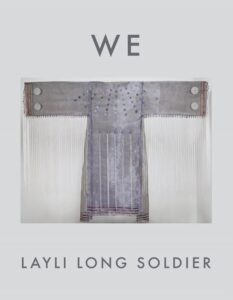
Layli Long Soldier, We
Long Soldier’s long-awaited second collection is a capacious, wooly conglomeration of poetry and prose. In lyric sequences, visual poems, visual art, argumentative personal essays, photos, diagrams of constellations, and pages of rigorous and engaging notes, Long Soldier, who is a finalist for this year’s National Book Award and just won a MacArthur, approaches the deep sorrows and disappointments of our moment with disarming candor: “the images of George Floyd pierced my soul,” awakening “Timeless dread, older-than-you-and-me dread, from the grave and born again.” Rage and tenderness are interwoven in pieces about mothers and daughters; the X’s with which Native leaders signed the 1868 Treaty of Fort Laramie; and the necessity and fragility of art. Over and over, in many ways, with many means, Long Soldier “emphasize[s] that when I say ‘our history’)))) I really do mean our—both Native and non-Native))))…Anyone who lives on this land is a treaty inheritor.”
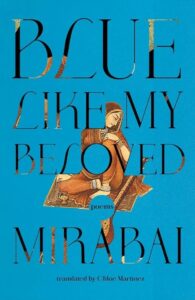
Mirabai, Blue Like My Beloved
Translated from the Braj Bhasha by Chloe Martinez
Mirabai, the sixteenth century Indian poet, mystic, and spiritual seeker, is a household name in India, but less well known here; this riveting new translation of her poems may change that. Legend has it that Mirabai fled a life of power and wealth to devote herself to the god Krishna, whom she calls “Mira’s man, Mountain-lifting lord.” In Martinez’s versions, Mirabai is indomitable, sexy, exceedingly earnest, sometimes funny, always speaking at the border of body and spirit. Martinez also makes Mirabai into a fluent speaker of modern American English and its many informal idioms: “Baddies can go jump in a fire.” Yet these anachronisms seem to make perfect sense, making these 500-year-old poems read like swift, contemporary lyrics, timeless yet utterly urgent. This book will earn Mirabai new disciples.
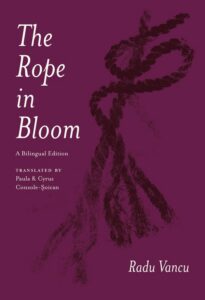
Radu Vancu, The Rope in Bloom
Translated from the Romanian by Paula Console-Soican and Cyrus Console-Soican
This gorgeous, dark, sprawling epic of grief radiates outward from the figure of the poet’s father, who died by suicide and addresses the poet in a series of imagined metaphysical dream monologues that meditate on life, death, history, and recent events. Vancu’s epic has many predecessors, such as John Berryman’s Dream Songs, Genesis, the failed epic poem by Delmore Schwartz, and Station Island, Seamus Heaney’s poetic pilgrimage. The dead, the poet’s father explains, exist in a kind of mirror-world: “in the afterlife it’s all reversed:/ all you say, we at once deny,// so the worlds are held in balance.” Following each canto, set in tercets recalling Dante, is prose commentary, in which the poet reflects the poem as it’s being composed, glances at the larger world and history, and makes stunning pronouncements: “we make our loved ones revel in our suffering so that we can love them all the more. This is a tender torture, in which the torturer may as well be the wife, the child, or the lover.” This project, classical in form, presents a sweeping vision of how the past has led to the present, an epic for this troubled age, a dispatch from a roiling Europe that nonetheless reflects back the difficult beauty of human existence.

Craig Morgan Teicher
Craig Morgan Teicher is the author, most recently, of the poetry collection August, September, October. He has won the Lenore Marshall Poetry Prize and has been awarded a Guggenheim Fellowship. He works as Director of Special Projects for the Bennington Writing Seminars. He teaches at Bennington and NYU.