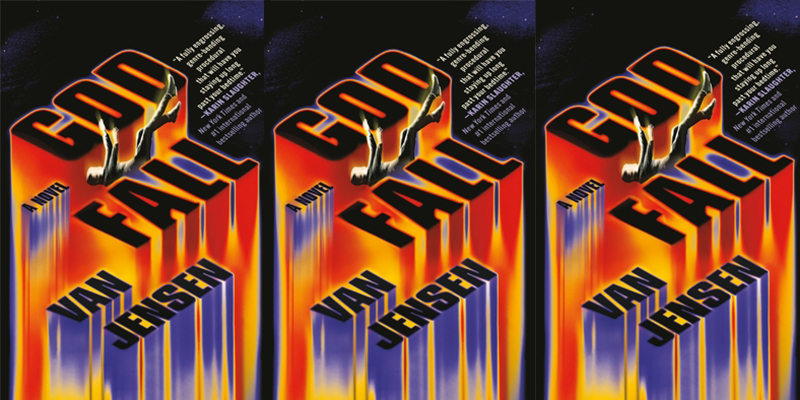
Novelist Van Jensen Talks With His Mother, Acclaimed Painter Jean Jensen, About Art and Family
Van and Jean discuss their collaboration on a special edition print to celebrate the release of Van’s new novel, Godfall
When novelist Van Jensen decided to do a special art print to celebrate the hardcover release of his book Godfall, he had an ace up his sleeve. Jensen’s mother, Jean Jensen, is an acclaimed painter whose work has been exhibited around the Plains and Midwest and had works selected to be displayed at a US embassy.
Godfall tells the story of a small Nebraska town, which becomes the center of the world when a giant alien crash lands out of the sky beside it. The town’s sheriff is tasked with keeping the peace among an influx of outsiders and hunting down a mysterious killer. The art print is available exclusively through Eagle Eye Books.
Here, Van and Jean discuss their collaboration, as well as the novel’s inspiration in the real small Nebraska town where Van grew up and Jean continues to live.
*
VJ: To start, I was hoping you could introduce yourself to the CrimeReads audience. To me, first and foremost, you’re Mom, but to the rest of the world you’re primarily known for your art.
JJ: I grew up here with a mom who loved to draw and always had paper and pencils around. I loved drawing and learning to paint in high school. In my early adult years, I discovered a yearly art workshop in the Nebraska sandhills and made that my personal vacation each year, studying with very talented artists. About 15 years ago I decided I had to give up my day job so that I would have enough time to really paint.
VJ: And talk a little about your style.
JJ: I couldn’t wait to leave small town Nebraska behind. After graduating college in Nairobi, Kenya, I returned home—only to find myself in love with local landscapes. I remember getting teary eyed when I first came back. Nebraska landscapes are subtle, simple, the colors understated. The skies are more dramatic. I love catching the light of a particular moment on the prairie.
You also wanted to get out of Lewellen as soon as you could, but now you have a great fondness for the area. What happened that took you from getting far away to appreciating your childhood environs?
VJ: Rural Nebraska was the worst place and best place for me to grow up all at once. I didn’t have any peers who liked books and comic books, and I felt very lonely. At the same time, the wide-open spaces and quiet are a huge part of why I’m a writer. I lived so much of my childhood in my imagination.
As an adult I’m drawn to the memory of the town that used to exist. Peaceful but active, a place where everyone knows everyone and, mostly, everyone cares for everyone else. No one gets forgotten or left behind. A community, in the truest sense. It was also a place full of oddballs, the kind of quirky people that you can ignore in a city—but not in a town of 300. That was my favorite part of Godfall, filling the background with these people. And the scenery, like you said. It’s subtle in its beauty. But once you take the time to see it, it’s breathtaking.
VJ: Okay, on that subject, when I reached out to you with this cockamamie idea of having you paint something inspired by Godfall, what did you think?
JJ: I thought, well, that’s fun! Then I had a moment of panic as I considered painting something totally from my imagination, but more challenging, from your imagination.
I explained the project to your dad, and he immediately came up with the idea of a man standing in a field next to his tractor looking at the giant in the distance. I was sold on the idea. Something about this man looking at the disruption of his world fit the story, which is all about a small town disrupted with urban growth.
VJ: How did the process on this painting differ from the way you typically work?
JJ: Generally, I paint from my own photos. I want to catch a particular moment, that season, that day, that interplay of sunlight. For this I wanted to portray your story in a way that would connect people to our little piece of the planet. On my own paintings I try to think about mood or intent for a particular painting. In this case I wanted it to reflect the mood that you imagined when you wrote this story.
VJ: Speaking of that, a lot of our conversation around the piece was about color and tone. How do you use color to evoke emotion?
JJ: I have always been inspired by the impressionists and a lot of that is the use of color. I think of colors like a musical scale, a movement of vibrations that resonate with the soul. Colors have an emotional content, whether the actual hue, how vibrant or grey and how light or dark. The Godfall painting is warm with low light using earth tones to capture the feeling of earth and farming. The sense of sunrise or sunset invokes a time of change, being on the edge.
VJ: The most fun part of this process to me was making a trip back home so we could work together.
JJ: I had a list of questions for you—what time of day, color scheme, mood. You referred me to the pages of description in Godfall and sketched with me. We had a lovely time driving around the river valley looking for just the right scene and hit the perfect spot when we found a tractor left for the evening by a farmer cutting hay. We went back the next morning to catch sunrise with you posing with the tractor. I truly enjoyed doing this painting with the giant looking like hills in the distance and trying to capture the beautiful morning scene with disruption on the horizon. The spear was a bugger. I painted it four times.
How did you come up with the idea for Godfall and why set it here?
VJ: I had this vision of a giant alien falling to earth, and it was always Nebraska. I think largely it’s the imagery. Western Nebraska is pancake flat. So, a massive alien falling onto it is an undeniable presence, looming over everything. I love those wide-open dawns and dusks. There’s something really subversive about blocking that. And as I thought more about the story, I realized that the giant was both a literal thing and a metaphor for the outside world. It was modernity and urbanity descending on my hometown, and that offered up so much both in terms of conflict and thematic grist that I couldn’t stop thinking about it.
It is strange that I never wrote about my hometown and even resisted the idea for years, but this idea came along, and I couldn’t resist it. And now I’m more connected to that place than I’ve been since I lived there.
JJ: Garden County has had a handful of murders over the years. One involved my high school classmate, who killed a deputy sheriff our senior year. Did any of that catch your interest as a child?
VJ: The story about your classmate absolutely had an impact. I started reading Stephen King when I was probably 10, and I really pulled into the fantastical and horror aspects of those stories. But when you know of something violent that truly happened and touched people close to you, it hits harder. That’s also why I put a lot of care into any depiction of violence in my books. It’s never frivolous. It always has moral and emotional weight. When I was a crime reporter, if someone was killed, my job was to go and talk to their family. I did that at least once a week. It was incredibly hard, and it reinforced that idea for me. Weird to say about fictional characters, but I want to empathize with them as if they’re real.
Speaking of which, Godfall is set in a fictionalized version of the town where you and dad still live. Did the book affect your perception of the town in any way? Was there anything that surprised you about the way I presented Nebraska?
JJ: I was touched by how much you clearly love the area and the people who live here. I have a running list of funny people and stories to add to the collection. Ornery, bizarre, cantankerous, brilliant, talented, stubborn—all characters from our lives. You mentioned earlier that this is a fictionalized version of Lewellen from your childhood, and it has changed in the last 30 years. We have a harder time knowing our neighbors these days. Lots of outsiders have moved in, though not as many as in the book.
I did wonder if the book would be a self-fulfilling prophecy—that the story would become so popular that tourists would overrun the town.
VJ: Well, I certainly think it’s well worth a visit!
___________________________________

Van Jensen
Van Jensen is an acclaimed novelist, screenwriter, and comic book writer. Godfall, his debut novel, is in development as a TV series with Academy Award winner Ron Howard attached to direct. Jensen began his career as a newspaper crime reporter, then broke into comic books and graphic novels as the writer of ARCA (IDW), Two Dead (Gallery 13), and Tear Us Apart (Dark Horse). Jensen has written world-renowned characters, including Superman, The Flash, Green Lantern, Godzilla, and James Bond. He has served as a Comic Book Ambassador for the U.S. State Department, teaching refugee children to tell their stories through comics. He lives in Atlanta.