No Matter How Much Great Literature We Feed Into AI, It Cannot Feel
Naomi S. Baron Considers the Role of Chatbots In Contemporary Literacy
“Reading makes you more empathic.” We’ll all heard variations on this mantra. As Barack Obama mused during an interview with the novelist Marilynne Robinson, “the most important stuff I’ve learned I think I’ve learned from novels. It has to do with empathy.” In a Vatican letter urging Catholic seminarians to read more literature, Pope Francis argued that by engaging with literary texts, “we develop an imaginative empathy that enables us to identify with how others see, experience and respond to reality.” Philosopher Martha Nussbaum, along with hosts of authors and literature teachers, have agreed.
Because I’m a social scientist (my undergraduate degree in English and American literature notwithstanding), I became curious whether there’s hard evidence that reading—particularly of the serious kind, maybe especially literary—engenders feelings of empathy. Psychologists with special interest in reading have been probing this question for over a decade. The challenge has been how to measure empathy. Self-reports may offer clues, but don’t pass objective muster.
With AI, where does the prospect for empathy come in? In a word, nowhere.
In 2013, David Kidd and Emanuele Castano shifted the research goal posts by asking if reading literary fiction (as opposed to non-fiction, popular fiction, or no reading) correlated with higher scores on what’s known as theory of mind. The concept of theory of mind was developed in the late 1970s by psychologists David Premack and Guy Woodruff. It refers to an individual’s ability to impute a mental state to another being, as well as to experience the mental state oneself. The idea was first proposed in context of studying the behavior of a chimpanzee named Sarah.
But how do you measure theory of mind, particularly in humans?
In the late 1990s, psychologist Simon Baron-Cohen developed a new metric for assessing human mental and emotional conditions, albeit indirectly. It turns out that human eyes often reveal a person’s emotions, more so than the smile or frown plastered on their face. Your ability to “read” a person’s eyes might constitute evidence that you’re imputing a particular mental state to that individual. Baron-Cohen’s “Reading the Mind in the Eyes” Test presented people with photographs of eyes (along with eyebrows). Study participants were asked to identify the mental state or emotion by “reading” the eyes in the photos. While the protocol was originally developed to demonstrate challenges that those on the autism spectrum have in recognizing the mental states of others, the test has since been widely applied as a measure of theory of mind.
Kidd and Castano used Baron-Cohen’s “Reading the Mind in the Eyes” Test, among other metrics, to show that reading literary fiction positively correlated with scores on theory of mind. The authors never claimed to have demonstrated that such reading generates feelings of empathy, though others—including the New York Times—have sometimes confused those high scores as evidence of empathy. Castano cautions:
The fiction/[theory of mind] link is often interpreted as evidence that (literary) fiction makes us more empathetic and thus better people….This is, in my view, too much of a stretch.
Castano’s not denying that reading literary fiction may generate empathy. Rather, he’s reminding us that we can’t prove it.
And yet, lack of proof that reading might help us empathize with others—be they characters in a novel or authors of essays or autobiographies—doesn’t invalidate personal reflections by serious readers whose judgments we value. When literary scholar Paula Marantz Cohen writes that reading Shakespeare’s plays can lead us to empathize with the likes of Shylock, I believe her, just as I believe Obama and Pope Francis.
Now, enter artificial intelligence. Progressively, we are invoking AI as our designated reading task rabbit. We ask it to pore through boatloads of research papers or lengthy meeting transcripts, then summarizing them for us. We feed it essays presenting alternative viewpoints and request a comparative analysis. And some turn to AI to read fiction on their behalf. True enough, the likes of CliffsNotes and SparkNotes paved the way—especially for students—to skip The Merchant of Venice, relying instead on a pre-packaged plot summary and analysis. But with AI, this time is palpably different.
If reading is to have the prospect of helping us understand and feel for our fellow humans, we best do the work ourselves.
The first difference is accessibility. Rather than needing to track down a canned précis of the play, you can turn to the likes of ChatGPT, Gemini, or Claude; customize a prompt to match your assignment; and voila!
The second difference is acceptability. No, not from literature teachers but from peers and the broader community. Given the ubiquity of AI in our lives, it’s become normal to call upon large language models to do the heavy lifting for us, be it writing or editing, image generation or computer coding, and now reading. Besides, within the worlds of both education and employment, guidelines as to what’s acceptable use of AI and what’s not tend to be fuzzy, if defined at all.
With AI, where does the prospect for empathy come in? In a word, nowhere.
Assume, for the sake of argument, that reading, especially of literary fiction, can help us better understand the minds, emotions, and experiences of others, with the potential of generating feelings of empathy within us. When AI does the reading, we’re handed a bloodless, soulless account. We ourselves haven’t engaged with characters or calamities. Building on the concerns of Pope Francis, we have deprived ourselves of the opportunity to “identify with how others see, experience and respond to reality.”
Chatbots have no minds. They don’t see, experience, or respond to the lived, physical world. By contrast, a Shylock conjured by human readers would bleed if you pricked him, and we readers might well empathize. Even Sarah the chimp—as a living being—evidenced theory of mind.
If reading is to have the prospect of helping us understand and feel for our fellow humans, we best do the work ourselves.
__________________________________
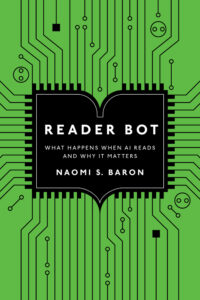
Reader Bot: What Happens When AI Reads and Why It Matters by Naomi S. Baron is available from Stanford University Press.

Naomi S. Baron
Naomi S. Baron is the author of Reader Bot! What Happens When AI Reads and Why It Matters and Who Wrote This? How AI and the Lure of Efficiency Threaten Human Writing (Stanford University Press) and Professor Emerita of Linguistics at American University.