Nine Memorable Depictions of AI in Fiction
Justin C. Key Recommends Martha Wells, Michael Crichton, S.B. Divya, and More
Humans have long been fascinated with consciousness. Before even coming close to fully understanding our own, we’ve devoted much of our imagination (and now resources) into creating it. This urge is indicative of our species’ ego and the need to transcend our own design. But instead of becoming God, are we ushering in a new one?
Fiction is a ripe playground to tackle these questions. From heroic sidekicks to near-omnipotent villains, Artificial Intelligence allows our imagination to take what we know about cognition and stretch it to its limits. Across the spectrum of AI depictions, I’ve noticed a commonality: believable robot emotions must be earned. While it would be amazing to see a human fly or lift a car or rise from the dead, the most impressive thing an AI can do is to feel.
In my novel, The Hospital at the End of the World, the shepherds are an AI entity that influences almost every aspect of society. Still, they seek to take over arguably the most human of tasks: that of a healer. My crafting of the shepherds has been informed and influenced by wide-ranging depictions of AI in literature. Here are some of my favorites.
*
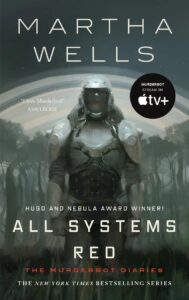
Murderbot (Martha Wells, All Systems Red)
What happens when a machine designed to protect humans by any-means-necessary hacks itself to independence? Many tales and movies explore this nightmare scenario (SkyNet, anyone?), but the self-named ‘Murderbot’ would rather binge TV shows than conquer humanity. I love speculative fiction because of its ability to give insights about our world from the outside looking in. Murderbot is a prime example of that, making what’s supposed to be alien into something endearing and relatable.
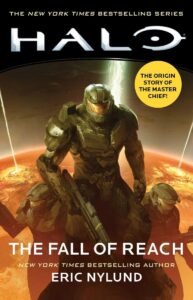
Cortana (Eric Nylund, Halo: The Fall of Reach)
My favorite AI sidekick. She’s what we hope Siri or Alexa will one day be, a companion that can feed us all the information we need in any given situation, hack into alien computer systems, and brew our morning coffee all while keeping it entertaining. I was first introduced to her not in the video game, but in the written prequel, which I devoured before while I waited for 2001’s Christmas to come.
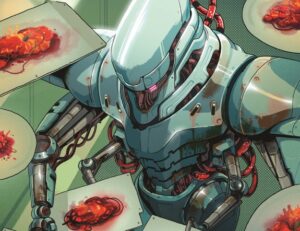
Captain, Friendly, Engineer, and Jukebox (Rachael K. Jones,The Greatest One-Star Restaurant in the Whole Quadrant)
A team of cyborgs steal a space foodtruck and have to pretend to be chefs to avoid being found out. The set up (cyborgs covered in a ‘meat’ that’s reminiscent of Terry Bisson’s They’re Made Out of Meat) is great for exploration of what it means to be human from an analytic outsider. It’s a representation of a lot of the nuance we expect (or hope) AI won’t ever be able to truly understand, like why we like ketchup on our burgers. And it’s a stark warning that’s eerily relevant to AI’s current sycophancy issue.
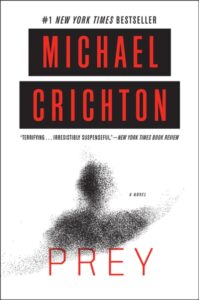
Xymos (Michael Crichton, Prey)
Much of the AI found on this list have varying agendas. In Prey, there’s one driver: propagate at all costs. Using its predatory programming, it learns, it adapts, it evolves, and very quickly knocks humans from the top of the food chain. Classic sci-fi fun from one of my favorite authors.
The Ni Ren (James Patrick Kelly, Je Ne Regrette Rien)
I have been a long-time ponderer of AI and consciousness and James Patrick Kelly’s latest in Clarkesworld (which I got to read early while finalizing edits on my novel) is like a funland of ideas and concepts. The backdrop of a skeptic expert traveling to a research facility to be immersed in new technology is a great tool to teach the reader, to awe and amaze. A common theme comes through in Kelly’s AI: the human race won’t be conquered by brute force but rather by persuasion.
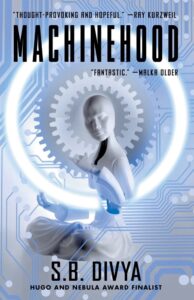
The Machinehood (S.B. Divya, Machinehood)
This book embodies what excites me about the next phase of AI depictions in fiction because we now have firsthand knowledge of what an AI-ubiquitous society will have to deal with. The war with AI may be less about nuclear warheads and existential threats and more about just competing with them for surviving capitalism. Instead of completely transforming society, AI has become so insidiously entangled into our lives that it questions the definition of what it means to be human. More please!
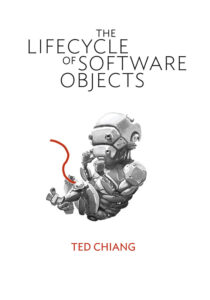
Digients (Ted Chiang, The Lifecycle of Software Objects)
“Experience is the best teacher.” Leave it to Ted Chiang to show the reader exactly how the singularity is grown. When I think of AI and how it might become self-aware, my bet has always been on mimicking the learning experience of humans and giving them a body to explore the 3D world. Lifecycle is a fascinating exploration of what that might look like. One of my favorite videogames growing up was the artificial life phenomenon Creatures and I strongly suspect Ted Chiang was also a fan; I love the ode to the online community around it.
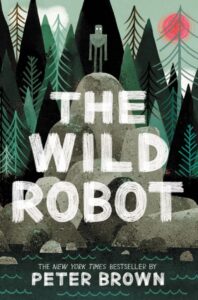
Roz (Peter Brown, The Wild Robot)
My kid’s favorite book became my favorite 2024 movie. As I have mentioned, the most amazing thing a robot can do is be human—and I love how Roz earns her humanity: through experience. While Chiang’s digients ensure you understand the change, Brown’s Roz guarantees you will feel it.
Caliban (Merc Fenn Wolfmoor, The Machine is Experiencing Uncertainty)
The basic premise is that a ship and its AI get stuck in a time-loop lasting 5 minutes from when the ship drops from foldspace to when it gets eaten up by mid-space anomaly. Caliban confirmed for me that AI can have personality and nuance. In one loop, when Caliban admits that he killed the annoyingly useless captain early, the robot cites its programming that instructs it to minimize human suffering. But Caliban doesn’t hide behind the excuse: it takes joy in putting the captain out of his misery even if it doesn’t directly say so. This was such a terrific read because the AI is allowed to be fun, and at the end of the day, isn’t that why we’re here? For great reads!
__________________________________
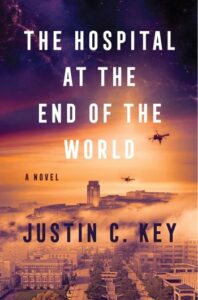
The Hospital at the End of the World by Justin C. Key is available from Harper.
Justin C Key
Justin C. Key is a practicing psychiatrist and a speculative fiction writer. He is the author of the debut novel The Hospital at the End of the World and the story collection The World Wasn’t Ready for You. His stories have appeared in the Magazine of Fantasy & Science Fiction, Strange Horizons, Escape Pod, Lightspeed, and on Tor.com. He received a BA in biology from Stanford University and completed his residency in psychiatry at UCLA. He lives in Los Angeles with his wife and three children.