“did you know he wanted a sin he had to a very grave mortal sin”
When one writes very quietly, writes themselves into the quiet, writes and writes into the long nights of questioning with a muted mouth, becoming quieter, quieter still. And there’s sorrow and perhaps the fear of failing to let the muted mouth go silently into the night, into the long nights of doubt, into those timeless nights with only this scent of fall in their words, words that experience life as inescapable loss, as a chain of hardship and fear and rage and violence and the animal part of the soul, which wants to break out and flail around, sparing no one, itself least of all, since there aren’t images for this, there are no signposts, no dams against the terror and hardship and fear and rage and violence. Words, breakable like children’s bodies; no hand in reach where they’d be well placed, secure, no hand in reach to protect their delicate clarity. A text, its word choice transparent, its language a metaphor for the failure of that language—art language, as my friend A. S. called it—but the art of this text doesn’t lie in what is said, no, it lies more so in what is left unspoken, the secrets between sentences, a transparent secrecy as thread-fine as the words themselves: unity that gives even someone like me the time to explore the secret within the realm of my own experience.
And so I sit down, read. In order to stand right back up again, and pace, pace back and forth, in time with the text, its music. In order not to drown in the secrecy between the lines, which is also mine—woman or not. Woman or not, back and forth, I repeat this to see whether there is something there that extends beyond the division of man and woman, something to do with fists, perhaps, your own.
Appeasing the unruly rhythm of the text. What a thing to say, when it causes your heart and hands to bleed, these hands—this pressing shut, this holding fast to hate and love, interwoven and thereby canceled out, yes, a new dimension, not yet considered by the likes of us; I think: this is the new. I am at your tender throat, incarnate, with my hands, in the name of the Father, the Mother, and everyone else with pain like this, foreverandeveramen. I am at your throat. Let no one tell me your throat isn’t a real place. Homecoming through death, which, once the card is dealt, releases me from my placelessness . Something resembling thankfulness in the silence. This comes after.
When I finally carried the text out of the house. Carried it to the Saint Lawrence chapel (I often say there’s too much to see there: the Rhine, the Rhine valley, the Piz Beverin mountain, the ash groves, ruins of castles whose names I can never remember, which are said to have housed Jenatsch, at least temporarily, that uncouth hero, and even the ashes, these wild-growing, wall-jumping, indecent, unmanageable beings). I carried it to the chapel as a gift, left it surrounded by the ashes and the sacred that’s said to have surrounded Lawrence; a deer screamed. I have a habit of bringing texts to Lawrence, the ones I can’t understand and others so near to me I can hardly stand their nearness. And so I heard a cry and I read “The Lost Story”*—so near to me I can hardly stand its nearness—leaning against the wall, bare feet in the blooming lousewort, meadow sage, lady’s mantle, wild thyme; and this deer screamed, and all I could make of this was that it had simply screamed, that this soft hill, overgrown with herbs, is fond of eliciting cries, far removed from any sort of zoological explanation, simple as that. Pink clouds adorned Piz Berevin like cotton candy—and indeed why should it appear any other way, when deer scream and lousewort sprawls across the bare feet of someone like me—my mouth felt sticky.
Near Lawrence, happiest of all the martyrs, near this man who had himself roasted alive. Almost a fakir, a legend like that. As a child I tried to imagine being there, standing next to him, this man who lay on the gridiron and died. Was he on his stomach, facing the refracted eyes of the earth and glowing embers burning their death marks into his flesh? Or on his back, eyes lost in the starry sky? Today, mindful of the most recent wars, mindful of all the atrocities com-mitted, this happy fantasy has lost its charm, death has lost its innocence, pain its magnitude, irreversible. But here, on the Lawrence hill, at the foot of the Lawrence chapel, the deer cries out, and I read that somewhere someone named Polo Ferro lived, and if I trace his name back to the cradle, he would have to be called “he-who-was-purified-in-iron” or “he-who-was-transformed-in-iron.” I read toward sin, toward “very grave sin,” toward “mortal sin.” For someone like me, brought up Catholic, mortal sin has remained the secret par excellence, a pagan custom, delicious in its dark-ness and all the human incomprehension that surrounds it. Sin keeps doubt in line and gives the act the tenderness it deserves. The act as insurgent against privilege, set to die in the rot of reason. Let us follow the cry of the deer, the metamorphoses are manifold, the risk of your life passing you by is too great.
The pink clouds have released Piz Beverin. Snow glitters cold and blue at its peak. The deer can no longer be heard. Thai is dead. She took the very grave sin, the mortal sin, away with her as sustenance for the journey. Look at the grass and the mother, look at the wild thyme, the meadow sage, and lousewort sprawling across bare feet.
Laughing Lawrence.
He is dead, blown away by another’s pain. What a fallacy, life: an abominable accident. Here, someone captured him, did a good job of it, proved their courage.
__________________________________
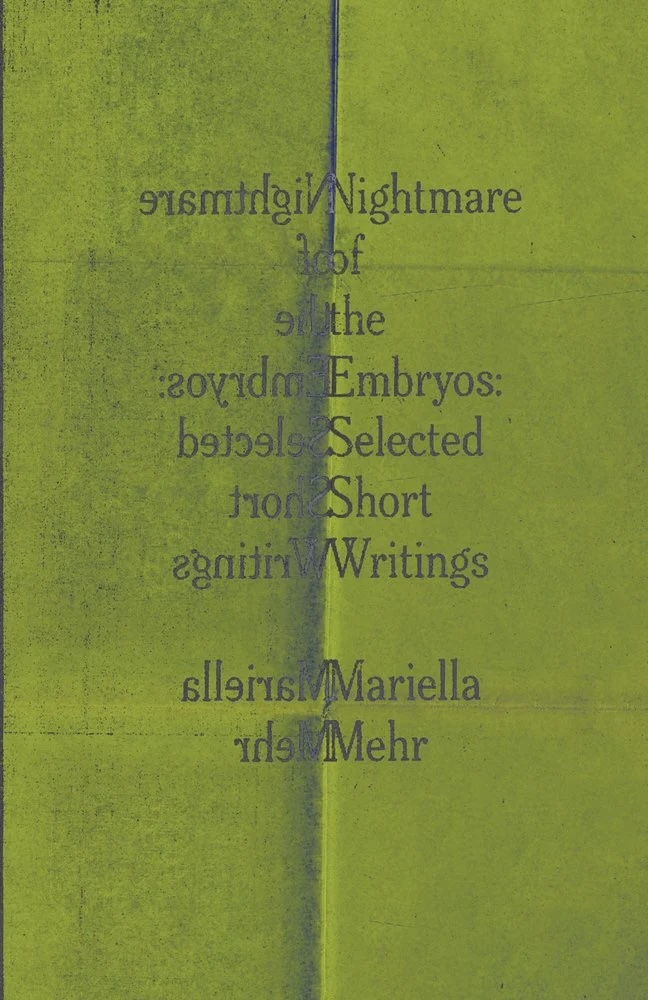
Excerpt from Nightmare of the Embryos by Mariella Mehr, translated by Caroline Froh. Copyright © 2026 by Christian Mehr, copyright © 2026 by Limmat Verlag, Zurich, Switzerland, translation copyright © 2025 by Caroline Froh. Reprinted by permission of New Directions Publishing Corp.