Navigating the Coming-of-Illness Narrative
“We need these stories, because they reveal a potent truth: no one is immune to illness and death.”
It can come on you suddenly or gradually: a tsunami or the slowly rising seas eating away at the shoreline till the topography is no longer recognizable. One day you simply wake up underwater, trying desperately not to drown.
I went through both—the gradual creep of illness and the sudden riptide pulling me out to sea. At first it was a small accumulation of changes: broken thyroid, misbehaving heart, guts that refused certain foods. A heart surgery here, a knee surgery there, a burst ovarian cyst to keep things interesting. And in between, long stretches of normalcy. Cloudy days, sunny ones, school and work, sex and friends and fights and books, always more books to read. I stayed away from the ones too much like me, at first. Only read Brain on Fire because my book club chose it; then The Collected Schizophrenias because a family member had the same diagnosis.
And even though these stories sent strange frissons of recognition down my spine, even though I understood the terror of hospital rooms at night, the exhaustion of pretending everything was fine, I couldn’t align myself with them. I hadn’t learned yet that these kinds of stories can look wildly different in their specifics while still following the same pattern as dozens of others.
Sometimes we readers are given a happy ending; often we’re not. But a lesson is learned, a change experienced by the protagonist.
It’s only when the tsunami came for me, swept me far from shore, that I scrambled frantically for the other books, my only life rafts. The coming-of-illness narrative had finally swallowed me whole after years of nibbling at my edges, and I know longer knew what to do. I wasn’t even sure who I was.
The bildungsroman was a staple of my school and college literary education. The Catcher in the Rye, To Kill a Mockingbird, The Adventures of Huckleberry Finn. My Antonía, Never Let Me Go, Candide, Jane Eyre, The Bell Jar. The list goes on. Every one of them a story of youth maturing, of exploring their world and coming to some adult understanding of how things work. Maybe experiencing love, maybe loss, almost always unveiling the flawed social systems in which they’re trapped. Sometimes we readers are given a happy ending; often we’re not. But a lesson is learned, a change experienced by the protagonist. They’re not who they used to be.
I thought of this popular category, the coming-of-age story, when I was reading one book after another about coming-of-illness. Cancer stories, (Suleika Jaouad’s Between Two Kingdom’s, Audre Lorde’s The Cancer Journals, Kate Bowler’s Everything Happens for a Reason, Paul Kalanithi’s When Breath Becomes Air), mental illness stories (Jami Nakamura Lin’s The Night Parade, Suzanne Scanlon’s Committed), endometriosis stories (Hilary Mantel’s Giving Up the Ghost, Abby Norman’s Ask Me About My Uterus, Tracey Lindeman’s Bleed, Emma Bolden’s The Tiger and the Cage), autoimmune stories (Sarah Manguso’s The Two Kinds of Decay, Tessa Miller’s What Doesn’t Kill You, Meghan O’Rourke’s The Invisible Kingdom), myalgic encephalomyelitis stories (Julie Rehmeyer’s Into the Shadowlands, Elisabeth Tova Bailey’s The Sound of a Wild Snail Eating), stories of pain and suffering and seeking (Porochista Khakpour’s Sick, Johanna Hedva’s How to Tell When We Will Die, Jenn Shapland’s Thin Skin, Darcey Steinke’s This Is the Door, Elinor Cleghorn’s Unwell Women).
Virtually all of them are written by women, often treated horribly by doctors. Some come out the other side of illness, but most loop through an unpredictable whirlpool, at times within sight of shore, at other moments spinning back out to sea. There might be a fight to escape, but even those few who crawl over rocks and grit and sand to reach terra firma find their surroundings changed.
To rebuild myself piece by piece, heart here and hands here and limbs tied to torso with slippery sinew, till I had a form I half-recognized.
When I was swept out, I thought I was a strong enough swimmer to find my way back. A sudden stomach malady called SIBO, an unidentified inflammatory arthritis? A challenge, but my old life was waiting. The harder I fought, though, the worse I became: graduating from fish oil to pain relievers to immune suppressants; from pelvic surgery to hip surgery to bladder surgery. Then a voice disorder, then a bout of tuberculosis (seriously).
At a certain point, there was no strength left in any of my limbs. I let myself float, finally accepting the trajectory of my coming-of-illness: chronically ill and disabled, one of millions adrift with so few supports but each other. The only way for me to survive was to turn to these friends and comrades, then to the artistic practice that had always sustained me: writing. From the Pole of Inaccessibility, I began to feel through the empty darkness of the illness narrative. I began to find a way—not through it, not to some easy end—but a way to make sense of what had happened. To rebuild myself piece by piece, heart here and hands here and limbs tied to torso with slippery sinew, till I had a form I half-recognized.
Of course, part of the challenge was the outward invisibility of all the changes—to anyone who had not been at sea, my new life was imperceptible. But to me, it was a painful and ongoing process of rebirth.
Sociologist Arthur Frank explores the shape of illness narratives in his sensational book The Wounded Storyteller. He writes about the ways that illness, despite being a common human experience, massively disrupts the perceived linear flow of a life. The American medical system does little to ameliorate this upheaval, with its byzantine bureaucracy, high costs of medication, racist and misogynistic practitioners, and long history of harms committed against marginalized communities.
Frank describes several forms that illness narratives can take. The “restitution narrative” is the most straightforward: the patient gets sick and through the work of doctors and medicine, they get better. What this narrative neglects are all the ways treatment might cause terrible side effects, or the long period one spends being sick, and how one’s identity may have changed in the interim.
The “chaos narrative” is when illness disrupts a person’s life to the extent that they can no longer create a coherent narrative. They are lost in the abyss of the deep ocean, unable to recognize themselves or their surroundings, overwhelmed and terrified. I suspect this happens most often when the illness has few treatments and carries intense stigma—diagnoses like Long COVID, Lyme disease, ME, autoimmune disease, and, in its early days, HIV/AIDS. It’s possible to entirely lose one’s grip of reality in this non-narrative, to be buffeted between “wellness influencers” on social media and con artists selling spurious supplements.
Last is the “quest narrative,” in which a patient tries to assign meaning to their suffering. They set off like the Knights of the Round Table, seeking a dragon or a Grail or some other metamorphosis. This might be the most hopeful structure, in which change occurs and is acknowledged, but is seen as a change “for the better.”
I have lived in all three of these narratives at different points, feared and scorned them at others. Restitution has only come when I’ve been sick with more prosaic things, a cold, a flu, strep throat. And while I appreciate the idea of a quest and reshaping oneself, I reject the idea that suffering must lead to self-betterment. Sometimes it does, and sometimes it doesn’t. Often it is only suffering.
Where I’ve lived most often is in some form of chaos and quest. In Ancient Greek cosmology, Chaos could represent the primeval universe that existed before anything else, or the deepest realms of Tartarus, the underworld. Its offspring included Erebus (Darkness) and Nyx, who goes on to produce Ker (destruction), Thanatos (death), and Oizys (pain), among many others.
Sometimes Greek heroes go to the Underworld, through Chaos, to achieve a quest: Orpheus goes in hopes of retrieving his wife, Eurydice; Odysseus needs to consult the dead prophet, Tiresias. These and others make a katabasis, a descent to death. But they rarely stay in Chaos. Their katabasis is followed by anabasis, an ascent back into life.
Coming-of-illness stories are, in many ways, underworld stories. Like the oceans, the underworld is vast and dark and full of strange creatures. It holds torments but also moments of wonder (the first time I saw pictures from inside my body, I couldn’t stop looking at the meaty redness, the sheen of viscera). As the oceans make up the majority of the planet’s surface, so, too, does the underworld represent the majority of all those who have ever lived here. The dead, the sick, the dying. We are a spectral legion, some of us gone, but many still present, living lives vastly different from those around us, but living all the same.
I didn’t know I was writing a coming-of-illness story when I started my book. I couldn’t see the journey I’d been on till I set it down in words. I have not achieved a restitution, and while I know I am on a quest of some sort, I now see it simply as the quest to live a good life with a struggling body. Mostly I find myself dipping in and out of chaos, with no way to make sense of what’s happening, even after nearly two decades of illness. Even after writing a book about it. You’d think I would’ve finished learning this lesson by now.
But illness and pain are teachers with infinite lessons, because they tend to force a certain stillness. When I feel most trapped, most alone, I think of one of the few beings to venture to the underworld and stay there. Persephone, goddess of spring and the fields, became the spouse of Hades, who ruled the underworld. Every year she returned to the living world for the growing seasons, only to return once more to the underworld. She represents a cycle of birth and destruction, life and death. She can be of chaos or apart from it, depending on the time of year. I aspire to accept those cycles as best I can in my own life; the changes that will happen with illness, the moments of peace and growth that may follow. What choice is there but to submit to something as powerful as the sea?
But I still have a plea to make of other storytellers: give me your coming-of-illness narratives. Make them poetic sagas, make them messy, make them fragmented autofiction or epic memoirs. When we fail to integrate these tales into our collective conscious, we are more prone to ableism, to individualism, to thinking each of us is above the whims of life. With rates of chronic illness on the rise, this couldn’t be farther from the truth. We need these stories, because they reveal a potent truth: no one is immune to illness and death. And when we have finally integrated this knowledge, perhaps instead of running from it, we can use it to build an entirely new ecosystem to nourish and nurture everyone, down to the very sickest, the closest to their finally journey under.
__________________________________
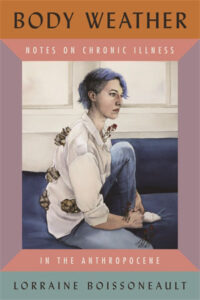
Body Weather: Notes on Chronic Illness from the Anthropocene by Lorraine Boissoneault is available from Beacon Press.

Lorraine Boissoneault
Lorraine Boissoneault is an Ohio native who currently lives in Chicago. She writers about science, history, and adventure for publications like The Atlantic, Chicago Magazine, Salon, Mental_Floss, JSTOR Daily, and Nautilus. The Last Voyageurs is her first nonfiction book.