Namwali Serpell and Vinson Cunningham on Toni Morrison’s Beloved
From the Podcast, PASSAGES: On Morrison
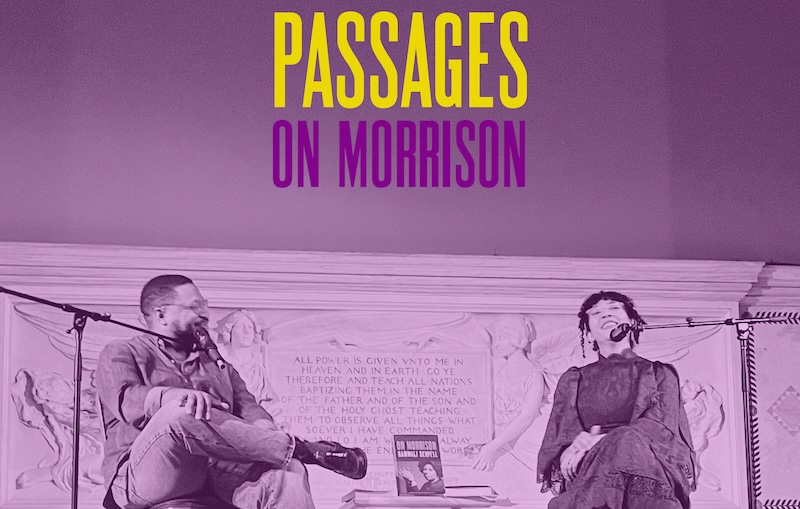
Beloved is a holy space made of words. Across the street from Washington Square Park, in New York City’s historic Judson Memorial Church, Namwali Serpell, writer Vinson Cunningham, and our live audience invoke the hauntings of Morrison’s most celebrated novel. Reading from Beloved’s final, stunning page, Namwali and Vinson trace how Morrison imbues meaning on the level of syntax and crafts her words into a story that cannot be forgotten.
*
*
From the podcast:
Vinson Cunningham: You know who else loved the em dash?
Namwali Serpell: Who?
VC: The Puritans and their descendants.
NS: Oh, yeah.
VC: This passage, to me, is so in conversation with Nathaniel Hawthorne.
NS: Oh, yes, for sure.
VC: Speaking of the uncanny, the long story “Young Goodman Brown,” where the young Puritan walks into the woods and sees unheimlich versions of his neighbors. All of a sudden the neighbor is a demon, and it’s like—oh yeah, there’s something about this sort of haunted ground and suspicion of the neighbor. To exclude the neighbor means to change your mind about them. Beloved always seems to me so early American.
NS: It has areal affinity for that genre. And you see her kind of going back to Hawthorne in a very specific way in A Mercy, which I see as a novel that’s speaking back directly to Beloved, and there’s a scene in a Puritan household in A Mercy where I think she’s definitely riffing on Hawthorne. But also, I love that you say this, because the first paper I ever wrote in graduate school about Beloved—which became part of my dissertation, became part of my first academic book, and then this is, you know, my chapter on it in this book—was a comparison between Beloved and The Scarlet Letter.
And I was seeing those two as in conversation, and this was really what helped me to understand, what interested me about American forms of ambiguity on the page, and what’s happening with this haunting on the page as well.
Something I want to talk about is these footprints.
VC: Mm.
NS: I love the idea that the footprints change size or fit whoever steps into them. “Should a child, an adult place his feet in them, they will fit. Take them out, and they disappear again.” I love this because, to go back to what you said about meta-fiction, it feels to me like that’s a description of reading as well. You have these tracks on the page that you step into.
So this feels to me like one of those moments where the first part of this passage, we’re in a community, these are the characters. The second part is us. It’s us readers, right?
VC: Yeah. I love that, the sort of mutability of the footprint. But then the very next paragraph, it’s like, okay, all trace is gone and what forgotten is not only the footprints, but the water, too, and what is down there. And that’s the depths, the unplumbed depths, it seems to me, is a different metaphor for reading, right?
NS: Absolutely.
VC: A sort of diving into the wreck.
NS: Yes, and the stream at the back of 124 Bluestone Road is one literal version of water, but this is also clearly the Middle Passage. “The water to what is down there,” and that is what gets forgotten. And that’s why Morrison wrote this book, right? That’s why it’s dedicated to “60 million and more who died on the Middle Passage.” This connection between this small community and this little stream behind this one house, this single figure, and the millions of people who died during the Middle Passage is also one of the things that I think makes this book so profound. And she manages to capture that with just that one little line.
VC: And suddenly the metaphor very quickly becomes atmospheric. You think, like, “Okay, the water and what’s down there, it is subsumed into the air and rains down on us. “The rest is weather.” There are so many possible associations of that line, but right after that bit about the water, I always think, and so is the whole story. The story is weather.
NS: Yeah, it’s an atmosphere. I love that, the connection between the weather of a text and the weather of our lives.
___________________________
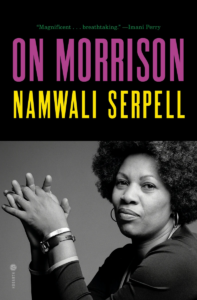
You can purchase On Morrison here and anywhere books are sold.
Cover art includes “Toni Morrison as Song of Solomon” by John Sokol (1981). “PASSAGES: On Morrison” is a production of the Random House Publishing Group.
Passages: On Morrison
“PASSAGES: On Morrison” is a podcast that takes reading on the road. Come along with Namwali Serpell, novelist, critic, and Harvard professor, as she joins fellow writers and skilled readers in conversation to pore over excerpts of Toni Morrison’s prose. Recorded throughout the book tour for On Morrison—Serpell’s electrifying, critical examination of Morrison’s writing—each episode welcomes listeners into rooms full of readers and discussions of how Morrison made her words sing. This show is the record of a traveling salon, a celebration of Morrison’s extraordinary work, and a love letter to reading closely in community.