Namwali Serpell and Dionne Custer Edwards on Toni Morrison’s Sula
From the Podcast, PASSAGES: On Morrison
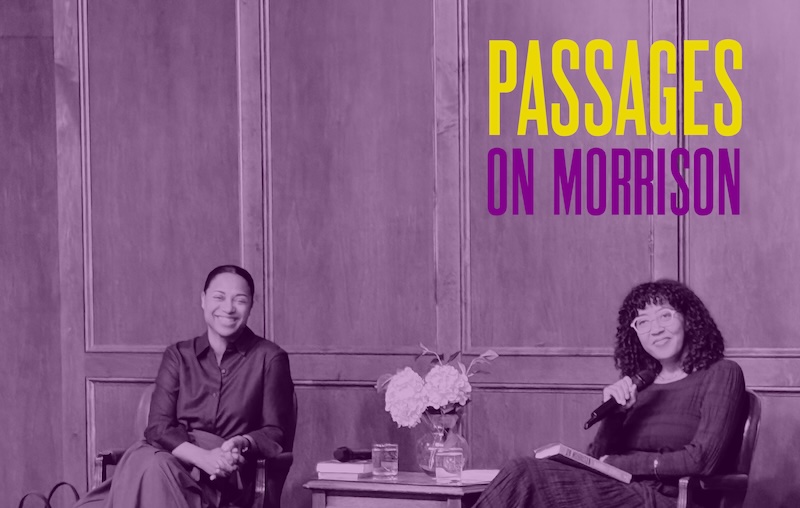
Continuing our tour of Ohio, Namwali Serpell joins writer and educator Dionne Custer Edwards to discuss On Morrison at the Bexley Public Library. They read and open up a passage of Morrison’s Sula, a brimming scene of friendship and play between the two central characters, Sula and Nel. Dionne and Namwali explore the innocence of the girls’ mirrored play with twigs and grass, but also the undertones of maturation, as Nel and Sula hover on the threshold between the girls they have been and the women they are actively becoming.
*
*
From the podcast:
Dionne Custer Edwards: Jesmyn Ward talks about—and many of us sort of have this experience of reading Morrison’s work in undergrad, in college, and being young, also becoming—and Ward speaks so specifically and transparently about grief and loss in this introduction, and how to go back and re-read Sula after having lived: that’s a whole other thing.
Namwali Serpell: Yeah.
DCE: Right?
NS: Yes.
DCE: Having lived a little, having lost a beloved, having birthed…There’s something to that.
NS: Yes. Morrison has this wonderful way, from the very beginning, from The Bluest Eye, of what’s called double narration, where you have an adult character talking about or thinking about their younger self.
And here you have just a narrator who’s telling the story of these girls, but the sense of a life lived as a girl, as a young woman, as a woman, as an older woman, is so present in so many of her works. And it’s true of her men as well. You know, we actually do get a sense of the youth of characters in her novel Home, in Paul D in Beloved as well. That layeredness of time is really important, not just because it gives you the sense of a life lived, but because it means that when you re-read the text, you’re coming in at this layer, and then at this layer, and then at this layer, and you’re looking back. By the end of the novel Nel is looking back, and she’s realizing things about their childhood that she didn’t yet know—and that’s also what Morrison enacts for us as readers. It’s incredible.
DCE: Yes, yes. I was thinking that when you said that this idea of what we don’t yet know we encounter a text…and at points where our eyes are maybe just glazing over the language, really trying to decipher what a scene is, or what device is being used, or maybe sound quality, we’re trying to sort of pick it apart. But once you’ve lived in a life for a little while, you can then apply that to a text, and what I’d appreciate about Morrison is this idea of a participatory reader.
Once you’ve lived in a life for a little while, you can then apply that to a text, and what I’d appreciate about Morrison is this idea of a participatory reader.
NS: Yes. Morrison’s aesthetic is very oriented toward a kind of richness of interpretation.
Sometimes you can call that ambiguity, but that suggests a kind of confusion. Rather I think it’s a kind of multiplicity, right? In literary critical language, we call it polyvalence, meaning many valences or facets, and it means that every novel that you read by her makes available different interpretations.
There’s this one point where she’s talking about Beloved, and someone’s asking her, “Well, who is the ghost?” Like, “What is the ghost?” And the way she talks about it is by saying, “This is in the text, and this is in the text, so all of this is available.” Not necessarily this is the answer, but it’s all available for the reader to make their own interpretation.
I think part of the reason she felt that way is that the reader has to participate in the making of the text. If you have a text that just tells you things or just gives you the message, then you’re passive. You’re just kind of letting it sit. You know, you’re absorbing. But as she put it, I leave gaps and spaces in the text for the reader to step in to help make that meaning happen.
And I love this so much because it helped me understand, when I was a graduate student and very drawn to texts that have this kind of rich uncertainty or ambiguity, that this wasn’t just, like, being poetically ambiguous, that there’s actually an ethos here, there’s something that she’s doing that’s trying to pull us into conversation with each other, so that when you close the book, the first thing you want to do is say, “Well, what did you think about this passage,” right?
DCE: There’s something about great art that invites you, even demands, you feel something. And in the way that you are writing about Morrison’s writing, the approach to the work, it very much is about feeling something. And it struck me when you wrote about where you feel Sula. You feel Sula in the breast bone.
NS: Yeah, right here. I start by saying it’s something about the name Sula, which is also very important to Morrison. She felt that naming and the way we name is something rooted in a Black cultural tradition. It’s one of the ways we use language. And Sula is one of these wonderful biblical names, Morrison uses a lot of them, that can go in multiple directions, right?
It can be Salome, right? But it can also be Shlomit, which means peace. Which means that Sula Mae Peace means Peace Peace, which is a kind of wonderful ironic doubling because this is not a peaceful clan of people.
But there, I don’t know, there’s some…I think maybe because my experience of reading this novel is one of the few Morrison novels that I read first without any reason to. I sort of picked it up off of a bookshelf in a house I was house-sitting, and I just liked the Vintage cover, it’s the woman with the afro and the yellow rose.
And I read it in one sitting, and I didn’t have a pencil in my hand. I was a graduate student at the time, so for all my reading I had a pencil in hand, but not this time. And I think also because there’s something about the way my experience of friendship resonated with what she was describing. Morrison always said this, “You have to write the book that you want to read.” But she also wrote books for us that we wanted to read. And that is a gift in itself. I had never read a story about friendship that captured all of this complexity. Specifically, I’m very interested in the irony in a friendship that you want to treat the person well on their own terms. Your love for them is not extractive, right? This is actually how Aristotle defines true friendship. You’re giving to them for their own sake. You have to think of them as a separate person, right?
Morrison always said this, “You have to write the book that you want to read.” But she also wrote books for us that we wanted to read.
You have to get them the gift they want, not the gift you want. But at the same time, this affinity makes you feel like they are part of you. So this question of who is my friend and who is me is this constant oscillation between separateness and togetherness, and Morrison just articulates that so beautifully without it turning into sort of, like, “Well, girls always have cat fights.”
You know what I mean? It’s like, actually, it’s much more complicated than that, and it’s much more beautiful than that.
___________________________
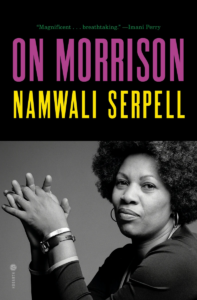
You can purchase On Morrison here and anywhere books are sold.
Cover art includes “Toni Morrison as Song of Solomon” by John Sokol (1981). “PASSAGES: On Morrison” is a production of the Random House Publishing Group.
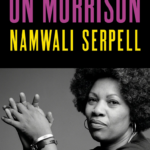
Passages: On Morrison
“PASSAGES: On Morrison” is a podcast that takes reading on the road. Come along with Namwali Serpell, novelist, critic, and Harvard professor, as she joins fellow writers and skilled readers in conversation to pore over excerpts of Toni Morrison’s prose. Recorded throughout the book tour for On Morrison—Serpell’s electrifying, critical examination of Morrison’s writing—each episode welcomes listeners into rooms full of readers and discussions of how Morrison made her words sing. This show is the record of a traveling salon, a celebration of Morrison’s extraordinary work, and a love letter to reading closely in community.