Namwali Serpell and Angela Flournoy on Toni Morrison’s Tar Baby
From the Podcast, PASSAGES: On Morrison
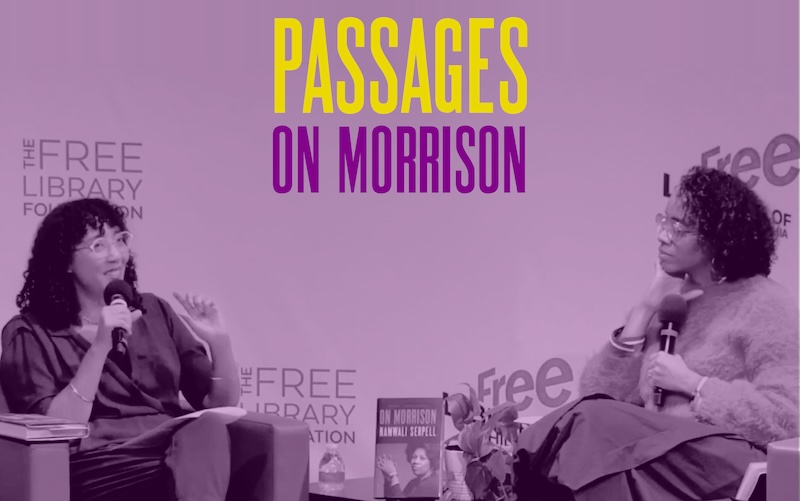
Continuing on tour for On Morrison, Namwali Serpell travels to Philadelphia to talk with writer Angela Flournoy about a scene from Tar Baby. Speaking at the Free Library, they trace the novel’s invocation of myths and masks, Morrison’s paradoxical presentation of stereotypes, and the surreal, slippery images that make the quotidian scene in grocery store stick.
*
*
From the podcast:
Namwali Serpell: So, this novel is a very surreal experience…what do you think this encounter means for Jadine?
Angela Flournoy: There’s what I thought it meant before I read your book, and there’s what I’m thinking it might mean now. Thinking more about particularly, Jadine has this degree in art history, and Morrison’s interest in African mask or sculptures, and also Jadine’s interest in existing and kind of commanding attention in the Western and European world.
NS: Yeah.
AF: And there’s this moment where this woman, who does not read as Western or European, is commanding this attention.
NS: Yes. Jadine has built her sense of self around how she is regarded by others, and she’s a very beautiful woman, but here she’s seeing a vision. This isn’t just beauty. This is something else, and it raises all sorts of insecurities in her, right?
“The agency,” she means her modeling agency, “would laugh her out of the lobby, this woman with too much hip, too much bust. So why was Jadine and everybody else in the store transfixed?” She’s trying to understand how this woman can have such beauty when it doesn’t map on to her own, let’s just say, Eurocentric standards that she’s become accustomed to molding herself to.
AF: Mm-hmm.
NS: Jadine is, I think, one of Morrison’s… There’s a pattern in Morrison’s novels of, like, shallow girls that can be very pretty. There’s a woman in her last novel, God Help the Child, who is a dark-skinned model, but is also very shallow.
AF: Extremely shallow, yes.
NS: And Morrison doesn’t seem to have any problem in representing this perhaps not feminist ideal of womanhood.
Do you think she’s giving us Jadine so that we critique her?
AF: She has to be, but not as Jadine just as herself, Jadine as, this is the best of what you can get if you have that pedigree, if you have this daughter that you send to France to be educated and to be celebrated. And obviously people think that she’s beautiful because she’s got this modeling contract, and the best that you can get is someone who is a little hollow inside…and someone who is still trying to figure out why is it that other people can turn heads in a room.
NS: Mm-hmm
AF: And of course, the woman, the woman in yellow, she’s depicted as a mask herself, right? She’s got, like, the scarification, the beauty marks on her face, the upside-down ‘V’s.
NS: Yeah, yeah.
AF: Like a mask, which is not something I thought about the many times I’ve read Tar Baby until reading your book. But she’s sort of like a floating mask, in a way, in the novel.
NS: She recurs as a kind of obsession for Jadine. There’s something that troubles her about this. I think she’s supposed to represent what Morrison called the African tar lady, right? There’s this sense that there is some earlier version of womanhood that Jadine has lost access to and that she’s been deracinated from, like she’s been cut off from those roots. And she eventually goes to Elo, Florida, which is an all-Black town, when she and Son become lovers, and that’s where he’s from.
And she there encounters Black women. She starts to have dreams, really bizarre nightmares about Black women, where it feels like she has no sense of community. She’s lost some kind of attachment to that. Something I really love about this passage is the way that Morrison is giving us kind of an objective picture of what this woman looks like as she walks into the grocery store, the effect that she’s having on everybody.
But you can also tell that there is an infusion of Jadine’s own thoughts and feelings, right? So in literary criticism, we call that free indirect discourse. It means that we’re in the third-person—this isn’t an I voice speaking, it’s a third-person voice speaking—but it’s colored by the character’s way of speaking, or way of thinking, or way of seeing.
And these questions, right? “The agency would laugh her out of the lobby, so why was she and everybody else in the store transfixed?” “The height?” You can almost feel the thought that’s happening in Jadine’s mind.
___________________________
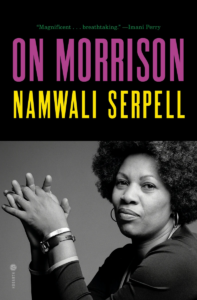
You can purchase On Morrison here and anywhere books are sold.
Cover art includes “Toni Morrison as Song of Solomon” by John Sokol (1981). “PASSAGES: On Morrison” is a production of the Random House Publishing Group.
Passages: On Morrison
“PASSAGES: On Morrison” is a podcast that takes reading on the road. Come along with Namwali Serpell, novelist, critic, and Harvard professor, as she joins fellow writers and skilled readers in conversation to pore over excerpts of Toni Morrison’s prose. Recorded throughout the book tour for On Morrison—Serpell’s electrifying, critical examination of Morrison’s writing—each episode welcomes listeners into rooms full of readers and discussions of how Morrison made her words sing. This show is the record of a traveling salon, a celebration of Morrison’s extraordinary work, and a love letter to reading closely in community.