Murder At the Supreme Court: Who Really Killed Roe v. Wade?
Amy Littlefield Considers the Many Suspects Responsible For the Death of Reproductive Rights in America
“The great thing in these cases is to keep an absolutely open mind. Most crimes, you see, are so absurdly simple.”
–Miss Marple in The Moving Finger by Agatha Christie
*Article continues after advertisement
On September 18, 2020, I was a new mom with a five-month-old, living in pandemic isolation, when Supreme Court Justice Ruth Bader Ginsburg died.
“NO,” I texted back when a friend sent me the news.
I knew it was the end of the right to abortion. President Trump would appoint a third Supreme Court justice, marking the final stage in a plot I’d watched the antiabortion movement assemble for years. For a decade I had reported on incremental cuts to the right to abortion. I knew from this reporting that people were going to die.
I knew what the suspects had done. They had killed the constitutional right to abortion.
They are going to kill people, I thought, gritting my teeth as I nursed my baby at 3:00 AM. How had the antiabortion movement managed to kill a constitutional right supported by the majority of Americans? I didn’t have the answers then. I was a love-drunk slug with an anxiety disorder. Motherhood, I learned, changes your brain as dramatically as adolescence, which is one of those details no one tells you ahead of time. I could see the parallels. I was using the same strategy to escape the anxieties of pandemic parenthood that I had used to cope with adolescence. I was reading murder mysteries, putting in my AirPods during feedings, disappearing into Agatha Christie’s chintzy drawing rooms and lush country estates.
The difference was that now, I was filled with rage at the idea that states would soon force people into this world of aching love and every-three-hours feedings. In early adolescence, I was antiabortion. I don’t know where it came from, because it was not the norm in my Boston suburb, but I remember how comforting it felt in the tumult of puberty to anchor myself to an absolute belief. When my dad tried to tell me that wealthy women got abortions, even when it was illegal, while poor women died, I batted him away. Abortion was murder. End of story.
In high school, I discovered feminism, and my neat world exploded. A beloved teacher clearing out her basement gave me a battered paperback of Susan Brownmiller’s second-wave feminist classic, Against Our Will, a book about how rape enforces male control of society. Lying on the hammock in my yard, horrified by scenes of violent domination, I realized how wrong it was to force a rape victim to carry a rapist’s child. My antiabortion phase was over. I became a rapid convert to radical seventies feminism, three decades too late, in the less-than-ideal environment of high school. To my peers, I was insufferable. I accused an indignant male friend of having a rape instinct. I burst into tears in the passenger seat of my boyfriend’s Jeep because I couldn’t get him to see that porn was like rape.
I had seen the light. I understood how gender oppression controlled our lives—and I could never go back.
I needed an outlet, badly, and when I got to Brown University, I found it in clinic escorting and journalism. I had always liked listening to people’s stories. My favorite detective, Agatha Christie’s sweet old-lady sleuth, Miss Marple, had taught me that listening could be subversive. It could be a way to expose evil.
So I studied journalism, and one day each week, I made my way down the hill to the Planned Parenthood clinic to shield abortion patients from Joe Manning.
Manning was an older, bearded white man with stooped shoulders, who showed up at 4:00 AM to set up a block-long display of bloody fetuses. With his clipboard and pamphlets, he was a fixture on that street corner, just outside downtown, between the bakery and the highway. I would throw on a pink canvas vest and walk with patients from the chain-link-enclosed parking lot to the clinic, forming a human barrier between them and Manning. He would lean in as close as he could to the patients’ ears, and hiss, “There’s another way, a better way.”
I wanted to shove Manning away in these moments, but the clinic had asked the escorts not to engage with the handful of regular protesters. So we ignored them, except occasionally when their signs blew over in the wind, or they shrieked that we were the devil, and then we laughed at them openly.
To the escorts, the protesters were religious freaks. Relics of a bygone era. They believed they were saving babies, although I never saw them succeed in changing a patient’s mind.
We believed people should be able to walk into a health-care appointment without getting a lecture from a stranger.
They believed in hellfire.
We believed in our own futures.
Back then, we felt like we were winning. Now I wonder if we did feel their victory coming, even then?
There’s a grainy photo of my friend Lily and me standing beside the clinic parking lot in our pink vests, the chain-link fence behind us. It’s the thirty-third anniversary of Roe v. Wade, the Supreme Court decision that established a national right to abortion. We’re holding a sign that reads “Save Roe. Act Now.”
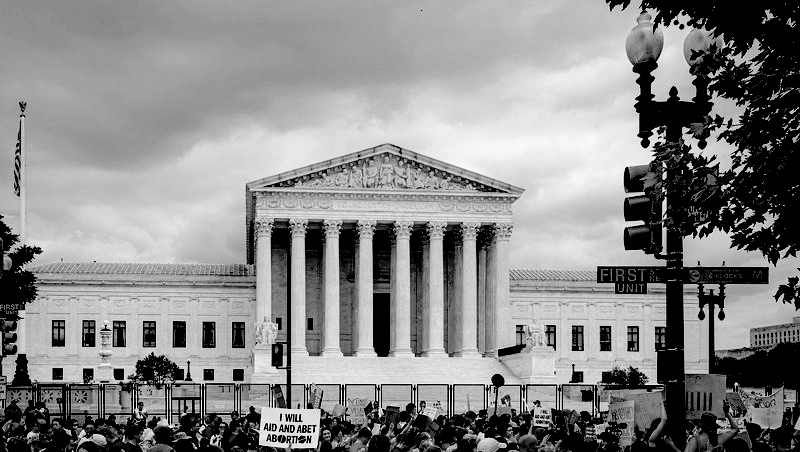
In sixteen years, a span of time almost as old as we were then, the Supreme Court would reverse Roe.
The crime was simple. But understanding who did it, and why, would be more complicated.
By then, I was a journalist covering abortion, married, and living in Boston. I had channeled my feminist rage into reporting on the little-known antiabortion laws and policies that put people’s lives at risk, even before Roe’s demise. One woman I interviewed, Alison, sought emergency care for a miscarriage at the only hospital in her town in the Pacific Northwest, which happened to be Catholic. The hospital sent her home three times. She almost died, she told me, recalling how the pain from her infected uterus made her arch off the bed like the demon-possessed girl in The Exorcist.
They are going to kill people, I thought, at 3:00 AM, all those years later, breastfeeding in the dark. Soon my baby was in daycare, and I was back on the beat. And while my feminist thinking had matured since my teen years, I still held on to the comfort of my mysteries.
There are certain rules in murder mysteries that applied to the story I needed to tell after the Supreme Court finally reversed Roe in the summer of 2022. Or maybe I just needed the comfort of this familiar paradigm to tell the story. In a murder mystery, you get an account from all the witnesses, because one of them might have seen something important. You consider not just the means the killer used, but the motive. And always, the person you least suspect turns out to be the culprit. In the case of who killed Roe, I knew the obvious offenders: the Supreme Court justices and Republican presidents and the Christian Right legal organizations like Alliance Defending Freedom. But what about the lesser-known, more behind-the-scenes suspects, the people like Joe Manning that I had been inclined to laugh at or dismiss rather than understand? Weren’t they guilty, too?
I knew what the suspects had done. They had killed the constitutional right to abortion. Plus, they were linked to other crimes: the deaths of women not just in the United States but around the world, the rise of white supremacy and Donald Trump, the crumbling of our democracy, attacks on transgender people, and climate change. They had relied on unexpected accomplices: Democratic politicians and even pro-choice activists, some of whom had seriously underestimated their opposition, just like I did on that sidewalk outside the clinic. The crime was simple. But understanding who did it, and why, would be more complicated. To do it, I would channel Miss Marple. I would listen to the murderers.
__________________________________
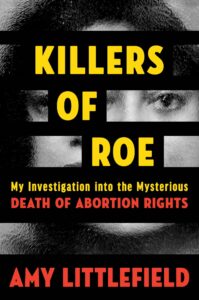
Excerpted from Killers of Roe: My Investigation into the Mysterious Death of Abortion Rights by Amy Littlefield. Copyright © 2026. Reprinted with permission of Legacy Lit, an imprint of Grand Central Publishing Group, a division of Hachette Book Group. All rights reserved.

Amy Littlefield
Amy Littlefield has reported on abortion rights for more than a decade. She is the abortion access correspondent for The Nation. She has contributed to The New York Times Opinion section and wrote the Times’ Sunday Review cover story “Where the Pro-Choice Movement Went Wrong.” She is a frequent commentator on abortion for TV and radio news outlets and podcasts, including MSNBC and Democracy Now! Littlefield was a lead reporter and narrator on episodes for Reveal, the national investigative journalism show. She lives in Boston with her family.