Motherships, Haunted Mirrors, and Heritances: September Poetry Releases
Rebecca Morgan Frank Recommends Kathy Fagan, Leslie McIntosh, Emily Skaja, and More
Readers, this month in publishing is lousy with poets, including terrific poets who I didn’t have space for and poets who I made space for but who deserve more than a few hundred words snapshotting their work. This could have been a double edition round-up of double entries. A round-up is, first and foremost, a heads-up, so I’ll note that September also brings Sherwin Bitsui’s The Next Sky (Copper Canyon), Cynthia Cruz’s Twilight (Four Way Books) Erica Meitner’s Assembled Audience (Milkweed), Don Mee Choi’s Freely Frayed (Wave Books), Joanna Klink’s Days and Chances (Penguin), Kiki Petrosino’s Perfect Italian (Sarabande), and Brenda Hillman’s Still House in the Desert (Wesleyan), among others.
As I read my way through the September stacks, I was struck by the feeling that we have finally reached the moment post-pandemic when the poets, collectively, are finding their way. Of course, as always, I’m just speaking for me, but this month’s poetry has teeth and soul, has wound and light.
*
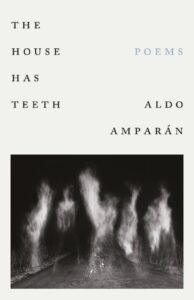
Aldo Amparán, The House Has Teeth (Alice James Books)
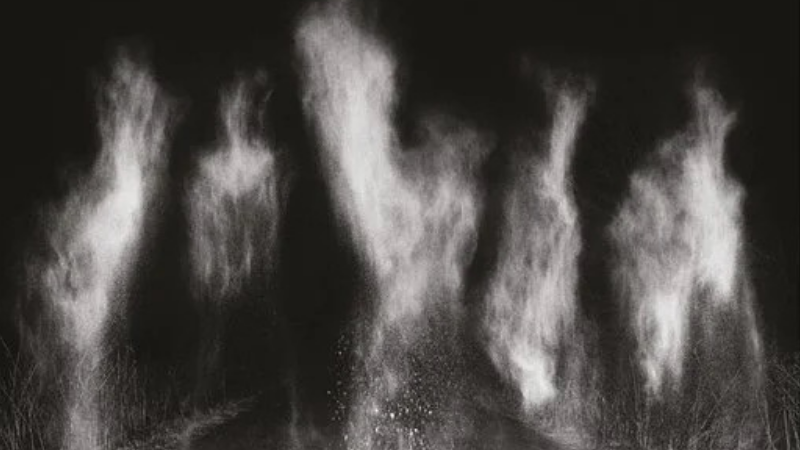
“Men instilled in me /an empty. I’ve grown up/ without a body // of my own.” The traumas and vital reclamations of “Self-Portrait of the Stolen Body” come midway in Amparán’s visceral second collection and its poems full of hauntings, of trauma reflected from the opening loose crown of sonnets filled with closets and candlelit rooms and wounded and severed bodies—“You kept biting your scar to make of it a wound / the shape of a man’s throat”—through a series of “Parable” poems for “the haunted doll,” “the haunted cloak,” and “the haunted mirror.” For “Symptoms of Ghosts” responds to the theory that male “gay orientation” is due to being “possessed by female ghosts.” The speaker exorcises violent histories and theories of the past, of a time when “I asked a priest / what was wrong / with my heart. // My yellowed heart / a glitter bomb . . ..” At the same time, Amparán depicts the brutalities of the world unmitigated by art; the speaker in “Watching a Cartel Snuff Film With My Brother” laments, “What did we expect / to gain, replaying that man’s end?”
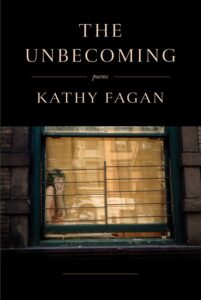
Kathy Fagan, The Unbecoming (Norton)
In The Unbecoming’s arresting opening sequence, “Listening to Others,” Fagan delivers fourteen sculpted and weighty miniatures that skewer the indignities, freedoms, and revelations of self as a woman graduating from “middle age,” but there’s no self-pity to be found here. The speaker is called “Old Bag” by a man on the street and marks him like “those who touched my hair in the street, my ass in the subway, / who kicked at pigeons and taught their sons to do the same: / they’re either dead now or, older bags than I, awakened / to their cruelties and changed.” The speaker left “ until I was the only woman seated at Mother’s Day mass, / my devout, dementing dad staring forward, head / high and at an angle I recognized as ashamed, not of but for me, / or so I like to believe,” and speaker left in grief for her father: “we had a lot to say: we were wordless at the end. / After he died, I took his hearing aids with me. Sometimes/ I bend to them and speak. Sometimes / I raise them to my own ears and listen.” And that’s all just the opening poem. The Unbecoming comes on the heels of Fagan’s William Carlos Williams award-winner, Bad Hobby, and her Kingsley Tufts’ finalist, Sycamore; Kathy Fagan has catapulted through “mid-career” to this book’s admirable heights.
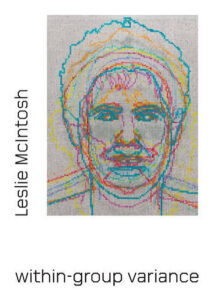
Leslie McIntosh, within-group variance (Changes)
Changes’ first/second book prize, launched in 2022 with Louise Gluck as the first judge, has already delivered gems such as Jimin Seo’s Ossia and Rachel Mannheimer’s Earth Room. This year’s judge, Terrance Hayes, gifts us Leslie McIntosh’s debut, within–group variance, which reminds us “how to love words / enough / to free them / from information.” These poems move between questions of observable biological differences—“why do I still have asthma / and my sister doesn’t” set against systematic inequities and biases—“why is my water line made of lead / when the governor’s isn’t // why do my doctors give me diagnosis before they open the chart.” Throughout, there’s a palpable vastness. In “psychopomp,” “Before I unlearned the romance of the stars, / I never dreamed they once abandoned Earth, / the wake of their departure grown cold now. / immaterial, yet not truly empty.” In McIntosh’s bio elsewhere, positionality is stressed—“black, male presenting, male attracted, autistic, an older millennial” and his work as psychologist is revealed; this radiates through the language and vantage: “I have a different face every day / but my brain is the same machine.”
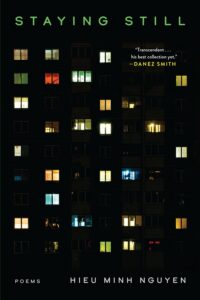
Hieu Minh Nguyen, Staying Still(Tin House)
“Who knows what you’re supposed to be when no one is looking?’ The speaker of Hieu Minh Nguyen’s Staying Still asks in ‘The Third.” Whether alone among others in the moment, or alone or in a broader sense when dispatched/displaced to new cities and states, the speaker in these poems is astute observer of self and others, and the extraordinary openings in these poems are Nguyen’s willingness to allow the speaker to be complex and fallible, to both survive and have agency. Looking backward in “The Dress,” the speaker concludes, “How was I to know beauty / was something I could ruin / for others by trying it on?” Or in “Lucky,” which begins “I pushed him off the cliff. / I was three,” the speaker reflects, “For years I’ve been trying to be clear / about what I’m capable of.” In the longer, sectioned “Looking,” deft navigations of power imbalances unravel, but the speaker reveals, “You are tired of trying to find places to store your / body when you’re not using it.” And looking back, “The slashed screen door you’d climb through as a child, running naked down the street, convinced you could turn into glass, convinced you could scream a hole in the air.”

Emily Skaja, Black Lake
“I wanted an uncomplicated joy,” laments the speaker of Skaja’s Black Lake, a moving exoration in a phenomenal examination of infertility and grief over miscarriages, and a refreshing expression of a unique voice. To say Skaja’s is one of the best book I’ve read about miscarriage doesn’t do it justice. Skaja tackles her subject head-on with a speaker who is sometimes ragefully funny; shopping at a nursery across from Planned Parenthood while experiencing a miscarriage: “Why else would I come here/ to marvel at the lilies of the fucking field/ unless it’s to check a bloody maxi pad at someone / & get a spot on the nightly news, earning myself a Bless her heart?” These poems let us in to a slow burn of grief’s many natures due to it devastating particularities; a series of “It’s the stage of grief where” take us into “waiting / for rage to open my mouth” after “the machines have gone silent,” while another poem imagines protecting the future child turned adolescent: This is a speaker who is “Taunting death by eating the glue / between worlds. By eating the exit itself.”

Paisley Rekdal, Heritance (Copper Canyon)
After the ambitious hybrid project, West, Rekdal returns to the simplicity of the lyric “I” alone on the page, morphing and moving with the mind in fearless acts of investigation of difficult subjects, mining liminal spaces. As neighbor to a man killed by the police, as observer of a viral brawl kicked off by racists, as both observer and owner of dolls that embody racialized histories, both national and personal, and as daughter: “like all daughters, I / have spent a life / looking for which mother / is mine: the dark / hissing one/ on the kitchen / floor, or this / bald-eyed, wordless creature / stunned by every pleasure . . ..” Amidst the longer unravelings and wrestlings, gorgeous shorter poems rise such as “Fledgling Cooper’s Hawks” in which of “[o]nce where were three,” for “This // is the miracle / I misjudged: / that anything learns/ to be the creature / it was meant to.” For in these poems, whether pain is observed—the needle in a dog’s paw, or felt—the unraveling of a marriage, Rekdal does not turn away: “Hurt, / we name wound’s/ recognition.”
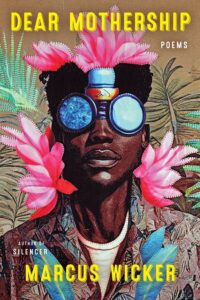
Marcus Wicker, Dear Mothership (Ecco)
“O Long-Playing Mothership forgive me my crackling radio static i have seen / things.” The heart of Wicker’s third collection samples and stakes out its own staticky formal grounds, calling on Outkast’s ATLiens, launching an Afrofuturist poetry grounded in interrogations of the whitewashing of academic analysis (starting with E.T.) and the packaging of the self. Propulsive, clever, incisive, and tender, Dear Mothership dips with verve (and music) into the slog of topics tied to hitting mid-life /mid-career during the pandemic that would drag in lesser hands, such as academic careers—“Accidentally giving over our 20s / & 30s to an academic Stairmaster” and trying to buy a house—“I tease my fiancée Let’s hold out for rehabs / that scream: Welcome, desegregated household! Does this wonky wainscoting / say Loving V. Virginia to you?” In “Toilet Paper Invective with Self-flagellation,” Wicker shows us what to do with the existential absurdities of trying to make meaning, make a life, make art amidst the new and longstanding failures and uncertain futures of this world. “Reparations Metric on a Theme by Sean Paul” concludes, “Give us / the lightness: buoyant // & flooding out. Soothing ache / unseen, engulfing // as the water/ we have carried.”’

Rebecca Morgan Frank
Rebecca Morgan Frank's fourth collection of poems is Oh You Robot Saints! (Carnegie Mellon UP). Her poetry and prose have appeared in such places as The New Yorker, Ploughshares, American Poetry Review, and the Los Angeles Review of Books. She is an assistant professor at Lewis University and serves on the Board of Directors of the National Book Critics Circle. She lives in Chicago.