Mothering at the End of the World: Six Contemporary Novels That Center Caretaking Through Crisis
Sarah Bruni Recommends Samanta Schweblin, Brit Bennett, Quiara Alegría Hudes, and More
How do you balance private pain and joy with cognition of widescale tragedy? What does care look like in the aftermath of loss? These are a few of the questions that guided me while writing my novel Mass Mothering. Its narrator, A., is an amateur translator who encounters a book about a group of women in an unnamed country whose sons were disappeared by political violence. When on the heels of a medical trauma, A. is left unable to have biological children, she spends her days nannying a boy and her nights pouring over the book documenting the mothers’ stories. The novel’s depiction of different forms of caretaking through grief was as important to me as its interrogation of how stories are mediated as they traverse speakers, borders, and languages.
The novels on this list, many of which were on my mind during the last decade of writing, offer a range of portraits of radical care—of self, children, community—through moments of crisis. Set in the uncertain present and rife with the kinds of personal, political, and environmental unraveling implied by our time, these six novels explore mothering at breaking points. A dying mother speaks through the aftermath of an ecological disaster. A woman picks through loose threads of her life as a mother and artist following an extramarital affair. A maternal chorus watches over a motherless girl on the heels of an abortion. A mother takes a family road trip while charting the journeys of unaccompanied children crossing borders alone. A woman nannies a boy while a plague rages outside her window. An absent mother addresses the daughter she chose not to raise. Whether or not the narrators of these novels are mothers themselves, these stories explore the psychological toll of caretaking, the challenge of parenting through personal and political awakening, or the legacy of mutual aid within community.
*
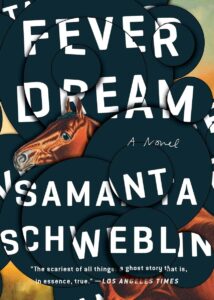
Samanta Schweblin, Fever Dream (translated by Megan McDowell)
One of the most gripping and spooky novels I’ve ever read, staged as an extended conversation between a dying woman, Amanda, and a boy at her bedside badgering her with a series of questions to get her story out before it’s too late. Amanda soon reveals that both she and her daughter were poisoned by toxic agricultural chemicals. While the crisis at the heart of this Argentine novel is an ecological horror, the title in the original Spanish, Distancia de rescate, refers to the constant tabulation of the space between a child in danger and a mother’s cautionary gaze. Amanda explains, “I always imagine the worst-case scenario … I call it the ‘rescue distance’: that’s what I’ve named the variable distance separating me from my daughter, and I spend half the day calculating it, though I always risk more than I should.” The terror of the reading experience, elegantly captured in McDowell’s translation, feels exactly like this—the racing brain of a vulnerable mother, desperate to keep her child safe from an unnamed threat.
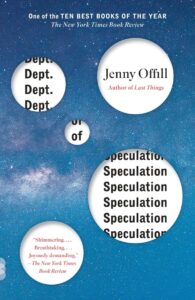
Jenny Offill, Dept. of Speculation
The fragmentary, dissociative state that characterizes this novel’s structure seems designed to call to mind the psychological effects of mothering on the brain without naming them as such. Following a child’s birth, a bedbug infestation, and a husband’s affair, the narrator combs through memories as if to encounter the moment of steering off course. Her attitude toward her young daughter is one of both awe and honest pragmatism that could also serve as a description of the novel’s form: “Caring for her required me to repeat a series of tasks that had the peculiar quality of seeming both urgent and tedious. They cut the day up into little scraps.” When asked by a male former colleague if “something happened” upon learning she still hadn’t published her second book, the narrator says, by way of explanation, only: “Yes.” The aftershocks of gendered sacrifice germane to balancing family with ambition are buried deep, implied in many of the silences between microchapters.
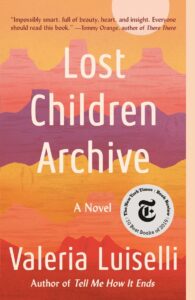
Valeria Luiselli, Lost Children Archive
The primary narrator of Lost Children Archive is a mother and a collector of soundscapes, embarking on a road trip with her husband and two children, from New York City to Arizona. It soon emerges that the family is on the brink of crisis, as it’s unclear whether her husband will return with the family once they reach their destination. Their children, a ten-year-old boy and a five-year-old girl, also narrate, navigating their shifting network of family relationships, while also tracking the simultaneous voyages of unaccompanied children seeking political asylum in the US. When the mother-narrator’s children go missing and cross paths with the lost children, their narrative cohabitation unearths questions around what it means to mother in the same world that children are forced to flee violence alone. In prose that renders the inner architecture of kids’ minds at work, the novel is as much a meditation on childhood as it is on caretaking, collection, and the politics of bearing witness.
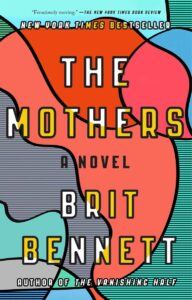
Brit Bennett, The Mothers
The Mothers opens with an abortion and spans the friendship of two motherless girls into adulthood, living in the aftermath of decisions their mothers have made. When, following her own mother’s suicide, seventeen-year-old Nadia gets pregnant by the pastor’s son, she forges an unlikely friendship with Aubrey, whose mother has left her family behind. The titular mothers of Bennett’s novel—narrating in the first-person plural—offer observations and judgements from the of Upper Room of a Southern California Black church: “We were all mothers by then, some by heart and some by womb. We rocked grandbabies left in our care and taught the neighborhood kids piano and baked pies for the sick and the shut-in. We all mothered somebody.” The novel is haunting, asking what we owe our mothers, the communities given to us by birth, and those we create for ourselves.
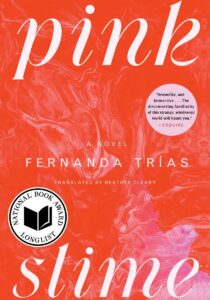
Fernanda Trías, Pink Slime (translated by Heather Cleary)
The unnamed narrator of Pink Slime is a single woman trapped in a holding pattern of caretaking while her port city—calling to mind Trías’s native Montevideo, Uruguay—deteriorates around her in an environmental disaster, from which most inhabitants have fled to the interior of the country. Choosing to remain while an epidemic whips through the wind around town, she marks time nannying a boy, Mauro, with a genetic disorder that causes him to have an insatiable appetite, and alternating visits to her hospitalized ex-husband, Max, and her own mother, another holdout. “Breathing in the stale air of the port, prowling the streets, visiting my mother or Max—these were the luxuries I afforded myself on the days my time didn’t carry a price. If I was lucky, that is, and there was no wind.” Cleary’s translation eerily registers at each turn the feeling of imminent threat and the narrator’s inertia in the face of it, as her continued mothering of both boy and man keeps her firmly rooted within the present danger.
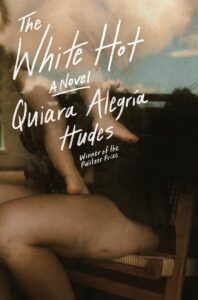
Quiara Alegría Hudes, The White Hot
The White Hot takes the form of a sprawling letter, penned by a mother who fled home and addressed to the now-adult daughter she left behind. The voice of the mother, April, is lyrical, bracing, briefly acknowledging atonement for years missed before launching into a staggeringly vivid account of what her absence afforded her: “Deeper down, though, a realer wish rumbles, directed at tangible present-tense you, a wish for Noelle Soto on the cusp of womanhood. That you lick the winds of freedom. On this, I have some experience. The knowledge cost me everything and I’ll be damned if it goes to waste.” April recounts her escape, in a moment’s impulse of white-hot rage pooling inside her, from the North Philly intergenerational home of women who raised her, and she charts the taste of each thrill and grace afforded her while brushing up against the larger world outside the deadening routines of sacrifice and survival, as well as the one she gets to know brimming within herself.
__________________________________
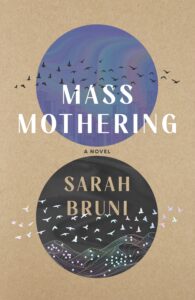
Mass Mothering by Sarah Bruni is available from Holt, an imprint of Macmillan.

Sarah Bruni
Sarah Bruni is a graduate of the MFA program at Washington University in St. Louis and holds a master’s in Latin American Studies from Tulane University. She has taught English and writing classes in New York and St. Louis, and she has volunteered as a writer-in-schools in San Francisco and Montevideo, Uruguay. She is also the author of the novel The Night Gwen Stacy Died. Her fiction has appeared in Boston Review, and her translations have appeared in the Buenos Aires Review. She lives in Chicago with her family.