







Megan Nolan on Agnes Owens’s
A Working Mother, an Ode to Working Class Scotland
“Owens found a novel way of conveying the surrealness of everyday life”
When my first book was published, a journalist interviewing me expressed breathless surprise that I didn’t have a college degree. It would be difficult to overstate, he later wrote in the piece, how unusual this is among novelists. This was intended benevolently, but naturally carried with it the inescapable whiff of prurient patronization. What, we might wonder, would he have made of Agnes Owens? Owens not only lacked an undergraduate degree but did poorly in school, where she was described as a hopeless case. Her first husband was a traumatized war veteran who self-medicated with alcohol, with whom she had her first four children. After his death at the age of forty-three, she worked as a typist, in factories, and as a cleaner. She married again, had another three children, and only at the age of fifty-eight did she publish her debut story collection, Gentlemen of the West (1984).
Owens was discovered at her local writing group—which she said she joined to get out of the house—by the visiting writers James Kelman, Alasdair Gray and Liz Lochhead, three pinnacles of contemporary Scottish writing. A 2014 obituary in The Scotsman referred to her upbringing as “poor, but not uncommonly so,” a summary which recalls Kelman’s description of the life his reviewers and detractors saw as so singularly appalling and raw: “My own background is as normal or abnormal as anyone else’s.” Of her contemporaries, Kelman stands out as Owens’s particular antecedent.
Owens found a novel way of conveying the surrealness of everyday life.
Formally they are different, Kelman writing the Glasgow dialect more or less true to actual everyday speech, aiming to effectively trap the reader inside his narrators’ monologues. Owens meanwhile writes staccato sentences in the vein of Gertrude Stein; simplicity which seems at times nearly aphoristic soon reveals its full effect. But they were both part of a literary era in which writers took politicized pride in the local—insistent on the validity of colloquialism in both style and substance, rooted in socialist principles rather than a more chauvinist brand of nationalism. Kelman, like Owens, refused the characterization of his work depicting life among the Scottish working class as something exhilaratingly foreign to the presumed reader.
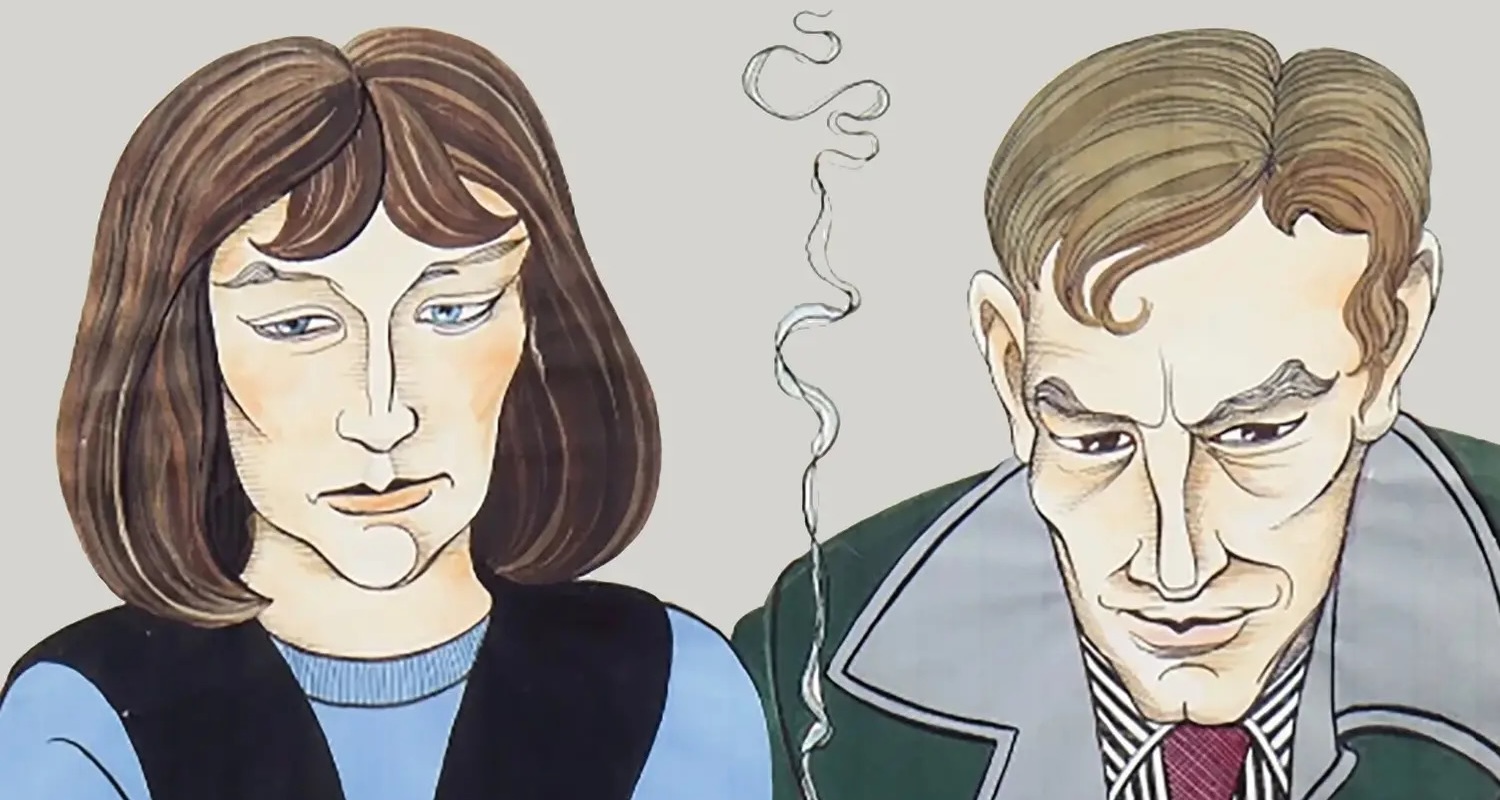
A Working Mother (1994) was Owens’s return to publishing following a fallow period after the 1987 death of her son, Patrick, who was murdered outside the family home at the age of nineteen. Perhaps relatedly, it’s an autobiographical work, reflecting on the chaos of raising and supporting children in the midst of substance-fueled chaos. It’s a brief shock of a book, veering between the mundanity of narrator Betty’s confined domestic life and the almost slapstick moments that intrude upon it when she turns to face the outside world in search of employment. Her husband Adam is too addled by trauma caused by his experiences serving in World War Two to hold down a job, leaving their bed at night crawling on all fours in his sleep, sweating out the memories; Adam’s alcoholism and PTSD were fashioned after Owens’s first husband’s. The two are fond but sick of each other, at times bickering with real melancholy and malice. At others, they function more like a companionable Punch and Judy show playing out before their two children, who erupt sullenly and spiritedly by turn (“I can’t eat no more of this rubbish,” her son Robert screams at one point, making for the back door in protest at a dinner of chips with no sauce.)
The couple are never so enlivened as they are by a bottle of “sweet, sickly, but somehow lovely South African wine.” The only improvement on getting drunk together is doing so at the pub with their friend Brendan, an appealingly oafish character whom the couple treat as something between a pet and a foster child—and whom Betty on the sly treats as a lover too. Conversations between Betty and Adam about the dire state of their lives are peppered with punchlines which send up but also mitigate the paltriness. They make for a conspiratorial kind of rhythm which is not without its charms. We can see that it is not only circumstance which keeps them together but a kind of nihilistic, wearily comic bond:
“I’ve got a job,” I told Adam.
“Good for you. I can now relinquish all responsibility for this household then?”
“And I can save up for a divorce,”
“So, let’s celebrate,” said Adam.
At work as a typist for a legal firm, Betty is confronted by a woman in more desperate straits than her own. Mai, gauche and plainspoken, is an unwed single mother—too scandalous a situation to be open about at work. During shared lunch breaks of pie and beans, Mai laments her singleness and voices her desire to be married with grim determination. She is made up dramatically, with spidery mascara and dyed jet-black hair. Betty is a little excited by the novelty of being out with a woman who turns heads and also perhaps by the presence of a woman whose circumstances are, on the face of things, worse than her own. When she reluctantly agrees to take Mai to the pub to be fixed up with the baleful Brendan, she is surprised but not unduly worried to find that Mai prefers Adam’s company.
A Working Mother is, in part, so singular in tone because Owens distributes weight to events with curious evenness. This is not to suggest flatness—the book is anything but dull—but rather that Owens found a novel way of conveying the surrealness of everyday life. In her world, running to the shop for a bottle is as pertinent an event as seeing your workmate make designs on your husband in front of you. Those events which usually serve as narrative scaffolding are stripped of inherent meaning. For Betty, losing an especially prized umbrella warrants as much attention as recalling her wedding day:
“He’s just gone round for sugar,” said Adam’s stepmother, who hated Adam. She leant out of her window, looking down on me from the second-storey flat.
“But he’s getting married today. We’ve arranged it at the registrar’s,” I called.
“Oh yes, I believe he mentioned something about it. He shouldn’t be long.”
Betty’s affair with Brendan, too, is oddly equivocal. Why, she wonders to herself, might she love a thuggish unemployed laborer, a man who isn’t even better looking than her own husband? But the question doesn’t agonize her; she observes the discrepancy between reason and action neutrally and falls back in the wet grass of their sodden nighttime liaisons to meet him again. There is in Betty what could be called passivity, heightened to such a degree that it becomes instead willful, a philosophy.
Though A Working Mother is often described as a book about a woman married to an alcoholic, Owens’s shrewd and ironic style refuses the obvious trappings and temptations of such a narrative.
That working class people live with paucity of choice, and of chances, may be considered from the outside as a moral and social ill to be reckoned with, but Betty correctly sees that this is the fact of her life and behaves and thinks accordingly. When a new opportunity arises, whether good or bad but certainly different, she is moved to follow it and discover how it bears out. She has a keen intelligence which fuels such interest, but it’s also informed by the recognition that she hasn’t much say in her own life. This reality is claustrophobic at times, but at others freeing, almost meditative. In such a situation, why not submit to the whims of fortune? When, occasionally, she tries to prod at her situation and illuminate it, there isn’t much give:
“I’ve never made you happy, have I?”
“I’m happy enough.” He sounded uninterested.
Though A Working Mother is often described as a book about a woman married to an alcoholic, Owens’s shrewd and ironic style refuses the obvious trappings and temptations of such a narrative. There is no misery porn here, no attempt to move the reader by lingering over the indignities, nothing plaintive. We can see why Betty and Adam like to drink together, and with Brendan. If it is no mystery why their drinking doesn’t end up well, it is also no mystery why they keep at it—as it sometimes is in addiction narratives which are told all in one note, that of constant anguish. The brutality is not negated or trivialized by the comedic warmth, rather it simply co-exists, as it also does in life.
*
A Working Mother’s other great character is Betty’s boss Mr. Robson, who takes a special interest in her and asks her to come to his house out of work hours to help him type his book, The Study of Human Behaviour in Animals. Mr Robson is elderly, genteel, and flattering. But there’s also a sordid aspect to their encounters: though he doesn’t propose any direct sexual contact, he masturbates behind a screen while Betty patiently waits on the other side: ”As I wasn’t involved in this I considered I had been let off lightly,” she recalls. Mr. Robson’s attentions are the cause of some strife at home, Adam enjoying the influx of income but resentful of his wife’s diverted efforts. What is most troubling about Mr. Robson, though, is not his carnal interest in Betty but a seedier and stranger one. When she recounts some trouble with Adam and his difficulty recovering from the war, Mr. Robson asks for further details about how it affected him:
“You mean mentally?”
He patted me in a fatherly way above the knee. “I mean sexually.”
Later, she will discover he has been observing her behavior and making note of it dispassionately as though she were a lab specimen. We think back to his initially kind overtures and see them now not as pleasantries or idle interest but expressions of disdainful fascination with a class of people who seem bestial to him. She fascinates him, her reckless oscillation, her lust for Brendan, her fatalism, as though she were a peculiar new breed of animal. When Owens’s son John Crosbie told his mother that he had read one critic describe the novel as an important book about alcoholism, Owens responded drily that she didn’t know she had written a book about alcoholism. Owens, it seems, rejected the impulse to categorize her work much as her narrator rejects Mr. Robson’s impulse to categorize her person.
In Owens’s lifetime the rule was often that you could make art about the poor so long as you held them at a distance and scrutinized them, slotted them into socio-economic sub-headings to show the various ills or improvements they represented. Here’s the feckless poor, here’s the striving poor, here’s the oblivious cheerful poor, here’s the drug addict, here’s the drunk. When James Kelman won the Booker Prize in 1994, the decision was met with disgust by the literary establishment, appalled by the profanity and the informality of the Glasgow drunk whose inner life the novel details. One prominent English columnist described Kelman as “an illiterate savage.” Owens meanwhile was told by one publisher that they were not interested in writing about poor people, the implication being of course that one condition, poverty, cancels out the other, being a person. In A Working Mother, Owens proposes the radical notion that you can be both, and that any given life rewards intelligent attention when it is as fine and as funny and incandescent as hers.
_______________________________
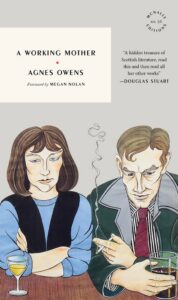
From A Working Mother by Agnes Owens. Foreward copyright © 2026 by Megan Nolan. Available from McNally Editions.

Megan Nolan
Megan Nolan was born in 1990 in Waterford, Ireland. Her essays and reviews have been published by the New York Times, White Review, Guardian and Frieze amongst others. Her debut novel, Acts of Desperation, was the recipient of a Betty Trask Award, shortlisted for the Sunday Times Young Writer of the Year Award and longlisted for the Dylan Thomas Prize. Her new novel, Ordinary Human Failings, is now available.