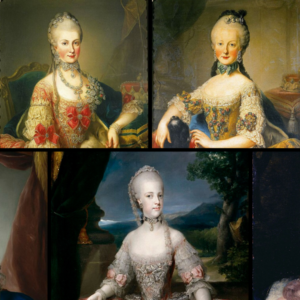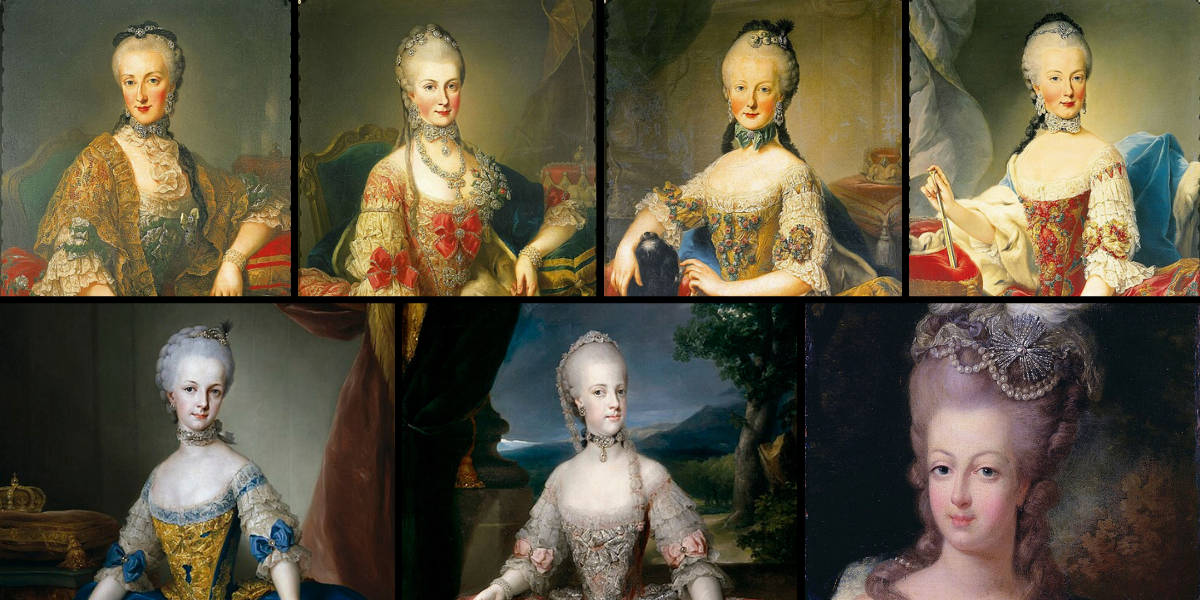
Meet the Habsburgs! And Watch Them Marry Their Way Across Europe...
Veronica Buckley on Revolutionary Europe’s First Family
For three hundred years the Habsburgs had been the most powerful family in Europe. Astute positioning of their many princesses and princes in other royal houses had vastly increased their territories and their influence across the continent. Often avoiding the need for open conflict by strategic betrothals to potential enemies, they had earned, over the centuries, the blessed historical dictum: “Bella gerant alii, tu felix Austria nube. Others make war; you, happy Austria, marry.”
To this old injunction Maria Theresia and Franz Stephan had responded heroically, aided by an eagerness to marry each other in the first place. Now, at the age of forty‑seven, the Empress was the mother of sixteen children, five of them already gone to God, as her firm Catholic faith taught and consoled her; there remained to her four sons and seven daughters.
Her own marriage, through the course of its twenty‑eight years, had become almost legendary: Alone among European monarchs, she and her husband shared a single bedroom, and spent every night in it together. One bold courtier, consulted by Franz Stephan as to the best way of persuading the Empress to a particular course of action, advised him to refuse to sleep with her until she came round to his way of thinking. The Prussian ambassador, who relayed this story to his sovereign, assured him the Emperor would not have long to wait.
Centrally located at the top of a grand staircase in the Hofburg palace, the imperial bedroom symbolized the duty and purpose of all Habsburg lives: to proclaim and continue the dynasty. Like their ancestors, Maria Theresia’s eleven surviving children were expected to place the demands of their exalted family before any preference or need of their own. Their mother, intensely conscious of her own place within so illustrious a house, was making her arrangements for each of them now with characteristic determination.
Visiting Vienna at about this time, Madame Geoffrin, a handsome dame d’un certain âge and a leading light in advanced Paris circles, reported that the Empress had “introduced to me, with an inexpressible grace, all the archduchesses one after the other, and the young archdukes; this family is the loveliest thing you can imagine.”
Joseph’s future and that of his three brothers had already been decided.
Of the two adult boys, twenty‑three year old Joseph matched his parents in height—his mother at least was above average—while lanky Leopold, at seventeen, towered already over them all. All seven girls were tall for their age. The eldest of them was Marianna, a fine artist, scientifically‑minded, once an enthusiastic hunter—a sweet portrait exists of her at the age of seven, already riding side‑saddle on a piebald pony—and an attendee at all court balls and theatrical performances, but now, at twenty‑five, living a rather quieter life, and likely to remain unmarried owing, it was generally thought, to her indifferent health.
Twenty‑two‑year‑old Marie Christine, also interested in art and a particularly good linguist, was the acknowledged favourite of their empress mother; twenty‑year‑old Elisabeth, volatile of temperament, quick‑witted, sharptongued, and flirtatious, was the beauty of the family; Amalie, just turned eighteen and also remarkably pretty, was their Amazon, a lover of horses and hunting, but somehow a little apart, too young for her three elder sisters, too old for the three below her—Josepha and Carolina, thirteen and eleven, Josepha not so bright but perhaps a little artful, Carolina clever and spirited; and the youngest, delicate of health and rather neglected by her mother, eight‑year‑old Antonia, sandwiched between two little boys of nine and seven, Ferdinand and Maximilian.
Unusually for a royal mother of the period, Maria Theresia had been quite involved in her elder children’s education, not teaching them herself, of course, but deciding what they were to study, setting out hourly routines for them, and personally checking their progress every day. The three eldest sisters had all had the benefit, in their aya, of the exceptionally able Princess Caroline von Trautson. A close friend and advisor of the Empress, this cultured woman was also a fluent French speaker, and this facility she had passed on to her charges, an important asset for them, since French was the lingua franca of Europe’s courts, and within the family they spoke only their native Viennese German.
But whether the demands on the Empress’ time had increased or her own enthusiasm had waned, by 1764 she was paying less attention to what was going on in the schoolroom, and taking less care in the appointment of ayas. The results were predictable, with the younger girls in particular being indifferently educated compared to their siblings.
For their sisters, however, a great deal of diplomatic work remained to be done.
There is a delightful series of coloured pastel portraits of all the imperial children, painted at about this time by Jean‑Étienne Liotard of Geneva. It shows the three elder sisters in blue‑grey silk, the four younger ones in pink, and their brothers in white, and it gives us a glimpse of their everyday activities, if only indoors, and only for the girls. Marianna is reading; Marie Christine is dipping a paintbrush into little coloured pots; Elisabeth gesticulates, as if in mid‑conversation; Amalie is embroidering; Josepha is playing on a double keyboard; Carolina poses with a pink rose matching her gown and neck‑ruff; Antonia pulls a thick‑threaded bodkin through a heavy fabric. Their four brothers, two of them still little boys, stand or sit in powdered attitudes of proto‑authority.
Joseph’s future and that of his three brothers had already been decided. As the eldest son, he was expected to succeed his father, and to this end he had just been crowned King of the Romans. Since there was in fact no Kingdom of Rome, and the eternal city itself was ruled directly by the Pope, Joseph’s title, with a nod to the seven Electors, signified only that he was heir to the Holy Roman Empire; in time he would also inherit his mother’s crowns.
As the second son, Leopold was to have his father’s Grand Duchy of Tuscany, with its seat at the massive Palazzo Pitti in Florence. Just turned seventeen and still sighing for a little Hungarian countess, he had recently been betrothed to a daughter of the King of Spain. Ferdinand, not quite ten years old, had been promised for five years already to a wealthy Italian duchess, and seven‑year‑old Maximilian was to have the Governorship of Hungary, currently held by a local noble.
For the moment, however, his focus was outwards: The Empress had half a dozen marriageable daughters; half a dozen marriage contracts advantageous to the Habsburgs remained to be concluded.
Each of the brothers could thus look forward to a handsome establishment. For their sisters, however, a great deal of diplomatic work remained to be done. It was largely in the hands of Maria Theresia’s formidably intelligent chancellor, Prince Anton Wenzel von Kaunitz‑Rietberg, fifty‑four years of age, tall and lean, a widower with a passion for Vienna’s theatres and also their actresses.
Kaunitz hailed from a far from wealthy Bohemian noble family, and his ancestral lands, such as they were, lay near Austerlitz in Moravia. His exceptional talents had raised him, and the residual sensitivities of his comparatively modest birth had left him disdainful of men of greater family and lesser ability. His elegance of dress and speech and his fastidious personal habits, to say nothing of his hypochondria—in his youth he had suffered from a weakness of the lungs—made him an easy target for those who had cause to resent or fear him. His residence in Vienna was “the most arrogantly aristocratic house” in the city. And he was vain, sporting epicene suits of pink and silver, and “unable to pass a mirror without standing for a moment in front of it.”
Whatever his foibles, Kaunitz was beyond doubt a man of rare gifts, widely regarded as “first minister of all the first ministers of Europe.” Devoted to the Monarchy and unimpeachable in office, he also had the habit, unusual for the time, of prioritizing domestic development over foreign entanglements. For the moment, however, his focus was outwards: The Empress had half a dozen marriageable daughters; half a dozen marriage contracts advantageous to the Habsburgs remained to be concluded.
What the Habsburgs considered advantageous to themselves had lately changed. For more than 250 years, since 1500, their dynasty had largely defined itself by a violent hereditary enmity with the French. Originally, neither Austria nor France had had much to fear from the swampy and disordered region of Prussia to their north and east, but a succession of ambitious Hohenzollern princes had ensured that the once minor state had gradually become one of the continent’s Great Powers.
In recent years its expansionist king, Friedrich II, had joined forces with a globally rapacious Britain to challenge the dominance of the Habsburgs on the continent and the French overseas, and in 1756, the two ancient enemies had been forced to come together to meet the new threat.
This overturning of centuries of policy, masterminded by Chancellor von Kaunitz and the French King’s politically powerful mistress, the marquise de Pompadour, was known as the Diplomatic Revolution, or le renversement des alliances. Though in Austria it had been generally accepted as a necessary adjustment to new realities, Franz Stephan himself had not supported it. His mother had been French and his upbringing in Lorraine strongly Francophile, and he doubted that centuries of enmity could be written out of millions of hearts by a few royal signatures on calfskin parchment.
In France itself, the renversement had never been broadly popular. The defeats of the Seven Years’ War, causing colonial losses in India and Canada and enormous, politically destabilizing debts at home, had only increased the general dissatisfaction with it. It had been all too easy to lay the blame on the new alliance with Austria: The enfeebled Habsburgs, it seemed, no longer had strength enough to restrain the dynamic young giants of Prussia and Britain.
By 1764, a year after the war’s end, it was widely agreed in France that the country had taken a serious misstep in joining forces with Austria. But the alliance had held, and diplomats on both sides had remained active, seeking to match the Habsburgs’ daughters with princes of the House of Bourbon.
These were not by any means all Frenchmen. Half a century before, the armies of the Sun King, Louis XIV, had defeated the Habsburgs’ Spanish cousins, imposing Bourbon rule over not only Spain itself but its Italian territories as well. Now, in 1764, three of the four Bourbon thrones were
occupied by Spaniards, all direct descendants of Louis XIV: Carlos III in Madrid; his son Ferdinando in Naples; and his nephew, also called Ferdinando, in the Duchy of Parma in northern Italy. On the throne of France itself sat Louis XV, the Sun King’s great‑grandson.
As women in an age of fierce constraints, they would begin as pawns on the Habsburg dynastic chessboard, in time, whether willingly or not, becoming players themselves.
Franz Stephan’s misgivings notwithstanding, three Habsburg‑Bourbon marriages had already been arranged, increasing Austria’s influence in Italy as much as in France. Two had been for his sons, but the most prestigious of them all was that of his youngest daughter, Antonia, with the little duc de Berry, grandson of Louis XV. To the eight‑year‑old girl herself, still playing with her dolls in the spring of 1764, this meant little, but political observers considered it the consummate achievement of the Diplomatic Revolution. In time, marriages with junior Bourbon houses would also be arranged for three of Antonia’s sisters, while three others, within the Austrian Netherlands and the crown lands of Hungary, Bohemia, and Austria itself, would serve the dynasty’s long‑term project of centralizing its power.
For the Habsburgs themselves, this centralization was a progressive undertaking, an attempt to modernize the Monarchy’s diverse economies and standardize its administration; this in turn was to make it more competitive and ensure its overall prestige within a changing Europe. For its individual regions, however, centralization meant a loss of local power and longstanding traditions, political and religious. The three eldest sisters would be caught up in the resulting tug‑of‑war between Vienna and its satellites.
For Marianna and Elisabeth, despatched to enhance the Habsburgs’ presence in newly strategic regions of Austria, the challenge would be to manage institutions once part of an all‑powerful Church, now subject to decreasing funds and increasing restraints. For Marie Christine, far to the north in the Austrian Netherlands, the battleground would be political as well as religious, a prolonged trial by combat between the forces of reaction and revolution. Like their younger sisters in the Bourbon palaces of Italy and France, they would walk a path of thorny compromise between obedience to the old dynasty and loyalty to their new families and subjects, with all sides attempting to form and confine each sister’s developing sense of self.
As women in an age of fierce constraints, they would begin as pawns on the Habsburg dynastic chessboard, in time, whether willingly or not, becoming players themselves. The diplomatic renversement intended to ensure the Habsburgs’ security and standing would itself be renversé, returning France to its ancient pinnacle as the greatest of all their enemies. Revolution and the expansionary nationalism of the Napoleonic era were to present the sisters with fearful new challenges, to be met by each of them according to her character and talents.
Each unique in passions and temperament, all seven sisters would be shaped, and all shaped differently, by the powerful personality of their empress mother. Their stories are in many ways a response to her own. Attempts to escape her, to placate or emulate her, even to take revenge on her, these form, for many years, their strongest impulses. They are fused as time goes by with wider fears and desires, with the will to power, ambition for children, and the love of men. The sisters’ interwoven lives reflect and also catalyze the ideals and events of their rich and turbulent age.
Often, and often despite themselves, they would become its symbols, positive or negative: Adulation of their patronage, piety, and dynastic continuity would have its counterpoint in accusations of abuse of privilege, hypocrisy, and betrayal. As women, they would be particularly vulnerable to instrumentalization as anti‑models of filial and wifely disobedience, sexual promiscuity, and political overreach.
Seven sisters, seven daughters. Four wives, three mothers, two queens. Two abbesses, in name at least. Marianna the seeker after truth; the grande dame Marie Christine; Elisabeth, the malicious, disfigured beauty; Amalie, troubled and troublesome; Carolina the politician; the tragic bride Josepha; and Antonia, youngest of the seven, sacrificial offering to the gods of revolution. Theirs is a story of many layers: It is the story of a great European family, the story of seven women, at once ordinary and extraordinary, and the story of a brilliant world collapsing, in a fearful time.
__________________________________
From Seven Sisters by Veronica Buckley, published by Viking, an imprint of Penguin Publishing Group, a division of Penguin Random House, LLC. Copyright © 2026 by Veronica Buckley.

Veronica Buckley
Veronica Buckley is the author of two previous historical biographies, Christina, Queen of Sweden and The Secret Wife of Louis XIV. She has also written on art, theater and travel, and has adapted children’s stories for performance with orchestra. With her husband Philipp Blom, she has published books on imperial Russian history and Viennese museum collections. Her books are published in many languages, and she has translated work for stage, radio, TV, and print media. She was born in New Zealand, has lived in many cities around the world, and now makes her home in Vienna. She is herself one of seven sisters.