Meet the Ancient Ancestor of Macaroni and Cheese—and Cook It Yourself
Karima Moyer-Nocchi Offers a Recipe For a Sweet and Savory Ancient Roman Delicacy
Our story starts long before Augustus and the goddess Annona with Marcus Portius Cato, an ultraconservative, “make Rome great again” senator. As was typical of the senatorial aristocracy, he had vast landholdings in the countryside. Part of his mission as an exemplary gentleman farmer was to convince his peers to attend to their estates and, in so doing, bring them back into the fold of solid Roman traditions.
These ideals, called the mos maiorum, had degraded with the influx of modern ideas and foreign food. He wrote his treatise, De agri cultura, ca. 160 BCE, as a manual to instruct his peers on how to run their country estates, in the hope they would straighten out their values and cease dillydallying in the city.
In the book, Cato included several traditional recipes that represented the Roman culinary identity and dishes for ritual feasts. One is called placenta—no need for alarm: The “c” is pronounced with the voiceless velar stop /k/. The word derives from the Greek plakoenta, indicating something that is flattened. Placenta was a holiday food, which invariably indicated a celebration of a religious nature. The dish is, in essence, sheets of rolled-out dough layered with cheese, the first recipe documenting the combination of the two elements.
But there is an ongoing, heated, and hair-splitting debate as to whether or not those sheets can be construed as pasta. Naysayers maintain that one of the necessary characteristics of pasta, as we intend it, is that it has to be boiled. Some hesitate because the recipe contains honey, pointing to various traditional honey cakes as the descendants of placenta. But as we shall see, macaroni dishes, too, would be sweetened. Other scholars, however, are inclined to see the layering of dough sheets and cheese as a proto-lasagna. The proof is in the pudding.
This hearty dish is not only laden with calories but also heavy with both privilege and tradition.
So how’s it made?
A coarse dough consisting of soaked and softened whole-grain emmer groats, durum wheat flour, and water is rolled out into flat sheets. These are oiled and left to dry flat while the filling is prepared. The filling is a mixture of fresh cheese, such as a primo sale or a queso fresco, mixed 8-1 with honey. In Cato’s time, there was no concept of sugary desserts—indeed, there was no sugar—so sweetness did not relegate a dish to the dessert trolley. Rather, it was the expense of the honey that made this stand out as a holiday treat.
On less celebratory days, one could satisfy a hankering for pasta and cheese with scriblitam, prepared just like placenta but without the rare and costly sweetener. Indeed, honey was most often conceived of as a condiment, a foil to the saltiness of fish sauce or the acidity of vinegar. The layers of the placenta are assembled as one would a lasagna: pasta, filling, pasta, repeat. Then the whole thing is wrapped in a thin crust of refined white flour and water, placed on a bed of fresh bay leaves, and baked enclosed in a pre-heated portable oven in the hearth. So much for the hardware of the dish. Now let us turn to the software.
A Sensual, Guided Tasting
Before looking at a recipe remapped for the modern kitchen, let’s consider the experience of placenta from a multisensory perspective: As the dish bakes, the bay leaves release their essential oils and infuse the kitchen with floral, citrus, and peppery aromas. The leaves are actually just a hack to keep the dough casing from sticking to the baking dish, but their distinct scent is an arousing reveille. The crust will toughen up and act as a cooking vessel for the encased layers of pasta and cheese.
When sufficiently heated, the fresh cheese contracts, sweating whey from the curds that provides liquid to cook the dough, which will plump up and undulate slightly as it expands. Little by little the crust acquiesces to the Maillard (browning) reaction, and the fat and honey will join forces to act upon the cheese, turning it a golden orange; some of it will seep out and caramelize. These combined processes unleash notes of toasted nuts, browned butter, baking bread, and toffee, which harmonize with the herbal aromatics.
The fragrance that wafts from the dish when the lid is lifted heightens the anticipation, the nose being the first point of entry and the most primeval of our senses. As the crowd gathers, these appetitive olfactory cues trigger deep-seated memories that intensify with each repetition of the ritual meal. These memories condition expectations: Will it be as good or better than last year’s? I remember when so-and-so made placenta—ah, hers was the best.
The mounting expectations set off by aroma mark the first stage of mouthfeel and taste. Expectancy escalates when the dish is finally displayed. The golden color makes promises about flavor, while the thick layered pasta and the weight of the warm heft in the hand (no forks yet) foretell the toothsome texture that awaits. The unctuous-creamy-sticky-sweet filling sandwiched in between plays the decadent, cheesy opson antagonist off the staid, whole-grain sitos.
The best way to enter into the evolutionary trajectory is through the experiential portal. By preparing and eating the dish firsthand, you’ll gain a deeper, more complicit understanding of the role this dish plays in the history of macaroni and cheese. Once you’ve tried it, see how you weigh in.
*
Placenta
Serves 8
1/2 cup (100 g) whole-grain emmer (farro) or spelt—or groats if you can find them
18 oz (500 g) primo sale (or other unripe cheese preferably goat or sheep’s milk; not ricotta, which will be too soft. A semifirm homemade paneer or queso fresco can substitute)
1 2/3 cups (225 g) fine semolina flour (semolina rimacinata)
3 1/2 Tbsp (50 mL) olive oil
1 1/4 cups (150 g) all-purpose or type 00 flour, plus extra for dusting
1/2 cup (1 110 mL) raw honey
10 bay (laurel) leaves (fresh if possible)
There are three components to this dish: pasta layers (tracta), crust, and filling.
If using whole grain emmer, crush the grains with a mortar and pestle or use a food processor to reduce them to the size of medium bulgur. You may be able to find ready-cut groats in shops that sell Middle Eastern or North African products. Soften the emmer groats in a small 1 cup/200 mL warm water until very soft, about half an hour.
Place the cheese in a bowl of warm water. Over the next 50 minutes, change the water three times. If your cheese is not salty, skip this step.
Mound the semolina flour on the counter and make a well in the center. Strain the softened groats with your hands, reserving the water. Place the strained groats in the well and gradually knead the flour in, adding the reserved water as needed to form a workable but stiff dough. Knead for 5 minutes, wrap in plastic, and set aside for 20 minutes.
Separate the dough into 6 pieces of equal weight. Roll them into 22-cm (8.5 in.) rounds as thick as lasagna or a thin tortilla. These are called tracta. Lightly wipe the rounds on both sides with an oiled cloth. Lay them out on a drying rack or any other flat surface. Cato recommends using baskets, which may have meant racks woven to suit this purpose.
For the crust, mix the all-purpose flour with (3 1/2 Tbsp (50 mL) water. Knead for about 5 minutes. Wrap in plastic and leave to rest for 20 minutes.
Preheat the oven to 375°F (190°C) with an empty 5 qt./ lt. (26 cm) Dutch oven inside.
For the filling, remove the cheese from the water and pat dry with a towel.
Macaroni and cheese proper was still some time away, but placenta was a springboard that would propel us in that direction.
Place it in a bowl and knead until smooth. Stir in the honey and set aside.
Flour the surface of the counter or a wooden spianatoia (pasta board) and roll out the dough for the crust into a 21-in. (54 cm) circle. The circle should extend 6 inches (16 cm) from the edge of the tracta, which will be placed in the center. On a piece of parchment paper, make a bed of well-oiled bay leaves the size of a tracta disk. Position the crust dough on top of the leaves. Today, the bay leaves are no longer needed to create a nonstick surface, but for the full olfactory experience they are necessary.
To put it all together, place a tracta in the center of the crust. Spread 1/2 cup (130 g) of the cheese and honey filling over it cover with another tracta. Spread another 1/2 cup of filling over it and continue. On the fifth piece of tracta, add the remaining filling. Cover with the sixth tracta and, as decorously as possible, bring the crust up around the filled layers. Remove the hot Dutch oven from the oven and carefully place the paper with the placenta into the pot. It is helpful if you use a bread peel or cookie sheet to assist with this move. Pierce the placenta with a knife 5 times. Cover and bake for 45 minutes. Then remove the lid of the Dutch oven and bake for another 15 minutes.
Once you remove the Dutch oven, place a flat plate directly on top of the placenta and press any air out if it has ballooned. This will help to even the form as it settles. Let it cool for 10 minutes. Then remove from pan before cutting.
Serve warm, although cold leftovers are also good.
Eating for Meaning
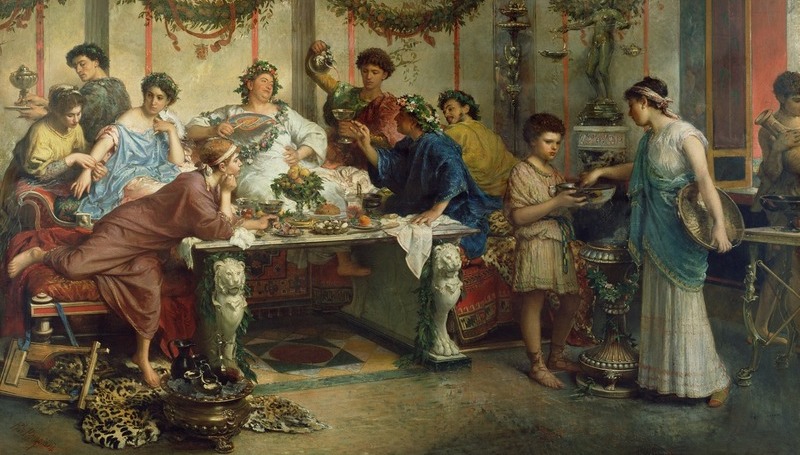
This hearty dish is not only laden with calories but also heavy with both privilege and tradition. Eating is not, as Pliny the Younger said, just an act of filling the pot. The joy and warmth of conviviality and companions (those with whom one breaks bread) enhance the appreciation of food, impacting if and how dishes would be carried forth into the future. Cato’s recipe is enormous, clearly meant for a large gathering. And it is on these occasions that the anticipation, the visual, textural, and olfactory elements of the food, the high spirits and surroundings, and the sense of continuity and belonging all meld together as a single collective memory.
While these qualities are not a guarantee that any given dish will survive the fickle tastes of time, Cato’s placenta was a likely contender to be ushered along to future generations. It was not only delicious but also a gastronomic trigger, charged with subliminal meaning forged through cumulative repetition. It was both retrospective and prospective—leading to the yearning for more. Macaroni and cheese proper was still some time away, but placenta was a springboard that would propel us in that direction.
__________________________________
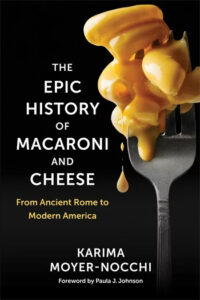
Excerpted from The Epic History of Macaroni and Cheese: From Ancient Rome to Modern America by Karima Moyer-Nocchi. Copyright © 2026 Columbia University Press. Used by arrangement with the Publisher. All rights reserved.

Karima Moyer-Nocchi
Karima Moyer-Nocchi is a culinary historian specializing in Italian food who teaches at the University of Siena. She is the author of Chewing the Fat: An Oral History of Italian Foodways from Fascism to Dolce Vita (2015) and The Eternal Table: A Cultural History of Food in Rome (2019).