May’s Best Reviewed Fiction
Featuring Elizabeth Strout, Douglas Stuart, Ali Smith, and More
Elizabeth Strout’s The Things We Never Say, Douglas Stuart’s John of John, and Ali Smith’s Glyph all feature among the best reviewed fiction titles of the month.
Brought to you by Book Marks, Lit Hub’s home for book reviews.
*
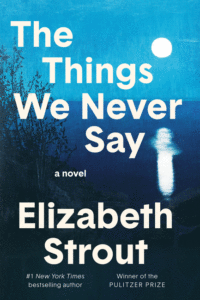
1. The Things We Never Say by Elizabeth Strout
(Random House)
10 Rave • 5 Positive • 4 Mixed
“As usual, Strout manages to create scenes of intense intimacy in prose that feels as casual and comfortable as your favorite flannel shirt. She’s just so damn good.”
–Ron Charles (Ron Charles Substack)
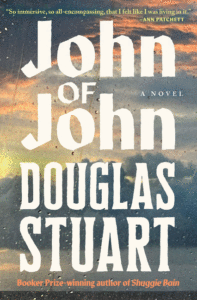
2. John of John by Douglas Stuart
(Grove Press)
11 Rave • 2 Positive • 1 Mixed
“A muscular narrative with scrupulous technique. It’s his finest work yet … Stuart’s prose is gorgeous and his plotting strategic; nothing is lost. A throwaway item in an early chapter loops back like a boomerang hundreds of pages later … [A] generational talent.”
–Hamilton Cain (The Boston Globe)
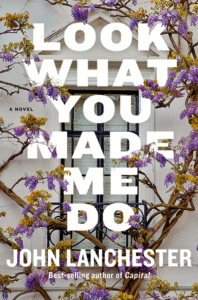
3. Look What You Made Me Do by John Lanchester
(W. W. Norton)
10 Rave • 3 Positive • 2 Mixed • 1 Pan
“A gleamingly accomplished black comedy … Skewed scenarios and retaliatory stratagems are craftily deployed in a novel that’s a kaleidoscope of tilting perspectives.”
–Peter Kemp (Literary Review)
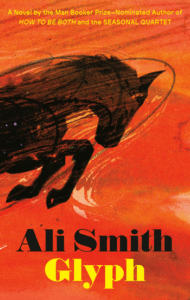
4. Glyph by Ali Smith
(Pantheon)
8 Rave • 6 Positive • 1 Mixed • 1 Pan
“Glyph’s primary power comes from its commitment to excavating the sediments of language; its etymological resonance and inference … It is a bold move to be so morally unflinching, especially in the face of a perceived aesthetic orthodoxy that so often privileges distance and irony, but in Glyph we see a major British writer answering the call of the day when so many others have equivocated or turned away.”
–Keiran Goddard (The Guardian)
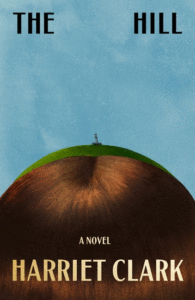
5. The Hill by Harriet Clark
(Farrar, Straus and Giroux)
7 Rave • 3 Positive
“Superb … Clark’s novel is a brilliantly deprived bildungsroman … From the novelist’s point of view, the story’s fatal glamour skews it toward memoir: Why fictionalize such remarkable facts? Clark’s wise remedy is to strip her fiction of most of those facts, reducing the local references so that the narrative shifts away from singular autobiography toward singular emblem.”
–James Wood (The New Yorker)
Book Marks
Visit Book Marks, Lit Hub's home for book reviews, at https://bookmarks.reviews/ or on social media at @bookmarksreads.