Maya Angelou Book Award Winner Alison C. Rollins on the Poetics of Sound, Space, and Image
In Conversation with Whitney Terrell and V.V. Ganeshananthan on Fiction/Non/Fiction
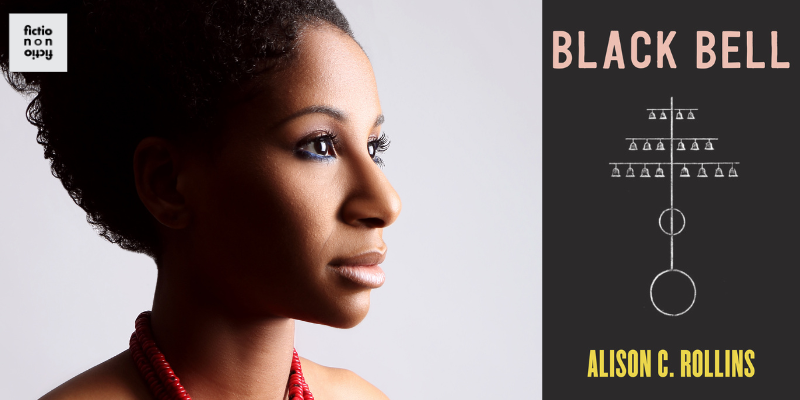
2025 Maya Angelou Book Award winner Alison C. Rollins joins co-hosts Whitney Terrell and V. V. Ganeshananthan to discuss her 2024 poetry collection Black Bell. She explores the history and symbolism of a bell-laden iron device used to control and torture enslaved people and describes the replica she created after studying metalworking. She also recounts the story of Harriet Jacobs, who spent seven years hidden in her grandmother’s attic before escaping slavery. Rollins talks about how her poems engage in call and response with other texts, including the music of Sun Ra and Stevie Wonder and images connected to ornithology, anatomy, Afrofuturism, and the history of slavery. She reflects on who has historically been granted the title of “poet” in America and discusses the archival research behind her writing. Rollins rings a glass bell and reads several poems from Black Bell.
To hear the full episode, subscribe through iTunes, Google Play, Stitcher, Spotify, or your favorite podcast app (include the forward slashes when searching). You can also listen by streaming from the player below. Check out video versions of our interviews on the Fiction/Non/Fiction Instagram account, the Fiction/Non/Fiction YouTube Channel, and our show website: https://www.fnfpodcast.net/ This podcast is produced by V.V. Ganeshananthan, Whitney Terrell, Amelia Fisher, Victoria Freisner, Wil Lasater, and S E Walker.
Black Bell • Library of Small Catastrophes
Others:
Incidents in the Life of a Slave Girl by Harriet Jacobs • The Divine Comedy – Inferno, Purgatorio, Paradiso by Dante Alighieri • The Chronicles of Narnia by C.S. Lewis • The Lord of the Rings by J.R.R. Tolkien • Wu – Tang Clan – Enter The Wu – Tang (36 Chambers) [Full Album Mix]
EXCERPT FROM A CONVERSATION WITH ALISON C. ROLLINS
V.V. Ganeshananthan: There are so many other visual elements in the book that you were mentioning before, geometric diagrams, like “The Hymn of Inscape,” an image of spacecraft crossing the solar system, this notated picture of the human respiratory system, and newspaper clippings of songs by Henry Box Brown like “Escape From Slavery” and “Hymn of Thanksgiving.” Can you talk about all of these different visual elements and how they are at play and at work in the book, and how you decided what to include. You’ve clearly done all this incredible historical research and archival work. Sometimes when I talk with other writers or with my students, we’re like, “I’m in the research and I’m lost, and I love all of it, and I want to put all of it in.” But you can’t. So how do you pick?
Alison C. Rollins: There are a lot of things that definitely didn’t make it or got left out. I love pictorial dictionaries. I fell in love with them through the work of fellow poet and librarian, Jesse Randall. She used them first, and I saw them and found the source material that she used and fell in love with them. They’re like visual dictionaries that have images and then they have definitions or words in relationship to the images that are numbered. I really found that as an interesting tool or guide for language-making or meaning-making or learning a language and learning terminology. I also love 19th century medical texts in terms of the images and also their pairings with language or definitions of the things that we’re seeing. Those serve as the source text for a few of the poems in terms of my thinking about repurposing that found language in a new way, or imbuing it with new life, alongside my lyric interventions.
Also, I think, as an adult, there’s something that’s so sad about—why I love and enjoy teaching graphic novels, which students often find surprising, is that there’s something beautiful and intriguing about having pictures alongside text or written text. As adults, we’re told that that’s not sophisticated or mature, but I think there’s something so delightful and pleasurable about it. So having visual images sit alongside the work was really important to me for this book, and again, adds another texture or layer to the reading experience that informs it, and elevates in certain types of ways, or creates a three dimensional engagement or play that’s not just standardized text or language on the page.
It allows me to geek out as a trained librarian. There’s a poem that has runaway slave ads alongside text. Re-contextualizing that language and those images in this new form in the book, again, is a way of playing or being in dialogue. We could talk about echoing call and response, what it means to have an image be a call and a response, to be done in the written word or through language in that way.
Whitney Terrell: And it used to be pretty common, I would think. I’ve seen old Charles Dickens novels that have drawings in them, right? It used to not be that you couldn’t have drawings in a book of literature. But my whole life, a poetry book is just words, small, a lot of white space. How do we arrive at that convention of what poetry books are supposed to look like, and is that starting to change exactly?
ARC: I know. My goal—I’m working on a fiction book, we’ll see what takes place. Prose intimidates me so much in so many fucking words. But I always loved books or fantasy books that inside the cover, the opening page would have a map, like when you think about Narnia, or The Lord of the Rings, or books that had some type of matter that kind visually situated you or guided you before you entered the realm of the book—so it’s always just been a goal to think about having or imbuing or integrating visual matter alongside the words.
WT: The other thing we wanted to talk to you about is religion, and the way you think about religion. In the book, you have a poem called “Nine Circles of Hell (36 Chambers)” which is skeptical of, but also engaging with religion. Could you talk about that poem and your own religious beliefs? You mentioned already, you’re thinking about the call and response of the Black church. Could you talk about that in your own relationship to spirituality and your work?
ARC: The Nine Circles of Hell come from Dante’s Inferno, a canonical poetic text.
WT: That’s a book of poetry that has pictures in it. I have some versions of it with pictures.
ARC: Yes. And I wanted to imagine or be in conversation with this canonical, authoritative text in a more playful and almost surreal way. And so it’s merging that with Wu Tang Clan’s 36 chambers. It’s integrating those two texts together in conversation. And I was raised and went to Catholic school my entire life, until college. I went through kindergarten through eighth grade at one Catholic school and a Catholic all girls high school. As much as I tried to depart from Catholicism, or rebel against some of its fundamentalist teaching, for some reason in my poetry, the strength and power of the visual imagery, the ritual of experience, of Catholicism, riddles and echoes throughout my work, even when I’m not consciously trying. I think there’s something really interesting about being in dialogue or conversation with a higher power, thinking about one’s ancestors or lineage in terms of connection and in terms of meaning-making across space and time in that way.
In this poem, I’m meditating or thinking about the afterlife. A lot of the book is considering or thinking about resurrection as a possibility or form, what it means to call from the dead or call back from the dead or be reborn in a particular type of way. So through each of these Nine Circles that Dante explores—greed, anger, violence, heresy—I’m reimagining or playfully, hopefully somewhat humorously, and imbuing it with a lot pop culture, hip hop references, music references, just having fun or play, imagining going through the afterlife in terms of Dante’s Inferno through modernized, Black vernacular lens.
Transcribed by Otter.ai. Condensed and edited by Rebecca Kilroy.

Fiction Non Fiction
Hosted by Whitney Terrell and V.V. Ganeshananthan, Fiction/Non/Fiction interprets current events through the lens of literature, and features conversations with writers of all stripes, from novelists and poets to journalists and essayists.