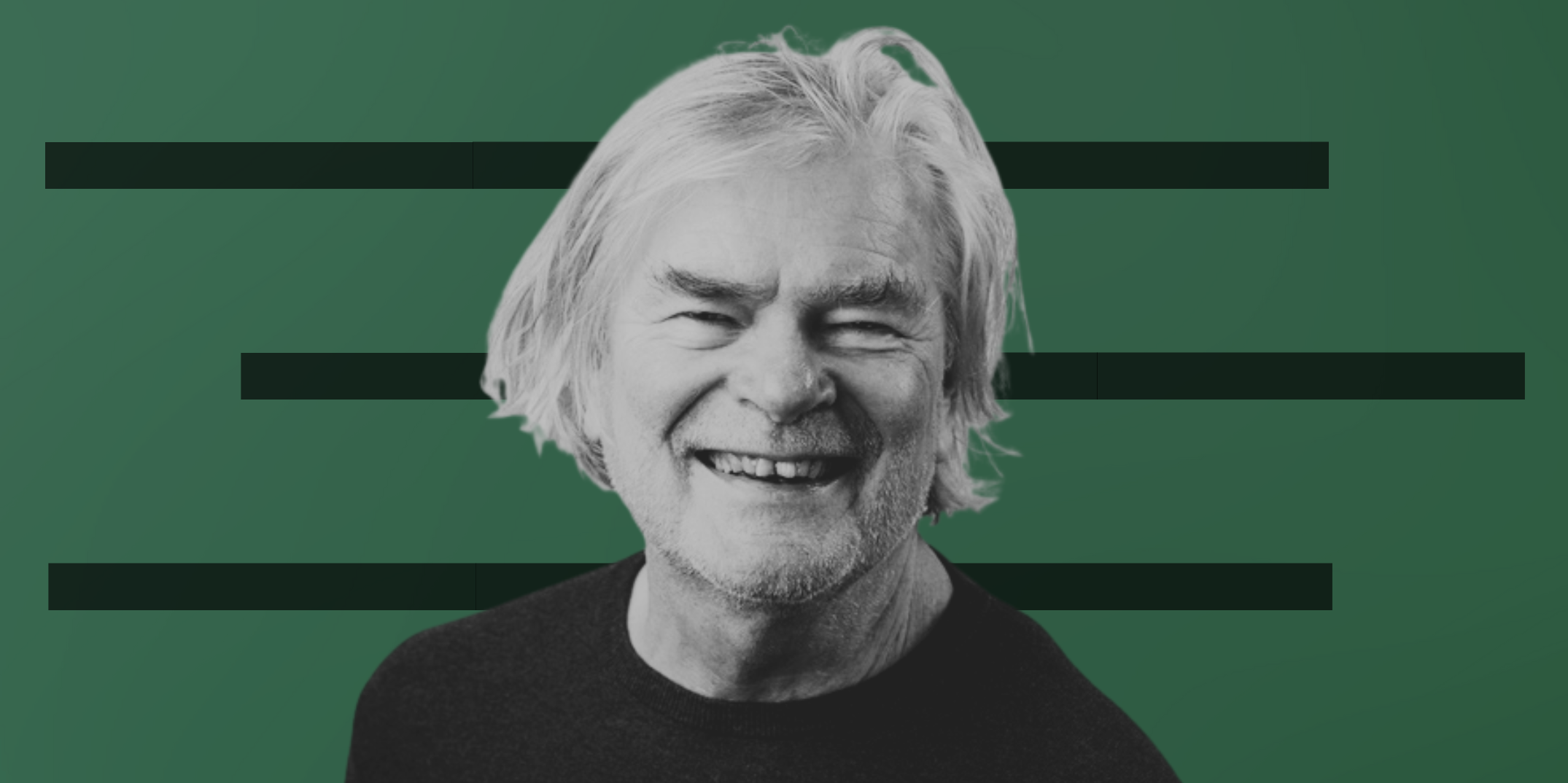
Maurice Riordan on Writing Rituals, the Creative Imagination, and His Journey as a Poet
In Conversation with Peter Mishler
This piece marks the 50th interview in contributing editor Peter Mishler’s long-running series of conversations with contemporary poets. To celebrate this occasion, Literary Hub has partnered with Faber to present a series of interviews from their extraordinary list of poets.
Our first of these conversations was conducted with Maurice Riordan.
Maurice Riordan was born in 1953 in Lisgoold, Co. Cork. His first collection, A Word from the Loki (1995), was nominated for the T. S. Eliot Prize, as was The Water Stealer (2013). The Holy Land (2007) won the Michael Hartnett Award. His Selected Poems (2025) draws on work published over four decades. He lives in London, where he taught at Imperial College and Goldsmiths College. Riordan was Editor of The Poetry Review from 2013 to 2017 and is Emeritus Professor of Poetry at Sheffield Hallam University.
*
Peter Mishler: Your Selected Poems was edited by Jack Underwood. What do you see when looking at your work in the order he selected?
Maurice Riordan: I was surprised Jack eschewed a chronological approach and took on the tricky task of presenting the poems in a new order. So, the selected begins with “The Seven Songs of Myself,” written in 2019, and ends with “Floods,” a millennial poem from twenty years before. I thought this re-ordering might lead to some jarring transitions. But I don’t think it does.
There is more unity of voice and theme over the years than I was prepared for; and there’s also, which is more important to me, a consistent level in the execution. I was worried I’d be dissatisfied with poems written many years ago. But it wasn’t the case. I gave myself a little pat on the back on that score. On the negative side, I guess I can’t avoid the conclusion that my work hasn’t evolved that much, at least in the past 40 years.
PM: How aligned is the poet you thought you might be in your youth with the poet you’ve become?
MR: When I was twenty, Hart Crane was my main man of the early twentieth century. And his kind of bare-knuckle romanticism was reinforced in me by Roethke and early Ted Hughes. I believed poems were transformative of the self—if not also, like Crane in The Bridge, of the culture. I grew into a more patient, more observational and sardonic approach later through reading Elizabeth Bishop and also Frost. Have I lost the early romanticism? I’ve retained a sense of my poems as exploratory, as a process of self-discovery. I haven’t relinquished altogether perhaps the old Keatsian notion of “soul-making.” Could the younger me have predicted the poems I’ve written? Absolutely not. Whatever else about it, my journey as a poet has always unfolded alongside feelings of “what’s this, where’s it leading?” and “why am I doing this?”
PM: To what extent have you thought consciously about “reinventing” yourself as a poet over the years?
MR: After each book, I’ve stopped writing poems. Not intentionally, but it happened. And this gave my brain time to “re-wire,” as well as for life to put new stuff on the plate, as it does. When I get going again on a book, I have a sense I’m opening up fresh areas of my dream-life. Of course, to an outsider the new poems that come about may seem like the same-old same-old! But for me that feeling I’m breaking ground, in terms of my own work, has always been a source of energy.
PM: Did you feel something was missing or something you needed to achieve that led you away from Crane as a guide?
MR: Well, all my cells have been replicated several times since my Hart Crane days! I think my poems secured their own idiom, and found some momentum, only in my mid-thirties—an age Crane didn’t reach. By then, my writing was being affected by all the stuff life throws at you—and especially at that time the circumstances of parenthood. I think it’s not unusual to start out with an aspirational type of poetry, a brave attempt to project the self into the world. But, as one goes on, the writing becomes an engagement with perhaps almost-overwhelming personal experiences. And then, as life moves through its stages, one’s experiences become layered, and eventually become—to go full geological!—a jumble of folded and fractured strata the imagination tries to make some sense of.
PM: Have you yet decided on a “why am I doing this?” that feels permanent or settled?
MR: Definitely not settled! There’s a purely selfish motivation. Back in the day, it was the hit, the “crow,” the relief I felt when a poem seemed to work. In recent years, it’s more an unfolding sense of surprise at what the writing reflects back and “reveals” about myself (I say “reveals” because it is, I know, a watery and unreliable mirror).
I do have faith in the creative imagination, overall, from the cave paintings to rap, as well as its role in mathematics and science, and including, too, the religious and moral imagination.
I suspect most people who write poetry, myself included, have squandered the chance to do something more worthwhile for the world. I do have faith in the creative imagination, overall, from the cave paintings to rap, as well as its role in mathematics and science, and including, too, the religious and moral imagination. Human history would be only diabolic without it. And with it? Perhaps not good enough—who knows yet. Do my own poems contribute to the pool? Just a drop I’d like to think. Hopefully not a drop of sour grape juice!
PM: What mannerism in poetry are you most wary of?
MR: I’m wary of the factitious. It’s essential, of course, to always be inventive and fresh. But that shouldn’t look too effortful, or overly dependent on novelty or shallow surrealism. The world is strange enough as it is.
PM: Are there habits that you find yourself falling into in your writing that you intentionally try to avoid?
MR: The false ending maybe—if that could be called a mannerism. In Irish poetry, because of Yeats (let’s blame him!), there can be a reliance on the resounding last line; and in UK poetry, alternatively, there’s a tendency to avoid that with the throwaway ending. I look for something that feels inevitable, though I’m not sure I always manage to pass between, as it were, the Scylla of one and the Charybdis of the other.
PM: What art form are you most passionate about after poetry?
MR: Music is the greatest art form, I’m sure—the language of heaven if there were one. But I’ve felt somewhat disabled musically ever since, at age 5 or 6, a teacher told me to stop singing, since I was a “crow!” Poetry seemed a poor consolation for that letdown. Would I now give up my poems to have been a classical tenor, or to front a rock band? Well, possibly the former. I’d have loved the collaborative nature of performance along with the glory of the voice. Even so, the more earth-bound pleasure of poems, reading them, remembering them, figuring them out, and occasionally writing some, has given me decades of reward.
PM: Where do you write? What do you write on? Could you please share some of the rituals of your writing practice, space, and habits?
MR: Mainly, I write on my laptop while sitting in the same orange armchair, and usually in the morning. Back in the day, my habit was to write in cheap notebooks with a good pen. Then one morning in April 1999 I sat down at my son’s computer and wrote a poem called “The Sloe” straight onto the screen. It’s a long, thin, free-flowing poem. I saw I could not have written it in one of my notebooks. So I switched allegiance to the screen. I still revert to pen and paper at times to test out what I’m working on. But mainly I’m happy with the flexibility of the screen—and glad, too, of the way it consigns countless changes to oblivion.
Music is the greatest art form, I’m sure—the language of heaven if there were one.
I work slowly, always listening to the lines as I go. I’m what I’ve heard called a binge poet. I write nothing for months, years even, only to become unexpectedly obsessed for weeks perhaps, and then, intermittently over a year or so, I produce a book. I’ve spent a lot of time on poetry-adjacent activities—editing, teaching, translating, other writing—and I’m also naturally indolent. The number of hours I’ve actually spent working on poems is relatively few.
PM: What does that period of obsession over a number of weeks look like for you when you’re writing most actively?
MR: I’m liable to be unreliable. I might do something dim—like depositing a large cheque in the slot at the post office rather than at the bank next door (true). Mainly, I feel sort of pleasantly wakeful and “high,” while also nervous I’m deluding myself. A couple of times I’ve felt scared.
PM: Could you elaborate on a specific time between books and “fresh area of dream life” and what ended up emerging for you for that new phase of work? I’m wondering if there is one of these “re-wiring” times that seems illustrative or particularly meaningful to you as a writer.
MR: Following my second book, Floods, I knew I’d write about the world in which I grew up—that’s to say in nationalist rural Ireland, a notably homogeneous culture back in the 1950s and 60s. I needed to find a way of doing it that would be different to how several male Irish poets with a similar background had written/were writing about it. I had the title, The Holy Land, even the epigraph from Dante, and a vague idea it would be a tour, field by field, around the vanished world of our childhood farm in the company of my father. I also had the rather whimsical notion that this would resemble a round of golf—just as in the Inferno you have poet and caddy, as it were, completing each episode as the next comes into view.
I worked on it on and off for two years. But it just wasn’t happening. Apart from a few poems, what I produced always sounded forced. But then, just on impulse, I did an imitation of a “prose poem” called “The Finest Music” (it’s actually a piece of so-called Fenian lore from a tale by James Stephens). I liked what happened and did a few more, and they seemed okay. And over the next weeks, I did one every few days. It seemed I’d forgotten about my book.
But then I realized this was the book. I stopped when I got to 18—perhaps to retain the idea of a round of golf. I’d little expectation these prose idylls, as I was now dubbing them, would appeal to my editor. But they did, luckily. I worked quite a lot more on the book, adding poems in verse, and shaping it overall. But that sequence of prose idylls was the core of the collection.
I would add that some such “unconscious intervention” has been necessary for each of my books.
I would add that some such “unconscious intervention” has been necessary for each of my books. And now sometimes, looking back, the poems resemble a serial dream—a kind of parallel distorted narrative of my life.
PM: To what extent have the literary traditions of Ireland interested you?
MR: I grew up in Anglophone Ireland, though in a part of the country where Irish and English had co-existed for centuries since the Tudors. Spenser wrote much of The Faerie Queene close to my birthplace. He also wrote A View of the Present State of Irelande, a prose tract so genocidal it was, some historians argue, too extreme even for Elizabeth’s court. He would have had Ireland cleansed of its native culture, articulating a colonial program that was almost but never fully achieved in my part of the world. The same ideology was more successful later in North America. That background has given a hard serrated edge to my relationship—long and ever deepening—with “canonical” English poets.
As for the native “Gaelic” tradition of literature, it’s a hinterland to my work, and to my life. But it’s not something I think about much, or often. I assume it’s there as a haunting presence. And I let it be.
I have spent time, however, with early medieval Irish writing, especially with the poetry, when editing an anthology of early lyrics. So I’ve absorbed things from that. I think an awareness of the porous fabric of linear time, a sense of the flimsy boundary between present and past, would be one thing. Also, it occurred to me recently I may have picked up a kind of artisanal respect for poetic craft—as something you learn to do with skill, with pride, with a sense of it being a hereditary occupation. The “bardic” tradition, from the 12th century through to its elimination in the 17th, showed almost none of the imaginative vitality of poetry in Britain and the continent over the same time-span. But there’s nothing slack, or lazy, or subjective, or self-indulgent, about the elaborate verse-craft of those bards.
PM: Is there something you would have expected to end up in your poems that just hasn’t appeared there? What do you make of that?
MR: One never knows what the next book may bring, or the second-next if there is one. I’ve sometimes wished more of my poems had a more public voice, to have had a kind of ready rapport with current events, and indeed family events. But for me experience, generally, has to sink into memory it seems, as if it needs to decompose before becoming available as material. I can’t help but see an odd disjunction between the “diary” of my life, with its salient episodes and emotional current, and the alternative narrative of my poems. This is disconcerting, or would be if I thought enough about it. It feels like a limitation, which I’ve come to accept as such.
PM: What are you working on now?
MR: I have a prose work, Rope, coming out next July. To cite the cover copy, it’s a “kind of contemporary commonplace book, accumulating with associative loops and echoes.” It’s loosely modeled on Ben Jonson’s Timber, or Discoveries, but I’ve tried something less formal, more personal, also more philosophical—and shorter! I am well on with a new book (poetry), but not far enough on to talk freely about it. I always fear talking much, or at all, about a work in progress “lets the air out of the tyres.” It’s called Islands.

Peter Mishler
Peter Mishler is the author of two collections of poetry, Fludde (winner of Sarabande Books' Kathryn A. Morton Prize) and Children in Tactical Gear (winner of the Iowa Poetry Prize, forthcoming from the University of Iowa Press in Spring 2024). His newest poems appear in The Paris Review, American Poetry Review, Poetry London, The Iowa Review, and Granta. He is also the author of a book of meditative reflections for public school educators from Andrews McMeel Publishing.