Matthew Pearl on What We’ll Do For the Prize
In Conversation with Whitney Terrell and V.V. Ganeshananthan on Fiction/Non/Fiction
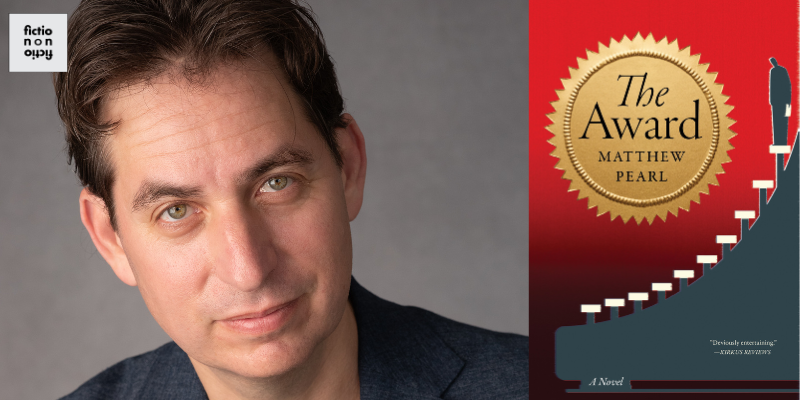
Bestselling and award-winning writer Matthew Pearl joins co-hosts Whitney Terrell and V.V. Ganeshananthan to discuss his new novel The Award. Pearl explores the relationship between cultural prizes and ideas of nationhood, as well as imposter syndrome and external validation, like MFAs, literary awards, and being seen writing in coffeeshops by and with other writers. He reflects on developing the character of David Trent, an aspiring young writer in Cambridge, Massachusetts, where Pearl himself formerly lived and participated in cafe culture. He talks about the ethical lines David is willing to cross to achieve success and how he rationalizes these choices to himself. He also explains the larger-than-life character of Silas Hale, the famous and mercurial novelist who lives downstairs from David, controls their shared thermostat, and has no interest in mentoring his young neighbor. Pearl considers how David’s life changes when he publishes a book and wins a prize. He reads from The Award.
To hear the full episode, subscribe through iTunes, Google Play, Stitcher, Spotify, or your favorite podcast app (include the forward slashes when searching). You can also listen by streaming from the player below. Check out video versions of our interviews on the Fiction/Non/Fiction Instagram account, the Fiction/Non/Fiction YouTube Channel, and our show website: https://www.fnfpodcast.net/ This podcast is produced by V.V. Ganeshananthan and Whitney Terrell.
The Award • Save Our Souls: The True Story of a Castaway Family, Treachery, and Murder • The Taking of Jemima Boone: Colonial Settlers, Tribal Nations, and the Kidnap That Shaped America • The Dante Chamber • The Last Bookaneer • The Technologists • The Last Dickens • The Poe Shadow • The Dante Club
Others:
Fiction/Non/Fiction Season 7, Episode 19: Jacinda Townsend and James Bernard Short on American Fiction • Erasure by Percival Everett • Rabbit, Run by John Updike • The Plot by Jean Hanff Korelitz • The Wife by Meg Wolitzer • Yellowface by R.F. Kuang • The Other Black Girl by Zakiya Dalila Harris • Young Lions Fiction Award | The New York Public Library
EXCERPT FROM A CONVERSATION WITH MATTHEW PEARL
V.V. Ganeshananthan: We were talking before the episode about the ways that prizes, including literary prizes, are sometimes connected to ideas of nation. I wonder if you can talk a little bit about the ways that awards can be political. Whitney was mentioning—and I didn’t actually know this fact—that John Updike, back in the day, was known for refusing to condemn U.S. intervention in Vietnam. Rabbit Angstrom was a character who was written to be pro-Vietnam. There was a period of time when all of these writers were going overseas as ambassadors of the U.S., a thing that I wouldn’t do at this particular moment. How do awards play into these political interactions?
Matthew Pearl: That’s so interesting. It sounds like there’s so many rabbit holes in there, and I actually can’t claim to know a great deal about the history of literary awards in general, but those are great illustrations of the way that awards in general can be so tricky, particularly for books. So on the one hand, attention for books. We all know, those of us in the book world, attention is so scarce. The capacity for attention on books is so scarce, more so every year. There’s so many books and so many great books with so little space to push them out into visibility. So on the one hand, awards can be really valuable when they can serve that purpose, but the sheer number of books makes the idea of awards for writers a steeper climb in terms of any kind of fairness to them. I imagine if you were in the world of cinema, if you were a film critic, you could pretty easily see essentially every movie that gets released theatrically in a given time period or given year. Maybe I’m wrong about that, but I think you probably could, certainly in any category. But there’s no one on any planet that could read anything but a small sampling of the books that come out in a particular time period, even in a certain category. That gets back to that idea of politics. Something has to bring certain books to the foreground, because there’s no way to have an even playing field. That makes the very idea of awards in literature filled with landmines.
Whitney Terrell: Awards do have a political resonance in terms of who gets looked at in certain periods of time. Like the period of time that Sugi was talking about was when writers like Saul Bellow were going overseas with the State Department imprimatur to give readings at Soviet Bloc countries and going to Russia as a way of showing “Hey, we’re free market, free speech advocates.” They were really ambassadors of what US policy was at that time, and that affected how people got awards back then. I would say also that we had a period of time where people really wanted to diversify who was winning awards, and that became an important political issue during the Obama era, not surprisingly.
Political actors recognize that awards have power and that writing has power, and that’s why you get political actors wanting to have a say in that. One way of having a say in that is affecting the way that awards go. I’m not saying that award boards are corrupted or anything like that, although there’s the example of Trump reappointing all the board members of the Kennedy Center, which is a form of an award, right? That’s definitely also another example of politics influencing the ways that awards can be given. It’s important to remember and recognize that awards tend to reflect the political era that they’re in, or at least the conflicts of that era. If you could change the ways that awards are done in the literary world—if you could make one change—how would you change that structure?
MP: That’s a great question. It’s so interesting to think about these networks of attention on certain pieces of art work and how that ecosystem works. You’d have to add language to the title of these awards. Instead of the Best Novel or Best Book of Poetry, it’s the Best Novel That We Happen to Have Read, or The Best Book of Poetry That We Got Around to Reading This Year.
WT: There’s also a regional component. Literary awards that are based in places like New York tend to nominate New York writers. I’m on the awards panel for the New York Public Library’s Young Lions Award, which I’ve read for for many years. Very often, I’m the only person not in New York who’s commenting on this.
MP: Which is a form of politics, right?
WT: Absolutely, in terms of who knows who. I actually think the most important part of literary awards is that they are insular.
VVG: We want to pivot to talking about your book. One of the ways that your book literalizes this insularity is through the protagonist of The Award, David Trent, a guy who would change lots of things about the literary world and its awards if he could—
WT: Mostly that they’re given to him.
VVG: He would. That’s where he would start. And at the beginning of the book, he’s trying to rent part of a house in Cambridge, Massachusetts. Even though the place has problems, he impulsively decides to take it when he learns that a well-known writer, Silas Hale, lives downstairs. He’s like, “This is my in. I will know people because of Silas.” And Hale is The New Yorker fiction editor-at-large. He’s won a Pulitzer for Fiction. David dreams that Hale will mentor him and goes so far as to tell people that Hale is his mentor. The insularity that you’re referring to takes place. It starts out in this house where these writers are living on top of each other—this really weird, old, creaky Cambridge, three floor, three floor house—where they’re tied together by things like who controls the thermostat. Can you tell us a little bit about developing the character of David Trent and also Silas Hale, who is the writer David wanted to be one day, and who is initially blowing him off. Can you talk a little bit about these guys?
MP: Thank you for such a great tee-up of the story of the novel. This novel is really the first time I’ve ever drawn from my own life in my writing. In fact, I’ve always been very uneasy at the idea of doing that. So this was a big leap for me, even though it’s fiction. So when I was creating these characters, David was definitely drawn from me in part, and from other writers that I was close to, as I was navigating that landscape of becoming a writer and and interacting with other writers, all of which were were very new experiences for me that were very specific to being in Cambridge. I never had a mentor. I didn’t go to an MFA program, so I didn’t have any infrastructure. I started writing fiction while I was in law school, which is not obviously a typical place to do that, or a place where it would grant you a network of either peers or guides or mentors.
Developing Silas Hale as a character was really imagining that quest for someone who could take you by the arm and lead you through, which I did not have. I was able to draw from all kinds of writers that I’ve met over the years in creating both of those characters, as well as other characters. And it was so much fun. It really was. I didn’t know what it would feel like to work on a book like this and Silas, particularly, that larger than life, almost demonic force in David Trent’s life was just a real blast to develop as a character.
Transcribed by Otter.ai. Condensed and edited by Rebecca Kilroy. Photograph of Matthew Pearl by Bachi Frost.

Fiction Non Fiction
Hosted by Whitney Terrell and V.V. Ganeshananthan, Fiction/Non/Fiction interprets current events through the lens of literature, and features conversations with writers of all stripes, from novelists and poets to journalists and essayists.