Matters of the Spirit: A Pastor, a Noblewoman and a Mysterious Bout of Melancholy
Christopher Clark on the Intersection of Mental Health and Christian Faith in 19th-Century Prussia
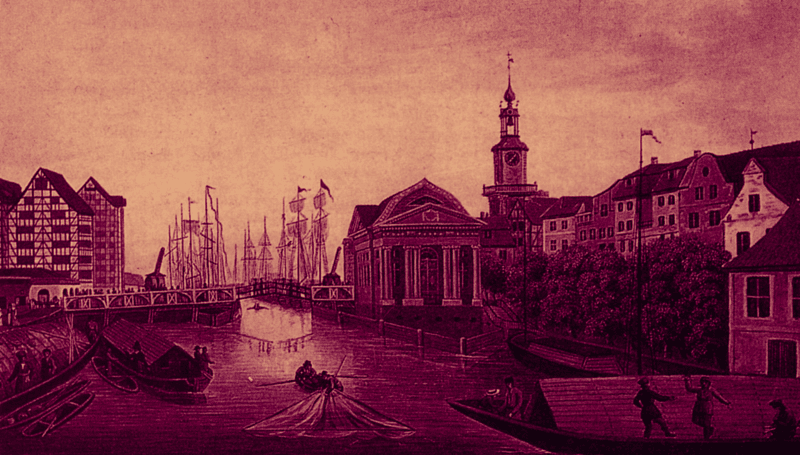
In 1816, three years after her husband’s death in battle, Ida von der Groeben still languished in a condition of profound apathy. Ida had been one of the most eligible young women of Königsberg high society. She was the third daughter of Hans Jakob von Auerswald, a senior functionary who had become President of the Province of East Prussia in 1814. Her eldest sister Lydia had married Theodor von Schön, who would succeed her father as President in 1824.
The next sister, Eveline, married a wealthy nobleman by the name of Kurt von Bardeleben. Ida had many suitors but chose the handsome Count Wilhelm von der Groeben, First Lieutenant, and Adjutant in the Cuirassier Regiment ‘Count Wrangel.’ After his death in battle at Großgörschen on May 2, 1813, when Ida was twenty-one years old, the high spirits for which she had been renowned evaporated. She withdrew from Königsberg and lived in seclusion at the country seat of her dead husband’s family.
Early nineteenth-century medical experts took a range of views on the causes and defining features of melancholy. The “obstinate fixation of attention on one object,” “dark and confused ideas,” and a tendency to develop mistaken judgements about them were identified by leading authorities as key indicators of melancholy, but protracted sadness, rumination, sleepiness, fatigue, shame, fearfulness, anxiety, despair and “the extinction of hope” also figured in the diagnostic literature.
If people believed that inner joy was an index of personal redemption, then some might also read their own low mood as signs of their abandonment by God.
Grief was the most common trigger, according to one expert, but excessive dryness of the brain, cerebral change, and a shock capable of disturbing the equilibrium between the power of judgement and the power of imagination also figured in the aetiology of this disorder. The most popular treatments included bleeding, vigorous physical movement, and brushing of the back and belly—all intended to shake loose the blockages in circulation (especially of black bile) associated with the disease.
In Ida’s case, the occasion of her descent into melancholy appeared, understandably enough, to be the death of her husband in battle. But her own later account of this period of illness had relatively little to say about the bereavement or its impact on her life. Instead, she dwelt on religious anxieties that had tormented her since childhood. At the heart of her disorder was the apprehension that salvation would be denied her because she had failed to find a way of loving God above all people and things: “When I checked and discovered that I loved people—father and mother—more than God,” she wrote, “I was filled with a great fear.” Her mother assured her that it was normal for a child to “cling to those who were performing God’s role [for her] on earth.” This comforted her for a while, but the anxiety soon returned. And underlying her fear of perdition was a deepening ontological uncertainty: Did the things around her really exist? How stable was her own existence? What relationship existed between herself and the world around her? And this incessant self-questioning was intensified by feelings of guilt about the direction of her thoughts.
The problem persisted into adolescence, until the distractions of society and her own entry into “what is known as the great world.” Ida was swept up by the fashionable romantic sensibility of her era. But if the distractions of society “alienated [her] from the quest for the highest things,” they also prevented her from finding “true peace.” It was the death of her husband after just two years of marriage that precipitated the next phase. Only after a period of profound unhappiness, she later wrote, did her life acquire “the direction intended by God.” Ida had never enjoyed attending church, because she found the sermons she heard there, delivered in the rationalist manner dominant at this time in the province, dry and lacking in insight. But in the preaching of Johann Ebel she found something that awakened her to a “tense state of alertness.” The “particular tendency of his influence,” she wrote, was “to spread joy in the name of the Lord, to call people to joy in Him, and to freedom, to the reciprocation of his love.” This seemed “new and unheard-of” in a time that had fallen for “a shallow and dead religiosity.” Ebel communicated the sense of a peaceful and joyful relationship with God:
Through Ebel’s preaching I gained a glimpse into the paternal heart of God and into his love for me, of which I had hitherto had no idea, and believing in which had until now always seemed the most difficult thing. God himself soon became my true love, I felt that I had never experienced such an attachment to anyone in the whole world as I now did for him, my heavenly father, whom I now believed that I had found; aroused to joy in the deepest foundation of my soul, I had now become truly happy.
When the doubts returned, and with them anxieties about her own sinfulness, Ida dared to share them with Ebel. In addition to assuring her of the mercifulness of God, the pastor urged her not to be fearful; there was a difference, he told her, between obstinate and arrogant doubts and “an honestly searching doubt.” She should not take these thoughts too seriously, but use them for the purpose that God intended, namely as a prompt to achieve a deeper understanding of His word. When Ida saw that her fear of being condemned for the fragility of her faith was without foundation, her courage returned, at least for a time. When the fears came back, Ebel showed extraordinary patience, finding fresh insights and lines of argument every time she consulted him. “The ordeal by fire that you are experiencing is as necessary for you as it is unintelligible from your standpoint,” he told her. “Believe me, the Lord would rather let us sink to the gates of Hell than give us up, if we are honest. […] And you are honest. You have nothing to fear. It is at night that we see the stars, just as you receive moments of insight in the heart of your struggle.”
On another occasion, when Ida was overcome with the feeling that she was unreceptive to and incapable of love, she wrote to Ebel about this new assault on her peace of mind. In his response, the pastor urged her to be patient. She was right to think that she still lacked the right love. To acknowledge this was deeply humiliating, but it was also necessary and salutary. Most importantly, it was as true of Ebel himself and of all sinners as it was of Ida. But God was love, and his victory over the hearts of those who longed for him was already prepared in advance. This love had taken the form of a man precisely in order to conciliate the loveless hearts of men and women. Christians were the followers of Christ not because they fulfilled love, which was the law of perfection, but because He loved them:
Love is the first and indispensably necessary prerequisite for redemption; it does not consist in our having loved God, but rather in the fact that he has loved us, 1 John 4. If you want to inspect your worthiness and establish a justice, then you are on the wrong path. Therefore, I entreat and enjoin you in all seriousness in the name of the Lord do not indulge in such miscalculations, but rather let yourself enjoy grace and simply throw yourself as a death-worthy sinner into the arms of our mediator, only then will love be poured out upon you from his divine heart.
Early nineteenth-century pathology acknowledged the existence of specifically religious forms of melancholy. These were conditions in which “dark and confused conceptions” and “sad and fearful feelings” were triggered by religious ideas and references. A tract published in 1799 claimed that of the persons confined on account of mental illness in the asylums of the German states, “about two-thirds have become mad by way of excessive religiosity or through ruminating on religious questions.” Religious melancholiacs, it was argued, exhibited certain identifying symptoms: the skin of the face might show a “pale, yellow, earthen colour” and the eyes “a sad, languishing, fearful gaze…”. The gait of melancholiacs was dawdling, the voice trembling and weak. They accused themselves of great sins and were in deep doubt as to whether they were in a state of grace. They were often disgusted by their own thoughts, which they took to be blasphemous.
As for the causes, the experts offered the usual array of possible triggers, from congestion of the blood to bad air and climate, to nervous conditions and “unfulfilled sexual desire.” Some acknowledged the possibility that melancholy could be inherited. This was relevant to Ida’s case because when she informed her father of her condition, he replied: “Not you too my poor child!” and confided in her that he had suffered from similar doubts since his youth. A persistent “inner dissatisfaction” had left him with a strangely depressed mood which expressed itself in reclusiveness and “an almost dark seriousness.”
[Ebel] entered deep into the logic of Ida’s anxieties, meeting her on the ground of her own beliefs and intuitions, and encouraging her to reframe her experiences as encouraging prompts from God.
Mental-health experts in the early nineteenth century were reluctant to blame religion as such for the phenomenon of religious melancholy. Most of them were themselves religious in some sense or other and affirmed the role of moderate and rational forms of faith in contributing to the well-being of the individual. But they did argue that false or mistaken religious beliefs could be implicated in the journey into mental illness. Of these the most common—also identified in present-day studies of religiously motivated anxiety—was the notion that one’s sins were too many and too great to be forgiven by God. Misprisions of this kind were more likely to occur, the experts argued, in religious settings marked by the rigorous policing of strict ethical injunctions or an emphasis on particular states of mind as markers of grace or perdition. If people believed that inner joy was an index of personal redemption, then some might also read their own low mood as signs of their abandonment by God and fall into a vicious circle of self-reinforcing anguish.
There was the added risk that people prone to this kind of doubt would focus on biblical passages with the potential to stir anxiety in vulnerable believers. The most important are those that refer to the “sin against the Holy Spirit” (Matthew 12:31, Mark 3:29) for which there is no prospect of forgiveness. According to Luke 12:10, “everyone who speaks a word against the Son of man will be forgiven, but he who blasphemes against the Holy Spirit will not be forgiven.” Since none of these passages offered any guidance on what this sin or blasphemy consisted of, there was nothing to stop anxious believers from applying it to their own behavior or experiences. An American study of “religious factors in mental illness” published in 1957 identified these passages as the most “dangerous” for believers prone to anxiety, because they encouraged them to believe that they “could not get through to God,” were “just not able to get saved,” and were “beyond the forgiveness of God.”
Johann Ebel was not a pathologist, but a preacher and a pastor entrusted with the care of souls. The rationalist psychiatrist Friedrich Bird claimed to have cured a depressed young Bavarian man by confiscating his religious tracts, changing his diet, and pressing him into a regime of regular physical exercise. He told another patient that he must blame himself, and not waste his time doubting the grace of God, who no longer performed miracles. “I asked him how he came to the idea of praying and keeping vigil as a remedy and he named me various biblical reasons. I referred him instead to earthly measures.”
Ebel took a different approach. He entered deep into the logic of Ida’s anxieties, meeting her on the ground of her own beliefs and intuitions, and encouraging her to reframe her experiences as encouraging prompts from God rather than signs that she had already been abandoned. There was no need for the studied “condescension” (Herablassung) recommended by some pathologists as a means of winning the trust of the subject. The notion that Ida needed to learn not to love but to be loved, that her sense of unworthiness was not an intimation of the truth but a necessary precondition for her journey towards a fuller experience of her faith—these suggestions reveal an acute understanding of the nature of her predicament. They were aimed at providing her with the means of regaining a sense of traction: “The fact,” Ida would later write, “that Ebel, who knew exactly what was going on inside me, nonetheless did not pronounce a death sentence upon this illness, but allowed me to see the power of reconciliation, truly did comfort me.” With time she was able to return to society and resume her place in the life of the city.
Ida’s restoration to good health was a sensation. News of it passed through the elite families of Königsberg. This was a transformative moment in Ida’s life, but also in that of her pastor, Dr. Johann Wilhelm Ebel, who was now a famous man and a welcome guest at the homes of the province’s best families.
__________________________________

From A Scandal in Königsberg by Christopher Clark, published by Penguin Press, an imprint of Penguin Publishing Group, a division of Penguin Random House LLC. Copyright © 2025 by Christopher Clark.

Christopher Clark
Christopher Clark is a professor of modern European history and a fellow of St. Catharine’s College at the University of Cambridge, UK. He is the author of Revolutionary Spring, The Sleepwalkers, Time and Power, Iron Kingdom, and other books.