Marlene Zuk on Tackling Writer’s Block (as a Scientist)
“Once you have something to get you going, the rest sometimes follows.”
This first appeared in Lit Hub’s Craft of Writing newsletter—sign up here.
In 1954, Florence Moog, a biology professor at Washington University in St. Louis, published a paper in the prestigious journal Science titled “Can Scientists Write for the General Public?” She was responding to an earlier report “that a batch of ‘science writers’ have come to the conclusion that ‘scientists do not write well enough to communicate their work to the general public.’”
Moog took umbrage. “A mere unlettered scientist myself, I do not presume to question this bit of crystallized journalistic wisdom, especially since the report offers the comforting assurance that journalists themselves ‘constitute the best possible (sic) link between scientist and layman.’ The difficulty is only that, lacking the insight of a science writer, I find these unqualified assertions hard to understand.” She goes on to claim, “‘Science writers’ do have an essential role to play in reporting the facts of science; but interpreting science is better left to scientists.”
Even though we no longer put the term science writer in scare quotes, as a scientist who writes for the public myself, I sympathize with her irritation, not to mention the wholesale dismissal of our ability to write. The lines are blurred; many of us manage to communicate to broad audiences, and many science writers have substantial backgrounds in the field. The division persists, however, and Moog’s piece shows how it far predates science blogs, science Twitter/X/Bluesky, and what’s often called scicomm. Arguments about who can communicate with which audiences, whether science writers are irresponsible or scientists hopelessly opaque, continue.
But one element of the distinction between journalists and scientists who write about science is often overlooked. Science writers consider themselves, reasonably enough, as a kind of writer. Scientists generally do not. That’s true even though, as I tell the graduate students in my course on science writing, they really could. Most of us spend more of our time writing than any other activity—we write reports, dissertations and theses, grant proposals, papers for highly specialized journals, papers for less specialized journals, and of course exams and syllabuses for classes. Ecologist Stephen Heard, author of the wonderful book The Scientist’s Guide to Writing, clocked his efforts in a given year at 132,000 words, which he helpfully noted is somewhere between the length of Harry Potter and the Prisoner of Azkaban and Harry Potter and the Half-Blood Prince.
That total, of course, applies to successful scientists. The less-successful ones, I suspect, fail to advance not because they can’t run experiments or write code, but because they didn’t manage to get their work into those reports and publications. Even if they can squeeze out a thesis or dissertation, that tome must be turned into the currency of peer-reviewed papers, a step that proves insurmountable for many scientists. In my subfield of ecology and evolutionary biology, an average dissertation could yield three to six papers, sometimes more. But someone told me a long time ago that the modal number—the number that is most common, not the average number—of papers that result from a science dissertation is… zero. People manage to graduate, but then can’t produce an end product that will help them progress. So yes, we have a problem with writing.
That structure may help some scientists write, but it doesn’t address the root cause of the problem. I believe our writer’s block stems from the same place as that of other writers: it’s not a writing problem, it’s a thinking problem.
And yet we shy away from calling ourselves writers, which leads many scientists to believe that their neuroses and self-doubt about writing, their inability to sit down and just have flawless prose flow onto their keyboards, is their personal dirty secret. They are shocked to hear that most writers struggle, that it’s normal to only be able to write when deadlines loom and frantically procrastinate even then, that even the legendary nonfiction writer John McPhee called writing “masochistic, mind-fracturing self-enslaved labor.” And that in turn means that they have little idea how to solve the problem.
You would think we’d have an easier time writing science than, say, novelists have writing fiction. After all, we have the comforting presence of structural constraints. Pretty much all journal articles follow an IMRaD structure, where the Introduction sets the stage, the Methods section explains the process for getting the data, the Results says what was found and the Discussion explains why it matters. It’s like those writing prompts for creative writing, the ones that suggest you imagine vampires that exist on something other than blood, or that you write about a date that went horribly wrong. Once you have something to get you going, the rest sometimes follows.
That structure may help some scientists write, but it doesn’t address the root cause of the problem. I believe our writer’s block stems from the same place as that of other writers: it’s not a writing problem, it’s a thinking problem. Writing is thinking, which means that if you aren’t sure of what you want to say, you can’t write. Moog herself recognized this, pointing out “Good writing, after all, is just clear thinking.”
But scientists don’t always recognize that connection. Instead, they relegate the writing to a lesser stage of the process, airily saying “I just need to ‘write up’ the results” as if virtually all the work is done when the population of warblers is counted or the last readout from the PCR machine is done or the last bit of code is written. As if the words explaining what they did will simply emerge unbidden after the figures and tables are finished. None of that is true, which leads to self-consciousness and the aforementioned dirty little secret of not being able to do something that seemed like it should be an easy coda after the real effort is over.
Realizing that writing is thinking doesn’t magically cure writer’s block, of course. Both writing and thinking are hard, and people, scientists or not, like to avoid hard things. An entire industry has arisen around ways to trick oneself into writing—special timers, apps that limit internet access, changing the environment (coffeeshop, anyone?). Some scientists I know arrange physical or virtual group writing sessions, so that they feel accountable to others while writing. Personally, that last one seems appalling; being in the same room as a bunch of other people writing, or even on a zoom call with them, would be like having a group visit to the dentist. I know we all have to have our teeth fixed, but listening to someone else’s drilling, or even just seeing them in the next chair, feels unseemly. But that’s just me.
Regardless, I have no idea if Moog suffered from writer’s block. But she certainly thought of herself as a writer.
______________________________________
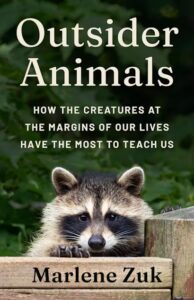
Outsider Animals by Marlene Zuk is available via Princeton University Press.

Marlene Zuk
Marlene Zuk is Regents Professor of Ecology, Evolution, and Behavior at the University of Minnesota and a member of the National Academy of Sciences. She has written for The New York Times, the Los Angeles Times, and New Scientist. Her books include Dancing Cockatoos and the Dead Man Test: How Behavior Evolves and Why It Matters and Paleofantasy: What Evolution Really Tells Us About Sex, Diet, and How We Live.