Lupe Mendez on Texas Politics and the Killing of Lorenzo Salgado Araujo
In Conversation with Whitney Terrell and Jennifer Maritza McCauley on Fiction/Non/Fiction
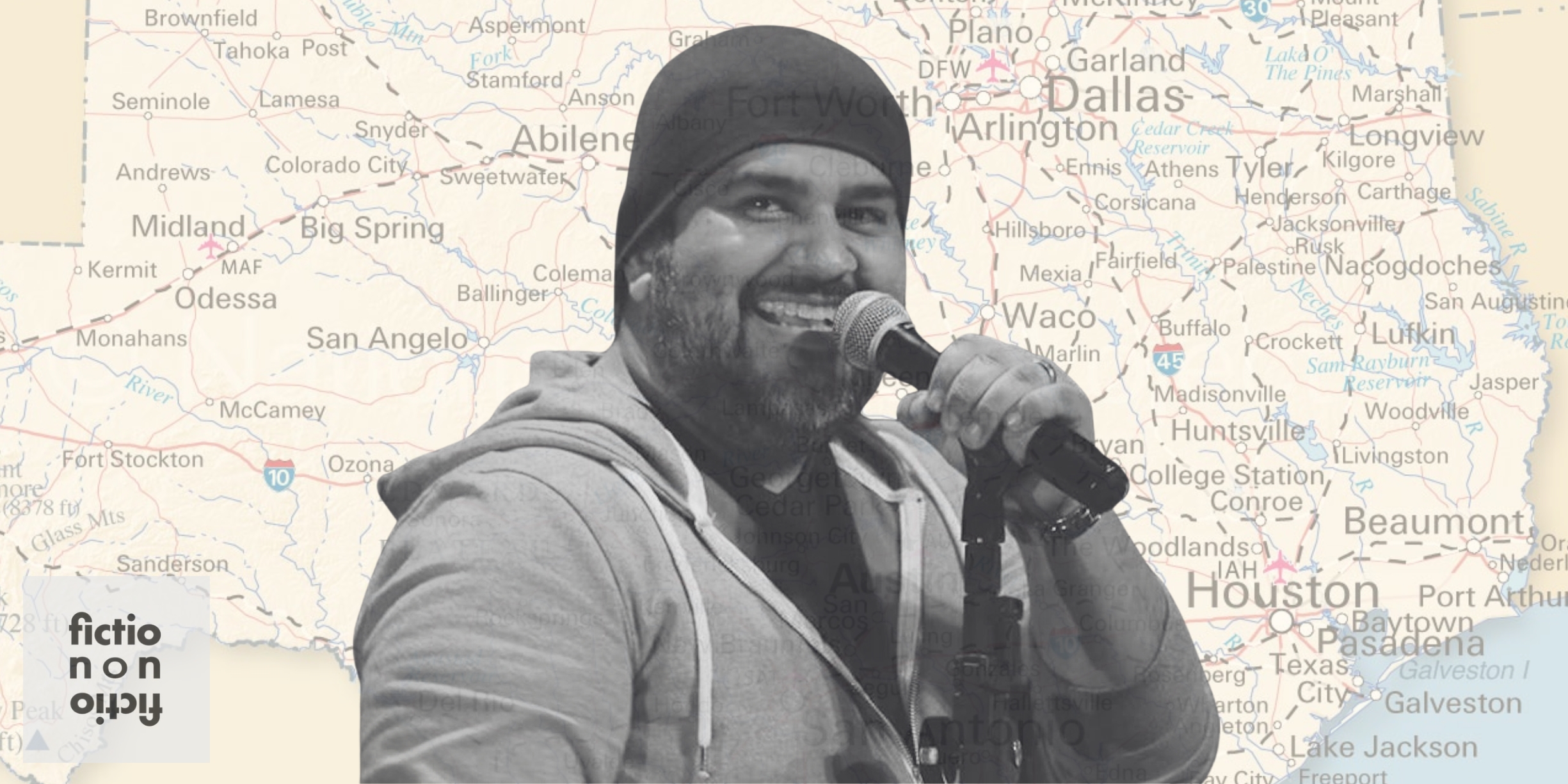
Houston-based poet Lupe Mendez joins co-hosts Whitney Terrell and Jennifer Maritza McCauley to discuss ICE raids, the killing of Lorenzo Salgado Araujo, and the political climate in Texas heading into the midterms. Mendez details the last few minutes of Araujo’s life and talks about the government’s altered story of Araujo’s death. Mendez also explains why he decided to write about the Mexican community’s boycott of racist integration practices in Houston during the 1970s and his compulsion to write poetry in Spanish and English. Inspired by Ebony Stewart, Mendez talks about how his “artivism” intersected with his role as Texas Poet Laureate. Mendez reads from We Exist in the Whisper: Huelga School Verses and Prayer Holding Night: New & Selected Works.
To hear the full episode, subscribe through iTunes, Google Play, Stitcher, Spotify, or your favorite podcast app (include the forward slashes when searching). You can also listen by streaming from the player below. Check out video versions of our interviews on the Fiction/Non/Fiction Instagram account, the Fiction/Non/Fiction YouTube Channel, and our show website: https://www.fnfpodcast.net/ This podcast is produced by Jennifer Maritza McCauley and Whitney Terrell.
Lupe Mendez
We Exist in the Whisper: Huelga School Verses • Prayer Holding Night: New & Selected Works • Why I Am Like Tequila
Others
Ebony Stewart • Jasminne Mendez • Librotraficante • Tintero Projects • Lorenzo Salgado Araujo Chased the American Dream for 35 Years
From the conversation with Lupe Mendez
Whitney Terrell: Before he ever ran into ICE, Lorenzo Salgado Araujo had what seemed to be a perfectly normal life. I want to talk about that first. Who was he? Where did he live? What was his family like?
Lupe Mendez: Salgado Araujo was an undocumented citizen here in the Houston area for 30-something years. He was 52 at his passing. I’m just shy of 50, so close to the same age block. He worked in construction, had his own company, provided opportunities for other laborers, and was working on job sites. He’d been doing so for quite some time. He was the sole provider for his house. He had a beautiful wife, three boys, one currently in college, the other two graduated. One’s an engineer, the other’s a high school teacher here in the Houston area. This is, has been, will always be the standard typical brilliance that is a Texas Latino household. We are connected to immigrant understandings and families. Each of us, in some capacity or another, are first-gen kids translating our worlds with our family in tow.
He wanted to live a quiet life, according to his sons. He didn’t want any hubbub. He just wanted to do his job, come home, get a good meal, watch his favorite soccer team, which is my favorite soccer team, Chivas Guadalajara, and deal with the bittersweet understanding that our team always loses at things. This is a man who had his everyday things. The sad part is being Brown while trying to go to work, and then you can’t.
Salgado was stopped by two unmarked ICE patrol cars. None of them with any kind of sirens or any kind of notification. For all intents and purposes, he probably understood that he was being sideswiped so they could take his things. He had a van full of equipment and tools. ICE first said that he took his van and slammed it into them, which was not the case. There’s no video proof of any of that. And then, after a little while, the public were told that Salgado Araujo and the other three gentlemen in the van weren’t even the targets of their enforcement. They were looking for two Guatemalan individuals. The three gentlemen in the van that he was driving were all Mexican on their way to work as day laborers. They were late to the job site that they were going to get started on that morning.
And then to have his sons find out information about what happened to their father through Facebook. That’s not the way that you find out the most important thing about a parent. That’s what they have to sit with. That’s what the public now begins to understand. Aside from the unimaginable duty of having to carry on his legacy, it affects everyone in the fact that we all have a family member that could be Lorenzo, either a brother, a father, or a son. Any one of those roles could be switched with somebody else. And the saddest part is that continues to still be the case? We don’t know when the next thing occurs.
Jennifer Maritza McCauley: Lupe, your description was so incredible that I got emotional over here. So, according to the Texas Tribune, ICE claimed in a statement issued after the shooting that their agent stopped Araujo’s vehicle as part of unspecified targeted law enforcement operation, and that Araujo tried to evade arrest, allegedly attempted to ram an ICE vehicle, refused to follow multiple verbal commands, and tried to run over the ICE agent before the federal officer fired his weapon in self-defense. So that was the original report from the government? How much of that turned out to be accurate?
LM: Zero, zilch, nada, absolutely nada. It’s come out through the three gentlemen that were in the van with him. They’re not testimony. They’ve talked to lawyers, but the government is quickly trying to move to expel them, so that we can’t get their stories. According to them, they were followed very quickly. It turned into a chase. Araujo was trying to evade two cars who they thought were trying to steal from them. He ended up slowing down to about five miles an hour because the space in which he was shot there’s actually street construction. They had peeled back all of the pavement on the street for like four blocks, and it was down to one lane. Araujo slowed down to about five miles an hour.
Here come both cars. They hit him. An ICE officer comes out, guns ablazing. As soon as he steps out of the car, starts shooting at the van, shoots into the passenger side of the car, misses the passenger, and the slugs hit Araujo in the belly. He still manages to pull the car over. They pull him out of the car. They handcuff him, and they let him bleed out on the street.
The FBI unsealed a record that now they were looking to see if he had drugs in the car. The workers and everyone else is saying they’re little bags of electrolytes, and the FBI says it looks like it’s meth, little crystals of things in their bags. They’re like, “No, that’s stuff to put in electrolytes for drinking, because hi, it’s hot in Texas and we’re construction workers.” And sure enough, it just came back yesterday, they tested it, and sure enough, it’s exactly what the gentleman had said. So even trying to tarnish these gentlemen’s stories, tarnish Arajo’s good name into the fear mongering that “Oh no, here is an undocumented individual who caused harm to the general public—”
WT: Plus, he wasn’t who they were looking for in the first place.
LM: Correct. So, all of this is now the tangled understanding of what they think they’re doing.
Transcribed by Otter.ai. Condensed and edited by Rebecca Kilroy.

Fiction Non Fiction
Hosted by Whitney Terrell and V.V. Ganeshananthan, Fiction/Non/Fiction interprets current events through the lens of literature, and features conversations with writers of all stripes, from novelists and poets to journalists and essayists.