Love Stories, Feminism, and Why Cemeteries Are Sexy
Jessica Ferri on Ann Rower’s Lee and Elaine
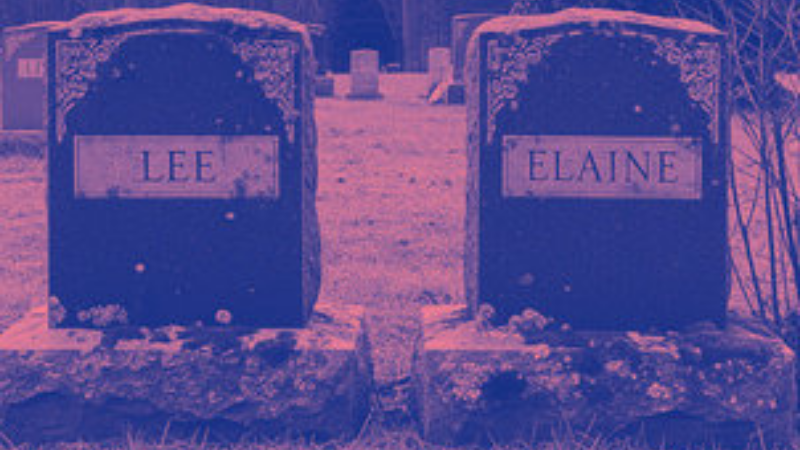
The first time I visited Green River Cemetery in East Hampton, New York, I had already read Ann Rower’s wonderful book Lee and Elaine. I was prepared to see the resting places of Elaine de Kooning, Frank O’Hara, Jean Stafford, Hannah Wilke, and more of the artists and writers our nameless narrator discusses in the book. I knew that Lee Krasner’s stone was going to be a smaller version of her husband’s, Jackson Pollock.
But even knowing all this, when I rolled up to Green River Cemetery, sometimes called Springs Cemetery or the Artists’ Cemetery, I was in a state of jacked-up ecstasy. I wanted to throw off any sense of decorum and roll around on the grass. Most of the photographs I took that day were terrible, due to my frenzied, shaking hands. “Cemeteries, like I said before,” Rower’s narrator explains, “always got me hot.”
When I spoke to Ann Rower on the phone in order to write this introduction, she in New York and I in Berkeley, I asked her why cemeteries always got us so hot. In the book, the narrator proposes that it has something to do with stability. “The cemetery didn’t change. I liked that. I loved that.” The real-life Ann told me it was probably something to do with “art being such a turn-on.”
“Lee and Elaine probably weren’t friends when they were alive,” Ann told me. “Who knows if they even liked each other? But I thought, ‘Wouldn’t it be great if they came back as lesbians?’”
“Oh,” I replied, “me too. I mean, me too!”
“Yeah,” Ann said, “writing, reading, painting—I mean, it’s weird.”
“It’s not weird at all,” I basically yelled through the phone, “I’m the same way.”
“No,” Ann said, “of course it’s not weird. It’s totally normal.”
For the record, I would usually never refer to an author by their first name in a published piece of writing. But because of my and Ann’s instant soul connection, I have to call her Ann. I can’t call her Rower. Who’s that? She is Ann.
Lee Krasner and Elaine de Kooning were two painters who happened to be married to two other painters who arguably became the most famous artists of abstract expressionism: Jackson Pollock and Willem de Kooning. Thanks to reclamations like Mary Gabriel’s book Ninth Street Women and retrospectives of their work, Lee and Elaine are better known today as artists than artists’ wives. Lee and Elaine imagines the two not only coming back from the dead but coming back as friends and lovers. “Lee and Elaine probably weren’t friends when they were alive,” Ann told me. “Who knows if they even liked each other? But I thought, ‘Wouldn’t it be great if they came back as lesbians?’”
Ann published one book before Lee and Elaine, a novel called Armed Response. Publishers Weekly called the book “competent but unremarkable.” They didn’t have complimentary things to say about Lee and Elaine, either. The reviewer at The New York Times wrote that Lee and Elaine was a “clichéd portrait of a name-dropping writer-artist … [that] suffocates on its own unrelenting self-referentiality.” This is not only a ridiculous gripe but also inaccurate. Researching Lee and Elaine’s potential friendship, Ann interviewed dozens of people who knew them. She reported these conversations in the book, but changed all the names. “When I started coming out to Springs, I started interviewing people,” Ann said. “The thing that kills me is that I never wrote their real names down! So I don’t know who they really are!”
When my first book on the cemeteries of New York sold, an editor of mine said, “Have you read Lee and Elaine?!” I had no idea what he was talking about. Finding the book out of print, I ordered a secondhand copy online. It arrived, an ex-library copy, with a bright-yellow “R” sticker on the spine. Indie imprint High Risk had published it in 2002, choosing the cover and adding a subtitle, “Pollock—the Wife’s Tale.” The need to put Pollock’s name on the cover is reflective of the time in which the book was written, when no one knew Lee Krasner’s name. Ann told me, “I have no idea how that cover was chosen and I knew nothing about that subtitle.”
My copy of Lee and Elaine bears two blurbs (praise for the book from other writers) on the back cover, and I read both to Ann over the phone. There’s a very nice one by the poet and writer Eileen Myles, who celebrates Rower’s ability to capture women behaving badly in “midlife.”
“We’ll have to change that now to ‘old age,’” Ann said, “since I’m eighty-seven. How did I get to be this old?!” The other blurb is from the late great Gary Indiana, who writes, “I know no other voice as full of surprises and unexpected, startling insights, championship chess moves disguised as digressions, as Ann Rower’s.”
When I asked Ann about the process of writing Lee and Elaine, she said, “It just poured out of me. It wrote itself. I don’t know how. As a writer I felt like it didn’t really belong to me. You know how Jimi Hendrix said, ‘I was dreaming when I wrote this’? It was like that.” At the time, Ann was in transition. She had just left a long-term relationship with a man, and was beginning to realize she was gay.
“I had always been a dyke, of course, since I was fourteen or whatever,” she told me, “but I think it was the timing of being in Springs and being so happy there that led to this book being written.” As the unnamed narrator of Lee and Elaine tells us of her stay down the street from the cemetery, “This was my first real time coming out. I mean to the house.”
“Is it feminist? Am I a feminist?” Ann asked, to no one in particular, during our phone call. “I’m not sure.”
I had used the word “novel” to describe Lee and Elaine. “I’m not sure if it really is a novel or not,” she said. We talked about genre and autofiction and form. “Do you think of it just as a book?” I asked.
“I don’t mind the term ‘autofiction,’” Ann said, “but I don’t write fiction. It’s just not what I do. I don’t know how to make things up. I just write about what happens. It’s the truth but it’s not the truth. It’s that in-between place. It’s very comfortable for me—I mean, it’s my sexuality. Now everyone writes this way and it’s not a big deal.”
When I wrote about Green River, I read Lee and Elaine as a feminist statement on the way women’s art is treated and remem bered. As the narrator looks at the graves in the cemetery, she wonders, “Is voyeurism a form of imperialism?” Lee’s stone is actually the footstone to Jackson Pollock’s boulder-sized marker. At one point in the book, Elaine de Kooning’s headstone actually disappears from the cemetery. It turns out her dates were incorrect and the sculpture on the stone had been attached upside down. When interviewing people that knew Lee and Elaine, our unnamed narrator comes across men complaining about Elaine always being drunk or Lee being unfriendly. “I wanted to kill him,” she thinks. “Is it feminist? Am I a feminist?” Ann asked, to no one in particular, during our phone call. “I’m not sure.”
My tattered copy of the book has Ann’s acknowledgements at the front. In them she thanks “Heather Lewis, who did every thing, from line editing to removing herself from the plot for the sake of the ending. She always knew how to read me well. Whitney will always apply.” Heather Lewis was a brilliant writer, the author of House Rules, Notice, and The Second Suspect, and Ann’s partner. Heather died, aged forty, in 2002, the same year Lee and Elaine was published.
I understood Ann’s acknowledgment to Heather—“Whitney” is of course Whitney Houston’s “I Will Always Love You”—but I asked what she meant about Heather removing her self from the book for the sake of the ending. The ending of the book is one of the most shimmering, beautiful endings of any book, novel or not. Ann answered simply that she and Heather had fallen in love and therefore Heather had to remove herself from the plot of the book; otherwise the book would’ve ended with a “Reader, I married her” vibe and that wouldn’t have been right at all. I had forgotten the way the book ends and I won’t spoil it now, but when I read the ending over the phone to Ann, who hadn’t read it herself in some time, she said, “Oh, I’m going to cry.”
Though Jackson Pollock is the most famous artist buried in Green River Cemetery, one of the most visited graves there belongs to the poet Frank O’Hara, who was killed on the beach in Fire Island, aged forty, in 1966. Visitors like to pay their respects by leaving pencils and bottles of Coca-Cola, referencing his poem “Having a Coke with You.” There are photographs of O’Hara’s funeral at Green River and the event was immortalized by his friend James Schuyler in his poem “Buried at Springs.” O’Hara’s epitaph is a line from his own poem “In Memory of My Feelings.” It reads: “Grace to be born and to live as variously as possible.” Living “as variously as possible,” it seems to me, is what Ann is doing in her writing.
Even though now everyone writes like this and it’s not a big deal, Lee and Elaine is still a wild ride. I had placed it in my mind as a feminist book, but in talking to Ann I realized it’s more of a love story. (Not since Mary Shelley did it with Percy on her mother’s grave has there been such an erotic depiction of cemetery schtupping—but I’ll leave that for you to read.) Lee and Elaine may have been inspired by Ann’s falling in love with Heather Lewis, but ultimately it’s truly about the hottest love story there is—the one where we fall in love with ourselves.
__________________________________
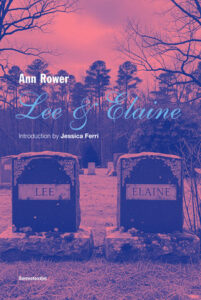
From Lee and Elaine. Used with the permission of the publisher, Semiotext(e). Copyright © 2026 by Jessica Ferri.

Jessica Ferri
Jessica Ferri's writing has appeared in The New Yorker's Book Bench, The Economist, The Daily Beast, NPR, Bookforum.com, Bookslut, The Barnes and Noble Review, The Millions, and The Awl.