Love and Struggle Throughout the Ages: A Reading List of Queer Historical Fiction
Eleanor Shearer Recommends Sarah Waters, Nalo Hopkinson, Robert Jones Jr. and More
The challenge of queer historical fiction is ignoring the charge of anachronism. While sometimes leveled in bad faith by those who pretend queerness is an invention of the last century, even the best-intentioned readers come to stories about the past with particular conceptions of how difficult and dangerous it was to be queer throughout history. There are also deep and probably insoluble debates to be had about whether labels we use today to describe sexuality and gender can be projected backwards, or if our ancestors worked with completely different conceptions of identity and desire.
When writing my second novel, Fireflies in Winter, I felt strongly that, without sugar-coating the past, I wanted to write about the possibility of queer joy and intimacy even in hard times. The novel follows two women, one Jamaican and one African American, who meet and fall in love in the wilderness of Nova Scotia in the 1790s, where the harsh frozen landscape offers a backdrop for their story of survival. The beauty of romance—especially queer romance—is how two characters discover their similarities and contrasts, and this novel was a chance for me to think through how two Black women shaped by radically different relationships to slavery, sexuality, freedom and the idea of home, would relate to each other.
For this book, I drew inspiration not just from research into love between women across the centuries and specifically how African pre-colonial and colonial cultures viewed gender and sexuality, but also from fiction like the books on this list. Our queer ancestors often left little archival trace, and so imagining their lives through fiction can be an essential part of exploring these often-overlooked histories. Some of these books are happier and some sadder than others, but all strike a balance between showing the fragile and hopeful possibilities of love alongside the tragic barriers queer people in the past faced to achieving it.
*
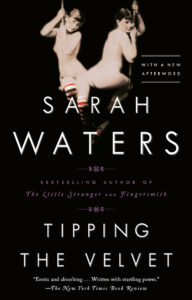
Tipping the Velvet, Sarah Waters
No list of queer historical fiction is complete without Sarah Waters, whose rich and twisty novels of love between women are the perfect balance of touchingly poignant and enormous fun. There’s so much to choose from, but I think my favorite of hers is Tipping the Velvet, a coming-of-age story set in Victorian London. It plays wonderfully with gender (one character is a male impersonator in music halls, another spends time doing sex work dressed as a boy), and it shows its queer characters as very much integrated into, rather than apart from or on the margins of, their time and place.
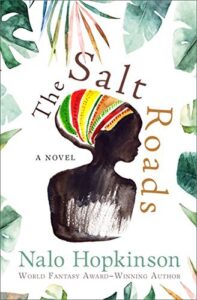
The Salt Roads, Nalo Hopkinson
Blending fantasy and historical fiction, this novel follows three women, connected by their relationship with Lasirén, a water goddess in West African folklore. Moving between 4th Century Alexandria and Jerusalem, 17th Century Haiti and 19th Century France, it explores love, loyalty and freedom across these times and places in a many-layered portrait of Black diasporic identity and fluid sexuality. It also brilliantly interweaves real historical figures and details with more speculative, magical elements.

The Prophets, Robert Jones Jr.
Much of the beauty of queer historical fiction can come from imagining the love still found even in times of oppression. Robert Jones Jr.’s story of two enslaved men who fall in love on a plantation in Mississippi evokes a time and place especially brutal for his protagonists, yet still explores the beautiful possibility of intimacy in these conditions. This isn’t always an easy or a happy book, unflinching as it is about the reality of slavery and its violence, but the richness of the world it creates, giving voice to so many on the plantation around the two lovers, is beautiful and affecting.
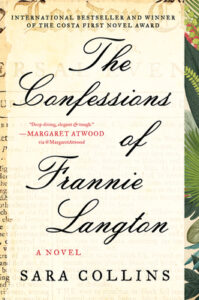
The Confessions of Frannie Langton, Sara Collins
Set in Georgian London where a formerly enslaved woman is accused of murder, this tense and atmospheric novel plays with the conventions of gothic fiction in its explorations of race, class, sexuality and freedom. The protagonist, Frannie’s, story begins in a plantation in Jamaica, the brutality of which is chillingly evoked, but by moving much of the novel’s action to London, Sara Collins helps show just how tightly interwoven Black Caribbean history is with the history of the UK.
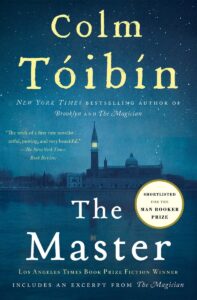
The Master, Colm Tóibín
Both of Colm Tóibín’s fantastic retellings of the lives of two literary greats, Henry James and Thomas Mann, are well worth reading, but The Master in particular, about James, set during the final years of the 19th Century, is an incredible exploration of art, loneliness and sexuality. James’ relationship to his own queerness forms part of the narrative—and the novel mentions the trial of Oscar Wilde from 1895, Wilde’s public conviction a contrast to James’ discretion—but this is interwoven with broader themes of connection, isolation and what it means to be a writer.
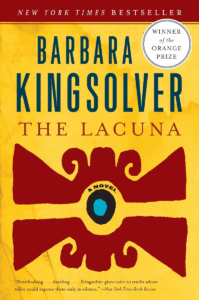
The Lacuna, Barbara Kingsolver
This epic novel moves between the United States and Mexico in the 20th Century. Vivid portraits of real historical figures abound, from Frida Kahlo to Leon Trotsky, but it’s the fictional protagonist Harrison Shepherd, who is the heart of the book, and we follow the journey of his life from childhood through working for Trotsky to being an acclaimed historical novelist. The structure of the novel, written as if Shepherd’s secretary and friend is piecing together the biography of his life from available sources left to her and having to work with the gaps—or lacunae—in the narrative works especially well thematically as an exploration of queerness throughout history.
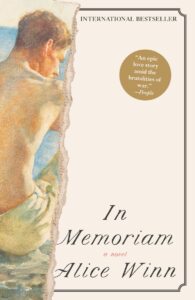
In Memoriam, Alice Winn
A beautiful love story between two British public schoolboys who fight together in the First World War, this is another example of an especially harsh backdrop—with the reality of frontline trench warfare evoked in full, horrifying detail—throwing into relief the moments of intimacy that can still flourish even under these conditions. This book is completely transporting in the mode of all the best historical fiction, and the romance at its heart between two vividly drawn characters is utterly lovely.
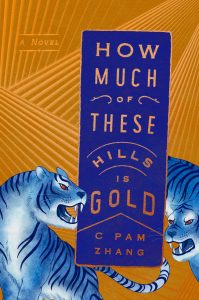
How Much of These Hills is Gold, C Pam Zhang
Historical novelists are working with people’s conceptions of the past as much as the past itself (the “Tiffany Problem,” for example, refers to the fact that in medieval England and France, Tiffany was a common girls’ name, but modern readers would find their credulity thoroughly stretched to encounter a character with this name in historical fiction of the period). C Pam Zhang’s novel is a great play on, and subversion of, many of those conceptions around the American “wild west.” Following two orphaned siblings of Chinese immigrant parents, the book immerses you in the harsh landscape of the west and in all the thorny realities of race, colonization and gender.
__________________________________
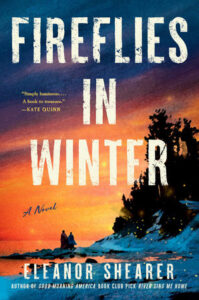
Fireflies in Winter by Eleanor Shearer is available from Berkley, an imprint of Penguin Publishing Group, a division of Penguin Random House, LLC.

Eleanor Shearer
Eleanor Shearer is a mixed-race writer and the granddaughter of Windrush generation immigrants. She splits her time between London and Ramsgate on the English coast so that she never has to go too long without seeing the sea. For her Master’s degree in Politics at the University of Oxford, Eleanor studied the legacy of slavery and the case for reparations, and her fieldwork in St. Lucia and Barbados helped inspire her first novel.