Looking Ahead to the Most Anticipated Poetry of 2026
Rebecca Morgan Frank Showcases Some of This Year’s Compelling Titles
My former teacher and mentor Gail Mazur, whose newest collection, World on a String, was recently released from Arrowsmith Press, once told me that as poets we maintain maps in our head within which we place the poets who we read, know, and love; I have found this to be true for myself. What comfort, when this country feels so alien, to see the map of our collective makings! This preview of 2026 in poetry includes poets based in California (Northern and Southern), Colorado, Florida, Georgia, Illinois, Maine, Mississippi, Montana, New Jersey, New York, North Carolina, Ohio, Oklahoma, Oregon, Vermont, Virginia, and, well, the afterlife. (Hello, Larry Levis.)
The majority of this list’s poets are with small presses, for all poetry presses, whether independent or housed at universities, are small presses; this is clearer than ever as they feel the impact of withdrawn or refused NEA funding. Geographical and institutional indexing aside, in this gathering, you will find both formal elegance and formal play. You will also find many poets whose ways of making through the music of the mind, move or interest me. May you find pleasures here, too. Cheers to the poets of 2026, and cheers to you, dear readers.
*
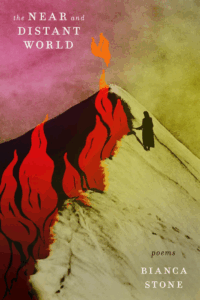
Bianca Stone, The Near and Distant World (Tin House)
January 2026
Maybe you know Bianca Stone’s poetry comics, or maybe you know her illustrations (from Anne Carson’s Antigonik to a wonderful picture book adaptation of Gertrude Stein’s “A Little Called Pauline”), or maybe you have stumbled across one of her first three poetry collections. If not, find your way to her. Surprisingly, it isn’t the image that primarily drives this artist-poet’s work, but a sharp and questioning mind, and the brilliance maturing in her last collection, What is Otherwise Infinite, blossoms in her fourth, The Near and Distant World.
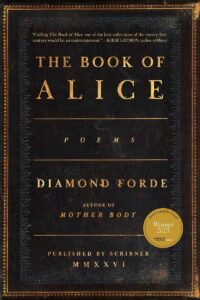
Diamond Forde, The Book of Alice (Scribner)
January 2026
You will notice this book on the shelf: striking, commanding, designed like a black embossed bible. Open it. In The Book of Alice, the most recent winner of the Academy of American Poets’ James Laughlin Award, Forde reimagines her grandmother’s life through narratives and the propulsive poetics of the King James Bible, as well as found forms, including recipes for Southern Fried Catfish (subtitled “How to Disguise a Carolinian in New York”) and Clabber Milk Cornbread (subtitled “How to Keep The Daughter Humble”). I collect “Lot’s Wife” poems, and Forde’s take is one of my favorites; the poem begins, “The truth is, I’d do it again….”
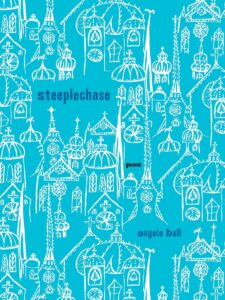
Angela Ball, Steeplechase (Pitt Poetry Series, University of Pittsburgh Press)
February 2026
To call Angela Ball’s tool wit would be to somehow sell her short; her deep-feeling play calls for critical contradictions–sly and authentic? She is perched on the livewire between the raw and the cooked, ready to delve into love, selfhood, and loneliness with timing and turns that keep you on board. There’s no one else like her, and Steeplechase shows she is at her prime with poems ranging from “Gym Suit” to “Man-Chaser” to “Confession,” in which the speaker’s eight-year-old self spreads a fire: ‘The Fire Department arrived /with big disapproval but I was gone / I am still gone.”
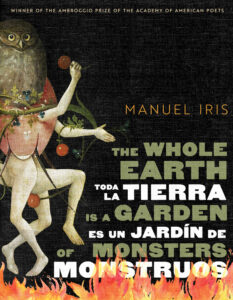
Manuel Iris, The Whole Earth Is a Garden of Monsters / Toda la tierra es un jardín de monstruos (University of Arizona Press)
February 2026
The Whole Earth Is a Garden of Monsters / Toda la tierra es un jardín de monstruos is the eighth winner of the Ambroggio Prize, an Academy of American Poets award offered in partnership with University of Arizona Press, for a book written in Spanish and translated into English. Iris’ collections in Spanish have garnered awards in Mexico, while his more recent turn to bilingual collections has resulted in honors from the Latino Book Awards and the Ohioana Book Awards. This third bilingual collection is co-translated with Kevin McHugh and offers an intriguing premise based on an unexpected pairing: Iris threads together the lives of Hieronymus Bosch and Juan Coyoc, a fictional migrant worker.
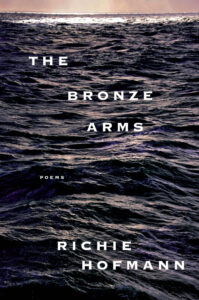
Richie Hofmann, The Bronze Arms (Knopf)
February 2026
Everyone is in love with Hofmann’s “French Novel,” a queer college-set coming-of-age poem from his sophomore collection, A Hundred Lovers, and if they aren’t yet, they surely should be, for the poem embodies the perfection of Hofmann’s lyric engagement. His third collection looks backwards to childhood and a near drowning– “On the island where boys drown, / I remember his arms pulling me from the water, / An archeologist in a bathing suit”–and promises more of Hofmann’s light and lasting touch, his ability to forge myths through conversational intimacy: “Love is a memory now, you said / Most of the bronzes have been melted down / and made into other bronzes, / coins, weapons—.”
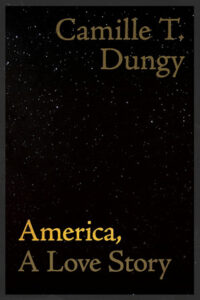
Camille T. Dungy, America, A Love Story (Wesleyan)
March 2026
“America, you are good at taking care of what you value.” Dungy’s fifth poetry collection, which follows her more recent nonfiction work, Soil: The Story of a Black Mother’s Garden, takes on intersections of nation and self, of mothering as a Black woman in America. “The average mother loses 700 hours of sleep in the first year of her child’s life; or, what that first year taught me about America” begins one of a series of 700-character poems. Dungy so deftly demonstrates how motherhood is not separate as subject, act, or role from the rest of our world, that one could argue this will be the mother of all books featuring motherhood.
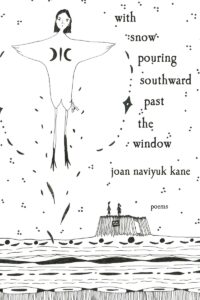
Joan Naviyuk Kane, with snow pouring southward past the window (Pitt Poetry Series)
March 2026
I have been reading and teaching Inupiaq poet Joan Naviyuk Kane’s books for years, so I was glad to see this in the 2026 lineup. This collection offers her range, from the gripping “After Anchorage poems”—“as a man who has grown sick of his wife will scrape and grind / as if he no longer hells infants / world-ward in their blood-rush”—to a bilingual ghazal that harnesses the form’s final move with impact—“You know Naviyuk (not) Joan Kane): / may such kinship remain in our line,” to the directness of poems such as “In Which The Poet Agrees That Being Alive is a Whole Bunch of Being Wrong.”
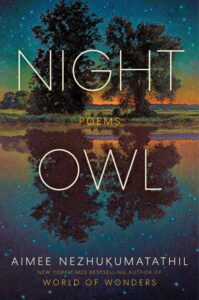
Aimee Nezhukumatathil, Night Owl (Ecco)
March 2026
Aimee Nezhukumatathil’s newest collection delivers joy and wonder, just as you would expect, although this time they are found in the night. These are poems filled with fireflies and titles like “How to Build a Moon Garden When the News is All Horror,” as well as poems in which the natural models for raising boys are made wonderous: “a male Darwin’s frog keeps a nursery in his own mouth” and “The male seahorse carries the dark swell himself in his brood pouch until he throws a parade ending with a confetti of gallops.” You, too, Nezhukumatathil guides us, can learn to love the dark: “How do we stay / curious as we swim in this life, kicky paddle feet hurrying / towards a new thing? Silly goose, just say it: Mahal kita!” Mahal kita, she translates, “means/ I love you.”
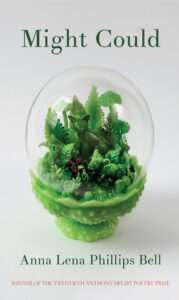
Anna Lena Phillips Bell, Might Could (Waywiser Books)
March 2026
Waywiser Books, which moved stateside in 2025 after twenty-five years in the UK, delivers Might Could, the latest winner of their notable contest for 1st or 2nd books that are “innovative and aware of formal inheritances,” selected by judges that have ranged from Alice Fulton, Charles Simic, and Richard Wilbur to Shane McCrae, who selected Bell’s Might Could. If you are from the South, you’ll immediately get the title, which encompasses the formalist-leaning Bell’s linguistic play with the sounds and natural images of the South. Bell’s gems of poems are always as carefully and delicately crafted as her artist’s books.
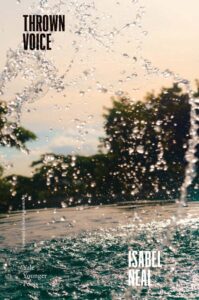
Isabel Neal, Thrown Voice (Yale Series of Younger Poets)
March 2026
The Yale Series of Younger Poets may have dropped its “younger” restrictions, but it is still going strong: Rae Armantrout has selected Maine poet Isabel Neal as the 120th winner of the award that has brought us poets such as John Ashbery, Jean Valentine, W.S. Merwin, Robert Hass, Muriel Rukeyser, James Wright, and a slew of memorable contemporary voices, including Eduardo Corral and Mary-Alice Daniel. There’s something unexpected in Neal’s syntax, in her way of seeing. Thrown Voice looks to demonstrate this series is still alive with innovative new voices.
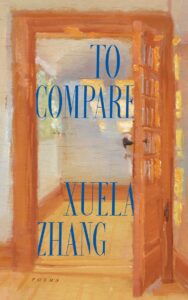
Xuela Zhang, To Compare (Fonograf)
April 2026
I had previously enjoyed Xuela Zhang’s “To Compare III” in Poetry magazine, and I have been curious to see what this poet and translator, who was born and raised in China and earned degrees in both poetry writing and comparative literature in the U.S., would do in the space of a full-length collection. Zhang sets the stage with two poems titled “Quarantine,” and titular repetition becomes a refrain—such as with “To compare”—as she circles the spaces and transmutations between languages and countries amidst globalization: “This part of life in another country / becomes the animal one might slip into.” I can’t wait to spend more time with this cerebral and refreshing debut.
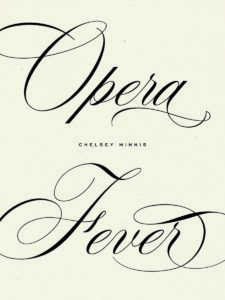
Chelsea Minnis, Opera Fever (Wave Books)
April 2026
“Is this a poem or the back of a shovel? / It’s a frying pan full of diamonds.” I remember when Minnis’ 2001 debut, Zirconia, dropped, complete with her use of the extended ellipsis. I dug how that collection built a bridge to an aesthetic that was foreign to me as an earnest new MFA student who loved a very different kind of poem. Her latest looks to deliver delightfully frothy imagery—“candy green moonlight,” “drugged gumdrops,” “pink dumpsters,” and plenty of fur in darkish, “darling”-laced two-stanza ten-line poems that deliver a performance full of intrigue. Did I mention that the lines I started this with come from a poem that begins “I feel like a floating agony…/ An agony like organza…”?
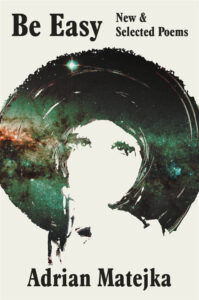
Adrian Matejka, Be Easy: New and Selected Poems (Liveright/Norton)
May, 2026
Poetry magazine editor Adrian Matejka delivers what is likely 2026’s most anticipated New & Selected: Be Easy, a hardcover with an album-worthy cover, no less. Alongside of selections from his six collections—including my personal favorite, The Big Smoke, based on prizefighter Jack Johnson—you’ll find twenty-one new poems, including the title poem, in which the speaker confesses, “Easy is all I’ve wanted since / I was a kid, cramped in summertime / Section 8: flowers everywhere, / my bird-legged brother a couple / steps back, my sister book-nosed / somewhere in the radius of us.”
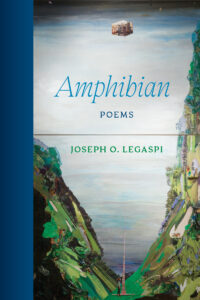
Joseph O. Legaspi, Amphibian (Northwestern University Press)
April 2026
Northwestern University Press continues to build its stable of poets, and one of their latest smart acquisitions is Filipino-American poet Joseph O. Legaspi, who you may also know as cofounder of Kundiman. Look out for his third collection, Amphibian, which offers up poems like “In the Tropics,” a reversal of displacement through immigration. Here the speaker and his husband return to “my ancestral / home, a country a point of reentry for us both.” His tall American husband’s physicality becomes a figure of displacement, described as “[a]n uprooted sequoia” “scampering around the public / market, his forehead bumping into pigs’ heads / like ritualistic greeting.”
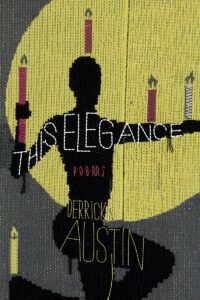
Derrick Austin, This Elegance (BOA Editions)
May, 2026
There is an elegance to Derrick Austin’s work itself, evident from his memorable debut collection Trouble the Water (2016) on, and I am delighted every time I stumble across one of his poems in a magazine. In Austin’s third collection, readers can expect his trademark gorgeously crystalline lyrics interspersed with more conversational wanderings, capturing new stages of life. “After a Year Sober,” reminds me of how Austin’s ekphrastic leanings stand out through his descriptive particularities, even as at the end he reaches outward into a memorable dual final figure: “like house music pulsing in the gay bar // where I learned to love my ungraceful limbs / or like the tinny bells used in monasteries / for prayer to call the body back to the body.”
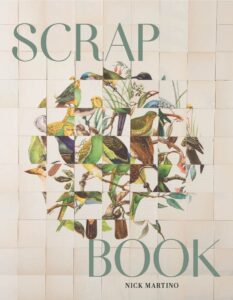
Nick Martino, Scrap Book (Alice James Books)
June 2026
In promotions for Martino’s debut, you’ll learn of the tactile elements: responses to scans of his mother’s handwriting—her journal entries during his father’s incarceration—and erasures of his own ekphrastic responses to polaroids of his parents. But the heart of this collection is Martino’s devastating and assured lyric. The love poem, in many troubled and expansive permutations—mothers, fathers, lovers—builds a narrative of how family history shapes understandings of love: “Once, my mother stopped the car / on the shoulder of the highway/ and walked out into a field of corn. // When she finally disappeared, / my mother was the cornfield.”
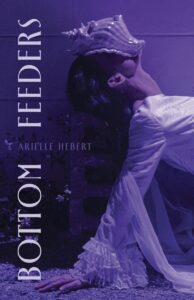
Arielle Hebert, Bottom Feeders (Black Lawrence Press)
June 2026
Black Lawrence is proving to be a publisher to watch for interesting debut poets, such as with Arthur Kayzakian, whose book The Book of Redacted Paintings I covered here in June 2023 before it was named a finalist for the 2024 Kate Tufts Discovery Award. I will admit that I am the target audience for collections focused on queer Southern girlhood, so Bottom Feeders, which tackles coming of age in Sarasota, Florida, caught my attention, but many of the sample poems on Hebert’s website kept it: this is a book I look forward to having in hand.
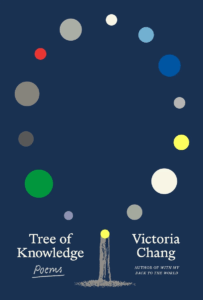
Victoria Chang, Tree of Knowledge (Farrar, Strauss and Giroux)
July 2026
Barbie Chang (2017), Obit (2020), The Trees Witness Everything (2022), With My Back to the World (2024), and now Tree of Knowledge: the last decade of Chang’s career have proven her to be the rare poet who can regularly deliver significant collections, each distinct in their formal expressions and focus, and all driven by Chang’s imaginative control of the image itself. Thus it is not surprising that in this collection that revolves around both a tree chopped outside of her window and the 1885 expulsion of Chinese Americans from Eureka, CA, there’s an index of more than fifty “Art Works Referenced,” with headliners including Picasso, Joan Mitchell, and Hilma af Klimt (the source of the collection’s title), and outliers like Renee Gladman and Ai Wei Wei. Unexpectedly, you’ll also find Chang’s artwork, forged from historical photographs.

Larry Levis, Swirl and Vortex: Collected Poems (Graywolf) and
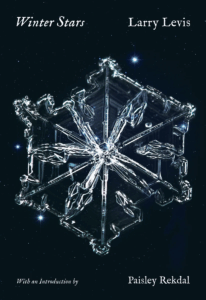
Larry Levis, Winter Stars (Pitt Poetry Series, University of Pittsburgh Press)
Is it strange to anticipate the dead? If Levis has become, perhaps, a poet’s poet, hidden in the shelves of the used bookstores where someone new might discover him, two 2026 releases may expand his audiences once again. From Pitt Poetry Series comes a reissue of his fifth solo collection, 1985’s Winter Stars, complete with an introduction from Paisley Rekdal. Graywolf Press delivers the substantial Swirl and Vortex: Collected Poems, which includes all five of Levis’ collections, and an afterward from David St. John, who has crafted all of Levis’ posthumous work—Levis died at the young age of forty-nine—into an “imagined collection,” Hotel on Fire. I’ll argue that both of these books are necessary for every poetry library. The Collected as reference, tour, and, as bonus, touching document of the depths of poetic friendships. Winter Stars as a manageable joy to be held in hand, in pocket, and to be leant out in the way that we give friends, family, students the world.
*
Jennifer Franklin, A Fire in Her Brain (Princeton University Press)
October 2026
Whether or not you already know that James Joyce had a daughter, or that she was an innovative and brilliant young modern dancer who was later hospitalized for decades, this forthcoming book from the Princeton Series of Contemporary Poets has a compelling subject, with Lucia Joyce joined by Virginia Woolf and Sylvia Plath as the focus of epistolary poems that involve Franklin’s own role as mother and caretaker as well. The collection takes its title from a quote attributed to her father: “Whatever spark or gift I possess has been transmitted to Lucia, and it has kindled a fire in her brain.” I look forward to this one.
*
Thanks to Lit Hub, we can continue to bring you news of the latest poetry books every month in a year that promises books such as Kiki Petrosino’s Perfect Italian (Sarabande Books), Cole Swenson’s Veer (Alice James Books), Jake Skeets’ Horses (Milkweed Editions), Sean Hill’s The Negroes Send Their Love (Milkweed Editions), Kathy Fagan’s The Unbecoming (Norton), Carolina Ebeid’s Hide (Graywolf), Laura Kasischke’s I Was Bonnie and Clyde (Copper Canyon), Joshua Bennett’s We (The People of the United States (Penguin), and many more. If you want to support this space for literary news and poetry coverage, and read ad-free, please consider joining Lit Hub as a member. Who doesn’t want a Joan Didion tote bag? Happy 2026!

Rebecca Morgan Frank
Rebecca Morgan Frank's fourth collection of poems is Oh You Robot Saints! (Carnegie Mellon UP). Her poetry and prose have appeared in such places as The New Yorker, Ploughshares, American Poetry Review, and the Los Angeles Review of Books. She is an assistant professor at Lewis University and serves on the Board of Directors of the National Book Critics Circle. She lives in Chicago.