Living the Ex-Pat Life in Moscow at the End of the Soviet Empire
Simon Morrison Explores the Aftermath of the Collapse of Communism in Russia
Russia (Rossiya) has never been called Russia, not officially. It’s been the Tsardom of Russia, Imperial Russia, Soviet Russia, and the Russian Federation but never just Russia. That place doesn’t exist, except in the imagination, in a dreamscape of crime and punishment, war and peace, Uncle Vanya and Doctor Zhivago.
Moscow stands at the center of a nation comprising eleven percent of the globe’s landmass, 11 time zones and about 145 million people—some 13 million of whom live in the capital. Church and state converge in the city, home to the Eastern Orthodox Church and the presidential administration, known colloquially as the Kremlin. Few places in the world possess the power to end the world, Moscow being one. That power was built up over centuries partly to compensate for the humiliation, subjugation, and grievous bondage of Russia’s history, real and imagined.
To thwart invasion, Moscow invaded, again and again, defining itself by what it took from others—especially from Ukraine, the Slavic fountainhead. Moscow might present itself as the home of a great civilization, but its authority has been seized from elsewhere (notably Kyiv) and remains jealously guarded. For over a century, citizens have been surveilled while the media is harassed and hectored into compromise, so that the official rhetoric of Slavic suprematism can go unchallenged. And if Russia can’t have Ukraine, Ukraine can’t exist.
I was a foreigner, and I realized that foreigners were part of the problem: they treated Moscow, and Muscovites, with exploitative contemptuousness.
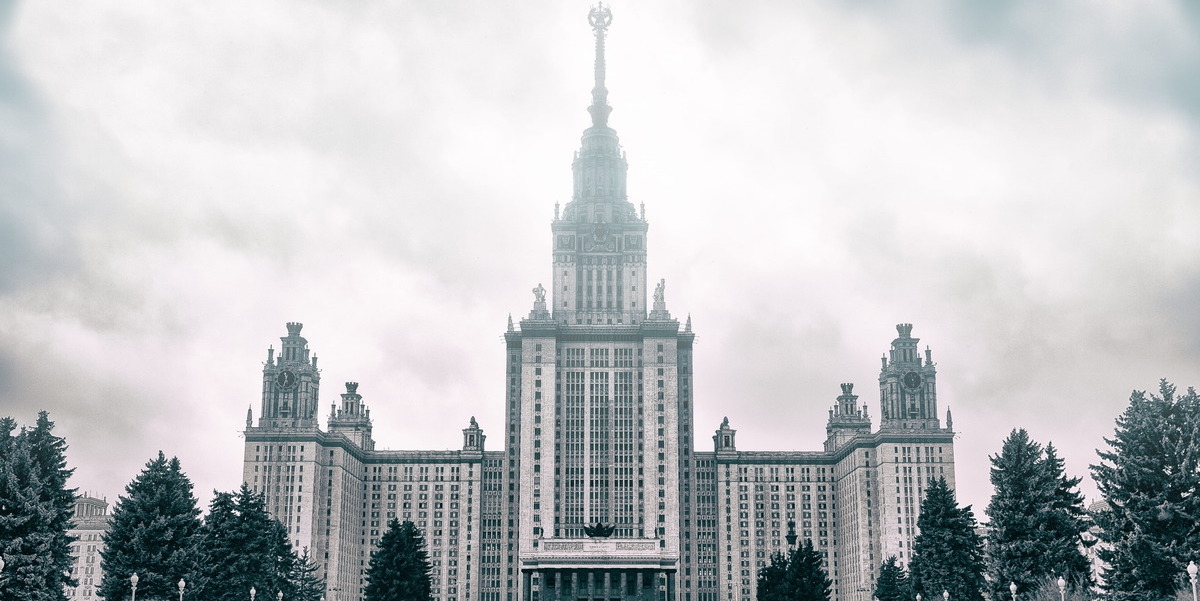
Nations and their power are always illusions, until they aren’t, and Moscow is an elusive place. Its greatest trick is the “riddle, wrapped in a mystery, inside an enigma” nonsense; the city projects an inscrutable aura but knows itself all too well. On shrill winter nights, Moscow’s power is conspicuous, its Orthodox cathedrals and Stalinist high-rises illuminated, though the view falls dim in the autumn and spring, shrouded in sheets of greige. Isolated between continents, it seems the loneliest of the world’s metropolises, unbounded like its aspirations. Had circumstances been different, Moscow might not have been the capital. Or it might not have existed at all.
In trying to understand the city I have studied for over two decades now, I have sifted through its memories along with a few of my own. I’ve researched the birchbark scratchings that record the oldest layer of Slavic civilization, the history of Russia before Russia in Kyivan Rus, the rise and fall of the Mongol empire, liturgical chronicles, icons, court documents, military records, music, literature, and more. As I gaze into a distant mirror, I hope to see the present reflected back. “Do you know what this country has been through?” my Moscow friends scoff. It’s relatively easy to recall the wars, invasions, pogroms, and prison camps of the last century, harder to resurrect those from centuries ago. Harder still to see the people who have persevered through it all and the culture that preserves signs of civilization, even in deeply uncivil times.
Moscow is hard to love, but I love it. I love it more than other parts of Russia, but I can’t say why. Perhaps it’s the mirth behind the rudeness, the up-with-life attitude that persists in good times and bad, or the fact that it’s completely unfree but seems anarchically unbridled. Nowadays there is less merriment, sunk as Moscow is in a combination of Putin stagnation, the Ukraine war, and the techno-feudalism that is making serfs of all of us in a world owned by billionaires pumping propaganda through the black boxes in the palm of our hands. Moscow is hardly the oldest place in the world, but it’s the most experienced.
I first visited in December 1990, on a trip organized by the Slavic Department of McGill University. Border guards entered the plane at Sheremetyevo airport and escorted the twelve of us on the trip into the unlit international terminal. The honeycomb ceiling of brass cylinders hid behind smoke from filterless Soviet cigarettes. A television screen flickered overhead, announcing the arrival of one other flight that evening from Helsinki. A mailbox in the terminal was labeled “for lost documents.” That’s where you could drop a note to the militsiya denouncing a traitorous boss or unfaithful lover, ensuring they’d be questioned by police. My visa was stamped at passport control but not my actual passport, so no official trace of the visit was preserved. A student behind me in line blanched with fear. Later I learned he was smuggling thousands of dollars into the USSR to pass to a distant relative. He made it through after our chaperone distracted the inspector by offering him a sealed pack of Marlboros.
We stayed across the street from the massive stone Foreign Affairs building in the Belgrade hotel. Today it’s called the Golden Ring and promises a four-star experience with views of uninhabited skyscrapers. In 1990, it was a drab dump full of petty intrigue. The front desk clerk exchanged passports for iron keys while also running a prostitute ring; peddlers roamed the premises hawking lacquer boxes and sports jerseys in garbled English. The soldiers at the door stared at a television screen tuned to MTV.
Our guide in Moscow, Tanya, was a middle-aged woman who wore thick glasses plucked from a swiveling Optika stand at a Metro station. Like every guide with the foreign tour operator Intourist, she was vaguely affiliated with the secret services (KGB) and so filled out reports about her interactions with foreigners that no one read. Tours were all the same. On the jet-lagged first morning, a visit to Red Square and adjacent churches, the depleted GUM department store, the Kremlin treasures, and lunch back in the hotel. Tanya tucked the leftovers—liver and puréed potatoes—in her purse to take home for her cat. The only color in the city could be found in the McDonald’s on Pushkin Square with its sky-blue walls and yellow plastic chairs.
“Here is where Chekhov wrote some of his most famous plays, stories, and letters,” Tanya narrated as the tour bus passed by the necropolis where Chekhov was interred, not where he wrote anything. We traveled outside Moscow to the enclave of Zagorsk to gaze upon gold cupolas and icons of the Mother of God. A girl engulfed in an oversized coat asked to pose for a picture with me, then begged for a dollar. On the trip back to the capital, the bus passed a giant metal statue titled “Worker and Collective Farm Woman,” which Tanya explained was cast in 1937 for the Paris World’s Fair and hauled back to Moscow to decorate the entrance of an agricultural exhibition.
I went for a walk in the area around my hotel, crossing a cement encirclement into an underpass where Roma huddled. Eventually I found myself on the pitch-black, cobblestone Arbat—one of the oldest streets in Moscow. It sparked my curiosity. As with many street and neighborhood names, the origins of Arbat are unclear. It might come from the Tatar word for cart or caravan, arba, I learned later, or the Arabic for suburb, rabad. Arbat might even derive from gorbat (hunchback), because the road curved in and around streams. An odder explanation involves sorcerers (koldunï-arbui) and sacrifices.
In September 1475, flames consumed the wooden houses along the road, including the home of Nikifor Basenkov, an aide to Tsar Ivan the Great. Most references to the Arbat in the ancient chronicles are connected to fires, amid mention of invasions and plagues and noble births. Beneath the cobblestones lie layers upon layers of ash and coal. I must have turned down a connecting side street, then several others, shorter and shorter in length. It was difficult to trace the path back through the shadows.
A year after that first trip, I moved to Moscow to learn Russian among people trying to learn English. It was 1991, after the collapse of the Soviet Union and the arrival of no-one-gives-a-damn cynicism. Amid the chaos under Yeltsin, a bleak frontier culture took hold. People burned crates in the middle of the road after the market closed; soldiers stripped metal fixtures from the unoccupied institute next door; everyone lined up for the water truck, which drove up around noon. Women sold cabbage pies and pickles out of battered buckets while asking for den’gi na khram, donations for the church. Later I learned this was a scam: Moscow was for sale. Anyone older than thirty seemed to be hawking the contents of their apartments on the streets. I didn’t understand the point of peddling burnt-out lightbulbs until I discovered that people swapped them out at work, sneaking the good ones home.
I lived with dirt-poor Russian graduate students in a tenement on the southwest edge of the city, past the last Metro stop on the red line, the first line ever built. State planning produced octagonal apartment complexes that loomed, ten to fifteen stories high, over patches of park and tiled newsstands. Winter clouds and sleet blurred everything together, but as my eyes adjusted, what seemed dull grew more distinctive. The Russian ambassador to Libya hung out in my room, as did a Russian kid named Konstantin with an unfortunate stutter and endearing affection for the American rock band Metallica. Yellow roach powder covered the scuffed parquet floors and coated the tongue of Masha the cat, who roamed freely through the complex. When I turned on the light in the communal kitchen, roaches scattered oblivious to the poison. Two ladies staffed the front desk during the day, answering the telephone and laying out mail on the odd occasion it arrived. One had a deathly dull second job as a dezhurnaya po eskalatoru, an escalator monitor in the Metro.
I learned to improvise meals from winter vegetables available at the wretched market near the transit hub, and hyperinflation meant that I could subsist on the ruble equivalent of $20 a week. A Nigerian money changer in the dorm next to mine set the exchange rates. Ensconced among piles of bills with Vladimir Lenin’s face, he fingered a revolver he claimed to have used just a couple of weeks ago. Across the street, a bread store sold white and rye loaves for the equivalent of a nickel; both sweet Soviet champagne and layer cake were easy to buy. Packs of dogs (former pets) scavenged along the roads and understood traffic lights well enough to avoid getting hit by the double-length buses trundling along Prospekt Vernadskogo. The packs also rode the subway, a problem solved by poisoned meat. I once saw a green dog and have since wondered whether it had the same affliction as the blue dogs featured in a Moscow Times article a few years back. They had all wandered too close to an abandoned chemical factory.
I continued to puzzle over street names and got lost in etymologies. The word for village, selo, is tucked into the word for universe, vselennaya. Sem’ya, family, means “the seven of us.” Zavod, factory, derives from “behind” and “water,” or that which draws from water. The word for bear, medved, attaches the word for honey to part of the word for seeker. Grad (settlement) and gorod (city) and gora (mountain) linked in my head once I read that Moscow (Moskva) was built on seven hills. The names of the oldest Metro stations also contained micro-histories, so too the faded playbills of the theaters and chipped words at the tramcar stop.
My teachers pretended to teach while I pretended to learn. One of my classmates lit a cigarette in class and opened a beer; he pointed out that the old expression “a hundred rubles, a hundred friends” didn’t mean anything now that a stack of cucumbers cost twice that much. Near the end of my four months there, I received a reminder from McGill that my master’s thesis was due, so I spent the rest of my time researching a propagandistic opera by Sergei Prokofiev. The response I received from my teachers when I explained my topic was, in effect, “That old stuff? How boring can you get!”
Today, Moscow is glamorous but sealed off and duller than the 1990s desperado days. The gyre of its history, I have learned, often defies the logic of cause and effect.
Soviet life had been a drag, and no path forward for Russia had emerged. Or would. This is another lesson Moscow has for the world: don’t wish for everything to collapse, since what’s built on rubble is crooked and unstable. Criminal elements stepped into the void, bringing chaos and reminiscences of the straight, stable life under Leonid Brezhnev. The prostitution-fueled club Night Flight was soon joined by casinos and a bar near FSB headquarters called The Hungry Duck, an overcrowded pit filled with sweaty expats hell-bent on a good time. I was a foreigner, and I realized that foreigners were part of the problem: they treated Moscow, and Muscovites, with exploitative contemptuousness.
A writer for Salon captured the scene at the hellish bar, the men in tracksuits ogling the “maidens of the masses whose lot in Russia, for the past 800 years, has differed in form but remained the same in essence—enslavement to Mongol invaders, serfdom on gentry manors, bondage to blighted kolkhoz and factory and, most recently, exploitation by oligarchs and a corrupt, rudderless state.” Judging by the antics of gonzo journalists with multi-entry visas in the 1990s, Moscow was eros unleashed, land of the turbo-charged libido, the urbanized Scythian steppe. Writers for The Exile, an expat American newspaper, tried to demonstrate their journalistic credibility by venturing into the provinces to interview striking miners but mostly bragged about their sexual exploits.
I washed dishes in a restaurant serving drunken (bourbon-soaked) beans, bought tickets for a pittance to out-of-tune performances at the Bolshoi Theater, and audited a course at the Moscow Conservatory. I also spent a night in jail after loitering drunkenly on the grounds of a church. I finished my thesis. I left and came back, this time to research a dissertation on aesthetics during the Russian Silver Age at the turn of the twentieth century. I took a room in an apartment building on the northern outskirts, a fifteen-minute walk along asphalt sidewalks past a Metro Station named after an aeroclub. I could have stayed at the Conservatory dorm, but it was so cramped that my friend Galina checked herself into a women’s hospital for a bit of peace. Rent in the apartment was $200 a month and then nothing, so long as I ran errands for my landlady, a middle-aged accountant named Valentina.
She made a mint as a loan shark for a fake bank, and her boyfriend pledged to make good on her threats to a certain Boris Nikolayevich for the million rubles he owed her after his hair salon went bust (or maybe never even opened). Hyperinflation didn’t bother Valentina, but the Chechen War, Yeltsin’s beet-colored face, and television advertisements for toilet paper did. She invited me to watch classic Soviet films like Moscow Doesn’t Believe in Tears, whose title is an ancient proverb meaning, basically, “you’re on your own kid.” No Muscovite would be so gullible as to assume the government was on their side. Valentina waxed nostalgic about her salad days as a member of the Communist Party under Brezhnev and doted on her imported Siemen appliances that routinely short-circuited the apartment.
Weekends were spent at her two-story brick dacha, and she flew to Istanbul a couple of times on shoe-shopping sprees, amassing fifty pairs—enough she said, to last the rest of her life. When, as so often happened, a Soviet hero of World War II appeared on television with a chest covered in medals, I braced for a lecture about how Iosif Stalin had saved the world. “He did a lot of bad stuff,” Valentina reluctantly admitted, but his security head, Lavrentiy Beria, bore the blame for the mass murder of “enemies of the people.” She would change the subject by opening the curtain and gesturing to the apartment complex outside. “Look what we got built,” she said with pride. I wasn’t sure what she meant as I took in the expanse of deteriorating, dirty white rectangles.
Moscow lacked police, basic services, any semblance of a functional government. Crumbled sidewalks were replaced by planks that covered the sludge that concealed the ancient wood fretwork that buried the bones of the metropolis and its people. Flea markets sold Soviet kitsch, while imperial antiques disappeared from private collections along with their owners. Nineteenth-century portraits and gilded icons were ferreted out the back doors of museums to the West, high on its Cold War triumph. Long-buried streams began to leak into basements, and the stench from the pissoir in the basement of the Lenin Library rose into the cafeteria and the reading rooms. Ammonia damaged the paper preserving ancient chronicles (letopisi) of tales that served the needs of princes and priests at the expense of those beneath them or at their throats. Russian rulers always knew that what was written became the truth, whatever the facts.
I had a library card that allowed me to call up books and articles related to my PhD work. On a lark, I tried to order one of the precious letopisi. I expected to be denied or handed a microfilm; instead, I was told that the chronicle in question had been lost. That fib (to which the librarian confessed) came back to me a few years ago while sorting through a box of old photographs from my student travels. I found a picture of me standing in front of a bronze statue Yuri Dolgorukiy, the fabled founder of Moscow. I don’t recall who took the picture, but looking at it again encouraged me to write up my research and reflections, leveling my outsider perspective with inner experience.
Today, Moscow is glamorous but sealed off and duller than the 1990s desperado days. The gyre of its history, I have learned, often defies the logic of cause and effect. Anything can happen, meaning Karl Marx was wrong: there is no dialectic, no preordained progression.
__________________________________
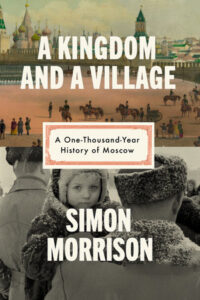
Excerpted from A Kingdom and A Village: A One-Thousand-Year History of Moscow by Simon Morrison. Published March 2026 by Alfred A. Knopf, an imprint of The Knopf Doubleday Publishing Group, a division of Penguin Random House LLC. Copyright © 2026 by Simon Morrison.
Audio excerpted with permission of Penguin Random House Audio from A KINGDOM AND A VILLAGE by Simon Morrison, excerpt read by Curt Ford. Simon Morrison ℗ 2026 Penguin Random House, LLC. All rights reserved.

Simon Morrison
Simon Morrison is a professor of music and Slavic languages and literatures at Princeton University. He is a regular contributor to The Times Literary Supplement and London Review of Books and has written for Time, The New York Review of Books, and The New York Times. He has received a Guggenheim Fellowship and holds a PhD from Princeton University.