Below Zero
You were breathing fire when I met you, I should have sensed the danger: a pale, shirtless sixteen-year-old in the middle of a frozen field inhaling slugs of kerosene and spewing jets of flame out into the night. A layer of f rost had dusted the grayish sedge, a faint thread of amber fluid writhed down the crease between your pecs. As you moved, parts of you shone like a Vermeer. You seemed at home in the night and the outdoors, something of the woodsman about you, a sense of solving things by force, with the blow of an axe.
That winter they tried to convince me that cold is just a state of mind. It’s a sensation, and sensations are psychological, some little Einstein who’d never heard of hypothermia blurted out at me. I didn’t want to have to argue with the guy, besides, I would have given anything to stop shivering, so, sitting on a tree-stump, huddled in my blue coat, I telepathically willed my body to conjure up some heat. You loved that coat, you said it was the exact color. The exact color of what, I never learned.
When I saw you walking in my direction I figured there must be someone standing right behind me. Are you drunk? you asked as your specter took on solid form. You wiped off your chest with a hand-towel embroidered with an apple and something written in cursive. With one deft motion you pulled on a thick woolen sweater; it must have been itchy against your bare skin but you showed no sign of discomfort. You squinched your eyebrows, casting your face in shadow: Don’t do that anymore, you’re not like those other girls, it doesn’t suit you. I looked at you the way Sailor Moon looks at Tuxedo Mask, like a cute kitten from the Internet, a look with which you were already well acquainted.
I was captivated by your confidence in who you were. I was lucky if I could occasionally grasp a fleeting sense of myself from the contours of clothing against my flesh, but you were already wholly yourself, clearly cut out from your surroundings by a die you’d long since cast aside. You seemed to know a lot about everything. And what an honor to be different from “those other girls,” though who they were I had no idea. And to be chosen to receive your words of advice, the joy that snapped through my body was an electric whip.
Touch
The sense of touch, how it works, has always intrigued me. You once told me that I couldn’t tell how soft I was because the palms of my hands are so rough. Do you feel that? you said. First you made me touch your hand for comparison, waxy, like soap, and cool, like a fish. Yours are like paper, you decided. After that I had a hard time holding your hand.
The crux of the problem of touch arises when I’m trying to sense myself, to evaluate my own texture. Which part is doing the sensing then? How do I know what I really feel like? It’s not a problem at every level, apart from my own body it’s clear enough, and I can say unequivocally that this dress I’m wearing feels luscious, as soft and inviting as foam.
I try to recognize myself in the things I buy. Under the fitting room’s mortuary glare I’m gray, shapeless, an orphaned World War Two refugee. In moments like this the feeling that I have to fill up the time, the minutes, the hours, the time until whatever, descends upon me, and with it an urge to spend. And as always, trying not to be late, I end up being way too early. That’s why I went into the shop in the first place, that and the airconditioning.
Although there’s something captivating in the image of me as a famished little orphan girl it’s unlikely that I’ll ever wear that light blue dress, the dress of a girl out browsing the meadows around your parents’ house in search of greens for the evening meal. My mother used to say that we always look better in our own mirror, the one we’ve tamed, but the rest of them are wild, unpredictable—mirrors that recognize the beast in us. The replica of Guernica in the lobby. I’m hoping that Delia will have the keys with her when she answers the door, though I already know that she won’t and I’ll have to go upstairs. In my mind I’m already there, I’m imagining the latest remodeling. They’ve knocked down a wall to enlarge the consulting room.
Doubling the size, to be exact.
Reexamining the geometrical precision of the figures I always notice some new detail: a blade leaping maniacally from what seems to be the mouth of a furious horse. The same cold as always, the coolness of the marble, a [the?] catacomb of dark ceramic. The elevator, no one speaks. She immediately offers me a seat and brings a glass of water, remembering that my blood pressure tends to drop suddenly: It’s important to stay hydrated in the summer.
I already have an inkling of how this will go. Your mother, like an actress entering her “living room scene,” arms waving: Dear this, dear that, this situation, they didn’t want to scare me, you asked for me but they think it’s better if I don’t go; Violeta has been “contained.” A certain artificiality that I couldn’t quite pin to anything specific, whether to the lexical choice of “contained” or to her movements, decisive but calculated, choregraphed even, as if she knew just the right tincture of drama to inject. Violeta’s with her parents, she won’t be coming back, and the cats have had a litter.
I’m sitting on the edge of the armchair and fear that I’ll leave a mark—I’m sweating and my bare legs are touching the leather, real leather. As you can imagine, she informs me, I can’t bring the cats here; I’m never home and I can’t force her (gesturing with her chin towards Delia), besides, I just got that new armchair. Her bracelets jingle as she adjusts a lock of hair that’s fallen across the left side of her forehead: I have to get back to my patients, but you’ll be able to manage, won’t you, dear? You look so beautiful—let me know if anything comes up, okay? You’re an angel.
Before saying goodbye, she gives my shoulders a squeeze, a way of saying thank you, I suppose. She looks me in the eye without blinking and grimaces, as if she wanted to smile with her nose. The skin of her face remains absolutely static, which adds a disquieting, not to say frightening, touch to her look, the way a doll that’s suddenly come to life would terrify the children. Her irreproachable breath invades my nostrils, I’m feeling ill, but I manage to hold her gaze.
Delia accompanies me down to the first floor again, exhaling in a heavy whisper, such a catastrophe, more to herself than to me. I can see her in the mirror delicately biting a hangnail on the thumb of the hand in which she’s holding the keys with the Hard Rock Cafe Cancún key ring. A pink convertible.
Horses
Not entirely aware of what I’m doing I head toward the polo field. There’s no one around, neither out here nor in the city itself. I take advantage of the desolation, the approaching holidays, to look in at the racetrack just across the street. The horses raise a dusty wake that remains in the air even after they’ve vanished, the dirt track so dry you can taste it on your teeth, as if biting into burlap. How long is it since you rode a horse? you asked me at our final dinner, at that place with the pianist and the red lighting. I said that’s a bit of an aristocratic question, isn’t it? I’ve never ridden on anything more impressive than a pony, and you said that everyone gets on a horse at some point, that I take satisfaction in acting like I’m poor.
I’m looking at the track through the gates, and beyond it there’s nothing. The afternoon light crowns the earth in a golden haze, the glow of Hollywood movies during the Great Depression, the glow of Shirley Temple’s curly locks. I know that there’s a merry-go-round on the other side of the parking lot. Things in my head are spinning around like teacups. I got to tell you that ideas were spinning around in my head like teacups. After that you stopped responding.
Before leaving I lean against the gate with my back to the racetrack and smoke a cigarette, replaying the music of memory, Xuxa, the condiment dispensers at Wendy’s, my mother in her dark glasses and white sweater, nut-brown lipstick.
Going up the Juan B. Justo overpass, the vertigo of the mannequins on top of Montagne. I don’t know why but this is where I always imagine you meeting Violeta, the scenario I invariably construct. You were shopping for jackets and she told you the yellow one looked nice on you. The timeline gets a little fuzzy; after all, I found out only when the whole thing was already well underway, practically from the newspapers. Why do I imagine the two of you here, in the shadow of the overpass, in a shop that may not even exist? Strange notion, but that’s how I picture it. To me, the idea of meeting people outside of family circles or established social structures always seemed weird. But that’s just me, one of my “little quirks.”
I wouldn’t exactly say the night came upon me unawares but it arrived a bit sooner than I expected. I didn’t have the energy to cook anything elaborate so I whisked two egg-whites for a low-calorie omelet. Watching the egg swell up in the pan to the consistency of a cloud, fatigue came over me, a fatigue so profound I felt I could fall asleep where I stood, narcoleptic fantasies.
__________________________________
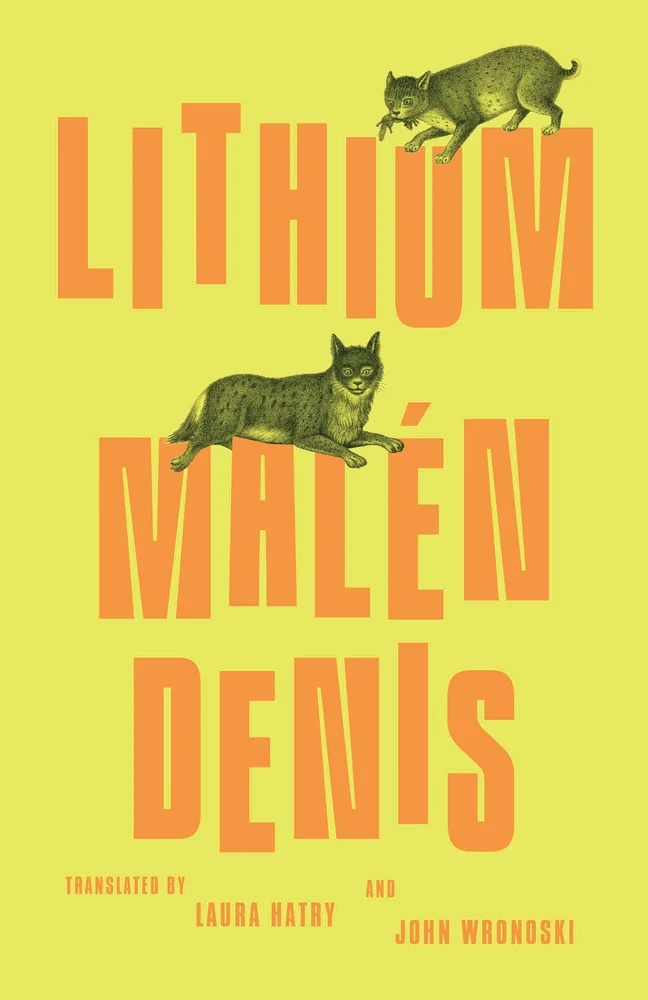
An excerpt from Lithium, used with permission of the publisher, New Directions. Translation copyright © 2026 by Laura Hatry and John Wronoski.