Literary Celebrity, Mussolini’s Mouthpiece, AND American Traitor: Who Was Ezra Pound?
Stephen Harding on the Modernist Poet and His Fascist Politics
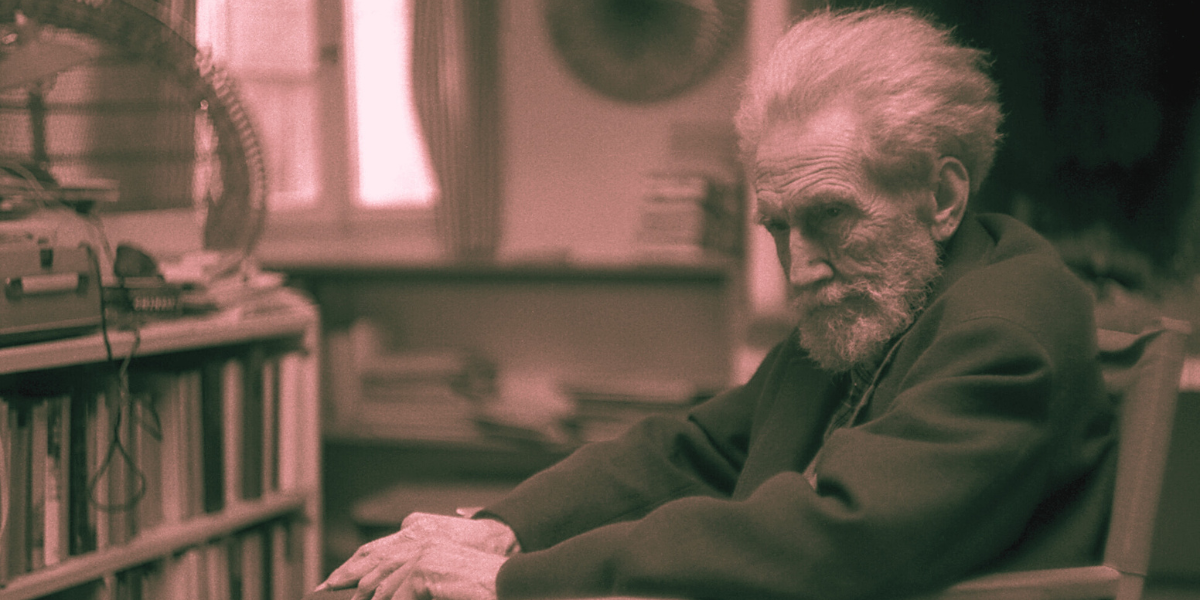
By the spring of 1939, the widely acknowledged dean of Anglo-American Modernist poetry, fifty-three-year-old Ezra Pound, had lived in Europe for three decades. After leaving the United States in 1908 at the age of twenty- three, the poet had initially settled in London, then moved on to Paris, and in 1924, to the Italian seaside town of Rapallo, fifteen miles southeast of Genoa. A virulent anti-Semite, Pound became an ardent and vocal supporter of Benito Mussolini and Italian fascism. The poet actually met Il Duce in person on January 30, 1933, and following Franklin Roosevelt’s inauguration as America’s thirty-seventh president just over a month later, Pound quickly evolved into a rabid and outspoken foe of the New Deal and all it represented.
Convinced that rising tensions in Europe between the democratic nations on one side and the fascist states on the other would likely lead to war, in April 1939, Pound sailed for America to “educate” Americans about the “folly” of allowing themselves to be drawn into a conflict with his beloved Italy. Deeply disappointed by the apathy with which his pleas were met, he returned to Italy and in mid-November 1940 approached Mussolini’s Ministry of Popular Culture with his ideas on ways to counter what he termed “anti-Italian and anti-Fascist propaganda” in Europe, Asia, and the United States.
Pound’s offer was met with both enthusiasm and caution, the former, because he was still a world-renowned literary celebrity, and the latter, because officials in Mussolini’s intelligence service feared he might be an American plant. Suspicion of Pound’s motives eased when the Italian embassy in Washington reported that during his visit to the United States, the poet had “displayed his friendly feelings for Fascism and granted courageous interviews.”
His fascist bona fides having been validated, Pound was given the green light to begin his radio broadcasts. The first took place on January 23, 1941, when the poet spoke in English on Radio Roma’s “American Hour.” In some two hundred programs over the following eleven months, Pound lauded Mussolini’s accomplishments—such as reducing crime and improving Italy’s road and railway networks—while also advocating that fascism was the only cure for social injustice, financial inequity, and the “dire threat” posed by “international Jewry.” In return for his radio services and his written contributions to Italy’s print propaganda outlets, including weekly articles in the newspaper Meridiano di Roma, Pound received a monthly salary, as well as such perks as reduced train and bus fares.
In a very real sense, it was the president of the United States himself who kicked the American government’s investigation of Pound into high gear.
The poet’s pro-fascist beliefs had caught the attention of the U.S. government even before he’d begun his radio programs, and in October 1941, the Federal Communications Commission’s Foreign Broadcast Monitoring Service began occasional monitoring and recording of Pound’s shortwave broadcasts.
That same month, J. Wesley Jones, a State Department official who had just returned to Washington from Rome, raised an additional red flag regarding Pound. In a memo to Ray Atherton, then acting chief of State’s Division of European Affairs, Jones said that the poet was “still . . . broadcasting his views,” and suggested that Pound’s name should be added to “the list of pseudo-Americans” still living in Italy.
The frequency of the FBMS’s monitoring of Pound’s broadcasts increased dramatically following Japan’s attack on Pearl Harbor. On the afternoon of December 7, even as Americans were desperately trying to understand the magnitude and import of Japan’s assault on the U.S. Pacific Fleet and Army and Navy airfields on Oahu, Pound was on the airwaves once again extolling the virtues of fascism. Because the program had been prerecorded, it included no mention of the disaster in Hawaii, making the poet’s comments seem all the more insensitive to his American listeners. Yet Pound himself was horrified by news of the attack, so much so that he vowed to “stand with my country right or wrong” and insisted he would “never speak over the airwaves again.”
His resolve lasted a mere seven weeks following America’s December 11, 1941, declaration of war against Italy, for he resumed his “American Hour” show on January 29, 1942. With the United States now a belligerent, Pound’s broadcasts stopped being seen by senior American officials as merely the ill-advised ramblings of a famously eccentric expatriate and entered a far more serious realm—that of treason.
In a very real sense, it was the president of the United States himself who kicked the American government’s investigation of Pound into high gear. On October 1, 1942, Franklin Roosevelt dashed off the following memo to Attorney General Francis Biddle:
There are a number of Americans in Europe who are aiding Hitler et al on the radio. Why should we not proceed to indict them for treason even though we might not be able to try them until after the war? I understand Ezra Pound, [Robert H.] Best, [Jane] Anderson and a few others are broadcasting for Axis microphones.
Roosevelt’s query prompted Assistant Attorney General Wendell Berge, head of the Justice Department’s Criminal Division, to reach out to the FBI regarding the expatriate poet. On October 13, Berge sent a memo to Hoover asking that the Bureau “obtain, if possible, transcripts of [Pound’s] broadcasts and transmit the same to this Division, together with any information you may have regarding this subject.”
Given that the FBI had been compiling a file on Pound since at least January 1941, Berge got a response to his memo just a day after Hoover received it. On October 14, the Bureau sent the assistant attorney general an eight-paragraph précis of the poet’s life, work, and political leanings. The document stated that “in February, 1940, Pound began airing his alien views and contempt for the United States over the Rome radio,” and added that a June 4, 1941, dispatch from the American consul general in Genoa “stated that Pound is known to have been very pro-Fascist for a number of years and to have spoken over the Italian radio system against the policies of the United States . . . it was stated that upon entering and leaving the Consular offices at Genoa, he was prone to give the Fascist salute.”
On November 20, the FBI provided Berge with three pages of excerpts of Pound’s post–Pearl Harbor broadcasts, with the first entry dated July 2, 1942, and the last on July 26. That initial tranche of transcripts was followed on December 12 by another eighteen pages spanning January 29 through June 28, 1942.
Just over a month after receiving the additional transcripts, Berge was ready to recommend a course of action. On January 15, 1943, he sent Attorney General Biddle a memo titled “Proposed Indictments for Treason of the Following American Citizens Broadcasting Enemy Propaganda from Axis Countries to the United States,” citing Pound and six other individuals.
After five hours of questioning, Amprim dispatched a cable to Hoover stating, “ezra pound in custody cic, ninety second division, genoa. admits voluntary broadcasts for pay.”
The memo noted that the seven “have for some time been broadcasting enemy propaganda to the United States from Berlin, Germany, and Rome, Italy,” and added that if transcripts of their broadcasts and other information thus far gathered about the individuals led to the conclusion that “their activities are considered of sufficient importance to warrant action by this Department, they may be properly be deemed treason within the meaning of Title 18, U.S.C, Section 1.” The seven-page document then went into detail on the exact legal meaning of the word treason, as well as giving several examples of how earlier treason cases had been handled in U.S. courts.
The building wave of official U.S. government interest in determining whether Pound’s broadcasts and writings reached the level of treason prompted Hoover to launch a nationwide, in-depth effort to investigate the poet.
Having just gained President Roosevelt’s authorization for agents of the FBI’s SIS to operate in Europe, Hoover decided to make Pound the first treason suspect to be investigated in the combat theater. The task would require the assigned agent to be embedded with U.S. Army units as they moved across the Strait of Messina and up the Italian peninsula, and the investigation would be a test case for Hoover’s test case for the Army Liaison Unit. Given the stakes, the director would have to dispatch the best agent he could find. That man was an Italian American and former lawyer from Wyandotte, Michigan, named Frank Lawrence Amprim.
When the FBI agent began interrogating Pound on the morning of May 5, the poet apparently believed the uniformed Amprim was a CIC (Counter Intelligence Corp) officer. The revelation that he was actually dealing with an FBI agent prompted Pound to make two requests. First, he wanted to send a telegram to President Harry Truman offering his help, as a longtime student of Confucianism, in brokering a “just peace” between the United States and Japan. Second, he wanted to make a final radio broadcast in which he would plead for America to be a benevolent victor over the defeated Axis nations. That Pound was shocked when Amprim declined both requests gives a clear idea of the poet’s stunning naïveté and overwhelming sense of self-importance.
After five hours of questioning, Amprim dispatched a cable to Hoover stating, “ezra pound in custody cic, ninety second division, genoa. admits voluntary broadcasts for pay.”
Pound was questioned on May 6 and 7, and at the end of the final session, the poet voluntarily signed two important documents. The first was the final version of a six-page typewritten sworn statement in which Pound outlined his early life and his initial move to Europe in 1908, his relocation to Italy in 1924, his fascination with and approval of Mussolini and fascism, and his writings and broadcasts both before and after Pearl Harbor. Pound admitted making the transmissions under his own name and at least two aliases, and acknowledged being paid by the Ministry of Popular Culture for his radio and print work. He also said that after the fall of the Mussolini regime, he had approached the Salo Republic about doing more radio broadcasts.
In the end, Ezra Pound was never tried for treason.
He said he was given 3,000 lire in “living expenses” by Carl Giorgio Goedel, a German who had worked for the Ministry of Popular Culture in Rome and then for the same entity in Salo—an organization Pound would certainly have known to be completely controlled by the Nazis. The poet also admitted that after Fascist Italy declared war on the United States on December 11, 1941, he said in one of his broadcasts that America was getting into a “whale of a debt” and should get out of the war immediately. In the statement, Pound also acknowledged that he understood the document could be used against him in court and that he was “willing to return to the United States to stand trial on the charge of treason.”
In addition to his sworn statement and the written authorization to search his Italian abode, on May 8, Pound provided Amprim with two additional written “supplements.” The first, titled “Outline of Economic Bases of Historic Processes,” was an exceptionally dense and rambling treatise quoting, among others, John Adams and Vladimir Lenin. The second item, “Further Points,” while also rather disjointed, includes a few concrete statements Pound wanted Amprim—and presumably the U.S. court that might eventually try him—to know.
At one point, the poet wrote, “I do not yet know at what date the mere use of a radio in a foreign territory became a crime. I certainly had no news of its being illegal before the date, whenever it was, that I heard I was accused of treason.” He then added, “I do not believe I have betrayed anyone whomsoever.”
In a later additional typed statement that day, Pound wrote, “I am not anti-Semitic, and I distinguish between the Jewish usurer and the Jew who does an honest day’s work for a living.” This latter statement would have rung false to Amprim, who was aware that the poet had publicly sought to justify Mussolini’s Nazi-inspired “race laws” and the Germans’ treatment of Italian Jews following the 1943 capitulation. Moreover, Pound added two lines to the statement that were to haunt him for the rest of his life: “Hitler and Mussolini were simple men from the country. I think that Hitler was a saint, and wanted nothing for himself.”
Amprim maintained a calm and friendly manner throughout his extended contacts with Ezra Pound despite such statements, and the poet later wrote that Amprim “expressed himself as convinced that I was telling the absolute truth . . . and has since with great care collected far more proof to that effect than I or any private lawyer would have got at.” Pound had obviously misconstrued the FBI agent’s “good cop” interview style, for Amprim was often irritated by the poet’s glib, offhand pronouncements in favor of Mussolini, Hitler, fascism, and anti-Semitism. The agent was especially incensed that on several occasions, when Pound was being interviewed between May 5 and May 17, the poet routinely gave the Fascist salute when entering the room..
In the end, Ezra Pound was never tried for treason. He was found mentally unfit to stand trial and transferred to Washington, D.C.’s St. Elizabeths Hospital for the criminally insane. Pound spent thirteen years in the institution, and upon his release in May 1958, he returned to Italy to live in Venice with his mistress, Olga Rudge. Pound died in 1972, followed by Rudge in 1996.
__________________________________
From G.I. G-Men. Used with the permission of the publisher, Kensington Books. Copyright © 2026 by Stephen Harding.

Stephen Harding
Stephen Harding is the author of nine books, including the New York Times bestseller The Last Battle, which is in production as a major motion picture, and The Castaway’s War, optioned as a major motion picture. He is currently the editor-in-chief of Military History magazine and lives in Northern Virginia.