







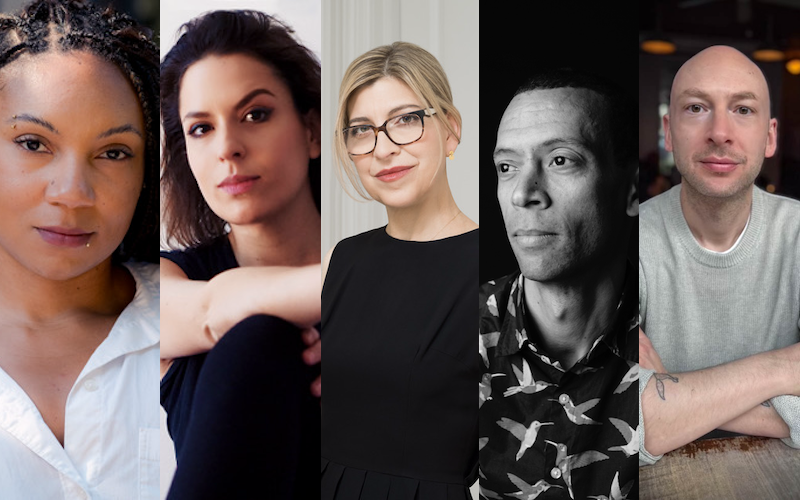
Lit Hub Asks: 5 Authors, 7 Questions, No Wrong Answers
Featuring Kawai Strong Washburn, Adam Wilson, Lauren Michele Jackson and More
The Lit Hub Author Questionnaire is a monthly interview featuring seven questions for five authors with new books. This month we talk to:
Lauren Michele Jackson (Back: Essays on the Soul and Spine of America)
Natasha Lennard (On Un/Certainty: The Uses of Doubt in Dangerous Times)
Julie Orringer (Luna, Phoenix, Queen)
Kawai Strong Washburn (The Names of the New World)
Adam Wilson (Fail Sons)
*
Without summarizing it in any way, what would you say your book is about?
Lauren Michele Jackson: Form—but isn’t everything? How what something looks like courts our thinking about it. The beauty of a wayward humanism. The United States as a not-self-evident object of attention.
Natasha Lennard: Stop talking about “these uncertain times.”
Julie Orringer: Artistic and marital betrayal. A love triangle. A stolen manuscript. An injured dog who elicits confessions. Loss and recovery. A deer and a hedgehog in love. The woods. A river. Invasive ivy. A clarinet in the snow. Parents and children. Sisters and brothers. Authorship and identity. How we remain ourselves as the outlines of our lives change.
Kawai Strong Washburn: Courage, political and cultural evolution, the glory of the Pacific islands, climate instability, race, transcendence, Minnesota. Combat and its opposite.
Adam Wilson: The fantasy of immortality. Mortality. Fathers, sons, and brothers. Failure. Grief. Millennials in midlife crisis. “America.”
*
Without explaining why and without naming other authors or books, can you discuss the various influences on your book?
Natasha Lennard: Constant talk of uncertain times, language games, hinges and riverbeds, uprisings, mass strikes, the impossibility of doubting everything.
Adam Wilson: Twenty years of talk therapy. Two years of physical therapy. Fear of death. Career dysmorphia. Becoming a parent. Grief. The movie Speed.
Kawai Strong Washburn: The landscapes of Hawai’i and Minnesota, storytellers that embrace the political, a multiracial and multicultural personal history that spans continents and defies categorization, storytellers that bend their prose to the breaking point, climate visionaries focused on a better future, hip-hop.
Lauren Michele Jackson: Digressive criticism, exasperation with takes and timeliness, amateur film viewing, gym bros, black-and-white photography.
Julie Orringer: This book was influenced by various dogs I’ve known. By getting lost in the woods. By what it feels like to love a person in the grip of an illness. By men’s betrayal of women’s authorship, and by a visit from a luna moth to the window of my studio when I was working on this book at MacDowell. By therianthropy. Fairy tales. Desire. Floods and tornadoes. By the Russian short story. Air travel. Jet lag. The terrible insecurity of being a novelist.
*
Without using complete sentences, can you describe what was going on in your life as you wrote this book?
Julie Orringer: Losing my grandmother. Covid. Five months in Maine. A favorable election. Late-night work sessions. Jumping on a trampoline with my children. Adopting a dog. Loving my husband. Teaching graduate students. A disastrous election. Tearing my MCL. Ocean swims. Losing my glasses in the woods. Thirty-two revisions. Hundreds of late nights. Help from my editor. Writers’ group. Owls. Occasionally, breakfast for dinner.
Lauren Michele Jackson: Social distancing, dream employment, acclaim and unwanted virality, blonde again, airline status, vaccines, engagement (now defunct).
Natasha Lennard: Constant talk of uncertain times, the movement against genocide, New York or Nowhere, Berlin, fascism, anti-fascism, the destruction of my university, being in love.
Adam Wilson: A birth, a pandemic, another birth, hospitals, funerals, school drop-offs, travel chess tournaments, a kitchen renovation, herniated discs.
Kawai Strong Washburn: Laughter, soccer, love, hockey, fear, frozen lakes, resistance, unemployment & reemployment, all manner of physical pleasure (including sexual), heat waves, anger, American political deterioration, snow sledding, rainstorms, aches & pains, early mornings, school, depression, evolution.
*
What are some words you despise that have been used to describe your writing by readers and/or reviewers?
Kawai Strong Washburn: It’s all love. I’m grateful people are reading and writing.
Julie Orringer: About my first book: “Little. Competent. Snapshots.” Like someone who’s learned to use an Instax in bad light.
Adam Wilson: Oversexed.
Lauren Michele Jackson: Anything in the realm of passion or intensity. I never write hot and “powerful” is not only lazy but an insult.
Natasha Lennard: Dense, academic flapdoodle.
*
If you could choose a career besides writing (irrespective of schooling requirements and/or talent), what would it be?
Adam Wilson: I could see myself as a kind of Rick Rubin-type mentor/producer figure for Gen Z bands.
Kawai Strong Washburn: A doctor, especially in whatever place might desperately need it.
Natasha Lennard: Heiress.
Julie Orringer: NICU babysaver. Croissantist. Nineteenth-century explorer. Climate-change reverser.
Lauren Michele Jackson: Being a literary critic, I have lately taken to musing on an alternative life spent in divinity school or law school—different and also some of the same hermeneutics. To be faithful to the prompt: professional dancer—ballet, soloist, or principal with a well-managed company.
*
What craft elements do you think are your strong suit, and what would you like to be better at?
Lauren Michele Jackson: I do think I have a talent for sitting with cultural detritus long enough to have an interesting thought about it. I wish I had a better historical sense; each time I write about anything, including within my own wheelhouse, feels like relearning what happened when to whom and in what order.
Adam Wilson: Rhythm.
Kawai Strong Washburn: I think I have a strong lyric instinct and some inherent sense of plot? I would love to craft more astute psychological observations.
Julie Orringer: If heavy lifting makes you strong, revision is my strong suit. And I’d like to get better at deciphering with my conscious mind the ransom-note cryptograms sent by my unconscious.
Natasha Lennard: I think I make complex ideas and concepts clear to nonacademic readers; I’m concise and concrete. I don’t think I’m a particularly skilled stylist. I’d like more poetry in my sentences.
*
How do you contend with the hubris of thinking anyone has or should have any interest in what you have to say about anything?
Natasha Lennard: Having dozens of writer friends who themselves partake in and normalize this hubris; an awareness that, actually, very few people have any interest in what I have to say. There’s a Pomeranian with over 10 million Instagram followers. As Ludwig Wittgenstein reminds us in his notes On Certainty, “The difficulty is to realize the groundlessness of our believing.”
Julie Orringer: I remind myself that if other writers were silenced by that thought, there would be nothing for any of us to read.
Lauren Michele Jackson: As yet, nobody I respect has begged me to stop. I figure I can put off the dilemma until then.
Kawai Strong Washburn: Devotion to the craft and the self-discipline to push myself, always, artistically. I never come to the page lightly. But there’s no hubris in my storytelling instinct, I don’t think; I do it to overcome loneliness and achieve a sort of liberation. I’m never less alone than when I’m creating art.
Adam Wilson: I balance it out with crushing bouts of despair.

Teddy Wayne
Teddy Wayne is the author of the novels The Au Pair, The Winner, The Great Man Theory, Apartment, Loner, The Love Song of Jonny Valentine, and Kapitoil. He is the winner of a Whiting Writers’ Award and an NEA Creative Writing Fellowship as well as a finalist for the Young Lions Fiction Award, PEN/Bingham Prize, and Dayton Literary Peace Prize. A former columnist for the New York Times and McSweeney’s, he is a frequent contributor to The New Yorker.