Lit Hub Asks: 5 Authors, 7 Questions, No Wrong Answers
Featuring T Kira Madden, Benjamin Hale, Lily Brooks-Dalton and More
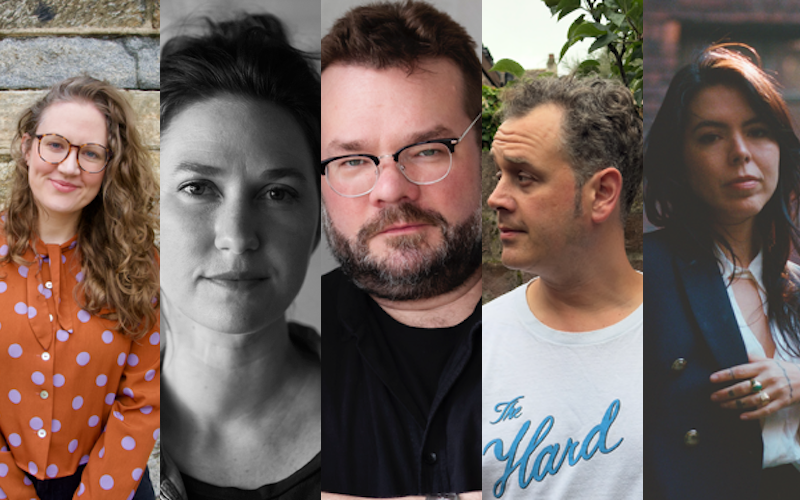
The Lit Hub Author Questionnaire is a monthly interview featuring seven questions for five authors with new books. This month we talk to:
Maria Adelmann (The Adjunct)
Lily Brooks-Dalton (Ruins)
Benjamin Hale (Cave Mountain: A Disappearance and a Reckoning in the Ozarks)
Luke Kennard (Black Bag)
T Kira Madden (Whidbey)
*
Without summarizing it in any way, what would you say your book is about?
Maria Adelmann: The myth of intellectual and creative labor existing outside of the market. Plus: class, power, academia, sex, and feeling uncategorizable.
Lily Brooks-Dalton: Ancient civilizations and modern disaster. Dirt, all kinds. Is it human nature to be extractive assholes, or is this just a phase? Are “difficult women” just unfashionably correct?
Benjamin Hale: A weird and terrifying thing that happened to my family in Arkansas twenty-five years ago, which leads directly into a much weirder and much more terrifying thing that happened in the same place almost fifty years ago, which leads me to a lot of thinking about religion, skepticism, faith, God.
Luke Kennard: Art, academia, unlikeable characters, the spiritual violence of describing anyone at all in a novel as if you really know the first thing about them; “circling the drain.”
T Kira Madden: Revenge. Rage. The strangers that live within ourselves.
*
Without explaining why and without naming other authors or books, can you discuss the various influences on your book?
Lily Brooks-Dalton: Trash, the Cloud vs. clouds, Atlantis, rock formations, the childlike pleasure of digging a good hole, Lara Croft, shitty history textbooks.
Benjamin Hale: I’m fine with not naming any other authors or books that influenced this book, because there weren’t any. I was flying blind. The influences were the people that I talked to as I traveled all over the Arkansas Ozarks while researching it, and the place itself. There was a moment of especially breathtaking beauty that happened right outside Marshall, Arkansas, as I was on my way to interview a retired lawyer about a case he prosecuted in 1978—it had been pounding rain all day, the rain had stopped, and the mountains glowed like gold. That was an inspiration.
Luke Kennard: Social psychology experiments from the 1960s; GoPro videos of insane men exploring lava tubes in caves with a 70% chance of getting stuck; Simone Weil’s concept of “decreation”; the Hikikomori movement in Japan, but preferably without the internet addiction.
T Kira Madden: That tight, dizzying, 360 shot of Carrie White dancing with Tommy at prom before all the pig’s blood. The crying limo monologues just after a “Bachelor” contestant gets dumped. Monica Lewinsky and Linda Tripp. Banana slugs.
Maria Adelmann: Course catalogs. Notebooks. Syllabi. Bad health insurance. Bad jobs. Toothaches. Turbo Man. Baltimore. My bank account. Poetry. Grad programs. MeToo, later. The twenty-tens.
*
Without using complete sentences, can you describe what was going on in your life as you wrote this book?
Benjamin Hale: First: despair, humiliation, desperation (was seriously considering quitting writing/teaching and starting a house painting company). Then: a renewed energy and sense of purpose. Then: major changes of mind about things my mind had been pretty made up on for a long time. A few people I loved died, and another was diagnosed with a terminal illness. Then: moved, started learning to hunt (which sort of began as book research), bought a beehive and attendant beekeeping equipment.
Luke Kennard: Disappointed with previous novel. Line manager for seventeen academics during the pandemic. Obsessively writing four prose poems a day. Falling in love. Watching too many video essays about caving and black holes. Parenting.
T Kira Madden: Years in hiding and years of presence. Soup, reclaimed language, new ways of meeting the world, the same old dogs. Running a wheelbarrow of horse and donkey manure up the hill in every season. Sometimes you make it to the top, sometimes you’re left covered in shit.
Maria Adelmann: Precarity, a teeny apartment, and mild revenge fantasies.
Lily Brooks-Dalton: Flying the previous manuscript into the side of a mountain. Financial panic: a biennial. Guess I’ll try something else. Sugar like it’s my job. Yearning to move, but where? Maybe Portugal will fix it. Unexpected diagnosis meets voracious research meets body.
*
What are some words you despise that have been used to describe your writing by readers and/or reviewers?
Luke Kennard: An irreverent romp, wacky, surreal, not actually funny.
T Kira Madden: About my memoir: brave. About my fiction: memoiristic.
Maria Adelmann: People sometimes complain that my characters are unlikeable. Characters don’t have to be likable, but I actually do like most of my characters. They’re willing to show every flaw, every unflattering thought, which is a very vulnerable place to be. Wouldn’t we all be revealed to be pretty imperfect—and possibly kind of annoying—if we transcribed our inner dialogues? (I hope it’s not just me!)
Lily Brooks-Dalton: Ambitious, timely, badass.
Benjamin Hale: I really dislike the phrase “true crime,” but it’s inevitable that it will appear in every review, and indeed is also in the jacket copy. But fight only battles one can win.
*
If you could choose a career besides writing (irrespective of schooling requirements and/or talent) what would it be?
T Kira Madden: Park ranger is appealing these days.
Maria Adelmann: A crafter or a visual artist—though I’m definitely romanticizing the creative freedom I feel doing activities that I never had to rely on for money.
Lily Brooks-Dalton: Cake decorator.
Benjamin Hale: When I was a teenager I also dreamed of directing movies. When I was a little older I dreamed of doing stand-up comedy. I still dream of doing monologues à la Spalding Gray. All storytelling in some form. For a while I thought seriously about trying to become a primatologist. I know I can paint houses, which I did for a couple years in my early twenties, but I did not then and do not now dream of it.
Luke Kennard: I think I’d be an undertaker. I genuinely think I’d make a good undertaker, but it would probably make me very, very sad and I’d dream of being a university lecturer.
*
What craft elements do you think are your strong suit, and what would you like to be better at?
Maria Adelmann: My strengths include laying things bare, sitting with discomfort, finding the humor in darkness, and letting my unconscious do its weird work before my internal editor gets its mitts on things. Plot, on the other hand…
Benjamin Hale: I like to think I have a good sense of humor, and I don’t like reading writers who never make a joke. I once loaned my copy of Saul Bellow’s The Adventures of Augie March to a friend, who told me he’d been amused to see that I (at about twenty-three or so, the first time I read that book) had circled a particularly astonishing paragraph and wrote in the margin, “Learn how to write like this.” Whatever that was, I know I’ve probably not learned to do it yet, but I still hope to.
T Kira Madden: I have good intuition when tasked with finding someone else’s beginning or ending. I am terrible at crafting or identifying them in my own work.
Luke Kennard: I’m pretty good at dialogue, or, more specifically, I’m good at knowing when to interrupt dialogue. Thankfully I didn’t read Thomas Bernhard at too formative an age, so I’m not doing the kind of Bernhard tribute act that gets praised for its originality: that beautifully pedantic repetition and poised uncertainty. I do love that, though, and I can see why it’s so popular, the beautifully pedantic repetition; it’s so popular because it’s seductive, in its pedantry and in its repetition and in its beauty. It introduces—and this must, I suppose, be intentional—an element of self-doubt which is soothing to read even if it ultimately bolsters, in its repetition, the absolute authority of the voice. I’d like, I think, to be better at that seductive and beautifully pedantic repetition.
Lily Brooks-Dalton: I think I’m good at creating an atmosphere but would like to improve on undercooking ideas—in the sense that I think something is obvious because I’ve been ruminating about it for a year, but then it doesn’t actually make it into the text.
*
How do you contend with the hubris of thinking anyone has or should have any interest in what you have to say about anything?
Lily Brooks-Dalton: I don’t think it’s hubristic to think another person will be interested in what I or anyone else might have to say. We are creatures who can extract our thoughts and share them—that’s so interesting.
Luke Kennard: Like most people, I pivot between thinking I’m quite good at writing and thinking I’m a talentless charlatan, but there’s always a risk of the former. Thankfully, if you carry on doing this for long enough, everyone gets bored and starts completely ignoring you anyway.
Benjamin Hale: I don’t, really. The formula is simple, and it’s something I tell my students often. You’re trying to create a text that someone would want to read for pleasure. Read widely and gather pleasure from as many different sources as you can. Think about the texts that give you the most pleasure. Study them carefully and try to discern exactly what it is about them that gives you pleasure. Then try to do that. Hope that there are other readers out there who share your taste. Repeat, repeat, repeat. To be a good person requires humility, but to write well requires tremendous hubris, an unforgivable and utterly unearned arrogance—try to never lose it.
T Kira Madden: People are asking ChatGPT to decorate their homes, order for them at restaurants, and write their wedding vows. Reciprocal listening, curiosity, discernment—this is how we save each other.
Maria Adelmann: This might weigh on me if I were rich or famous, but as it stands, when I’m typing alone in my room for years, unsure if a publisher will even buy my book, without any guarantee that anyone will have interest in what I have to say, writing feels less like hubris and more like having a weird, all-consuming, wildly impractical, and economically unwise hobby.

Teddy Wayne
Teddy Wayne, the author of Apartment, Loner, The Love Song of Jonny Valentine, and Kapitoil, is the winner of a Whiting Writers’ Award and an NEA Fellowship as well as a finalist for the Young Lions Fiction Award, PEN/Bingham Prize, and Dayton Literary Peace Prize. He writes regularly for The New Yorker, The New York Times, Vanity Fair, McSweeney’s, and elsewhere. He lives in New York.