Lit Hub Asks: 5 Authors, 7 Questions, No Wrong Answers
Featuring Patrick Cottrell, Tom Perrotta, Jim Windolf, and More
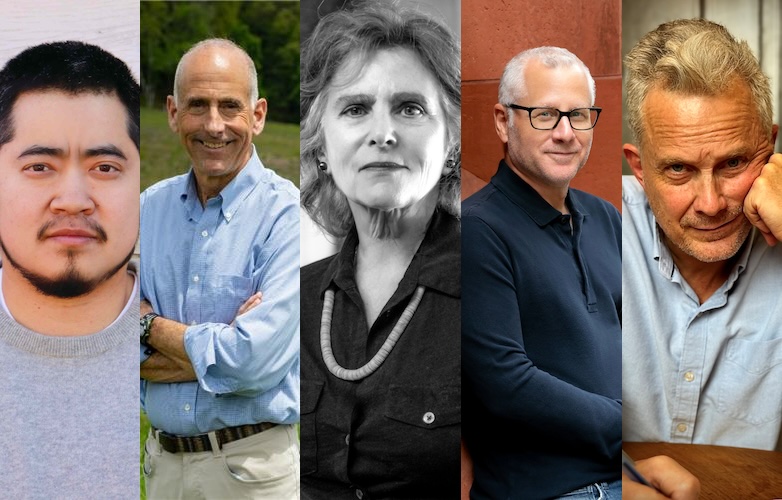
The Lit Hub Author Questionnaire is a monthly interview featuring seven questions for five authors with new books. This month we talk to:
Patrick Cottrell (Afternoon Hours of a Hermit)
Tom French (The Gap Years: Climbing, Skiing, and the Journey Back)
Tom Perrotta (Ghost Town)
Victoria Shorr (Fatherland)
Jim Windolf (Where the Music Had to Go: How Bob Dylan and the Beatles Changed Each Other―and the World)
*
Without summarizing it in any way, what would you say your book is about?
Patrick Cottrell: Lost men, loss, people I like, people I dislike, vengeance, names, the excitement of driving a car around suburban Milwaukee.
Jim Windolf: The price you pay for getting everything you ever wanted.
Tom French: Connecting with past passions, the power of stepping out of the mainstream, joy found in wild places, fulfillment inherent in endurance sport. The restorative power of all of this as one grows older.
Victoria Shorr: About the first and closest relationships that exist, between a father and his children. What happens when that falls apart? My goal here, as always, is to dramatize this story.
Tom Perrotta: The 1970s, absent parents, Ouija boards, weed and laughing gas, suburban racism, the ghosts who won’t leave us alone.
*
Without explaining why and without naming other authors or books, can you discuss the various influences on your book?
Victoria Shorr: One of the main influences was the movie Fanny and Alexander, by Bergman. I went to see it in São Paulo in the 80s, when I was living there, expecting a charming period piece (though what was I thinking, knowing it was Bergman?). In fact, it was a kind of horror story in drag, shocking and moving, which is what I had in mind when writing Fatherland.
Tom Perrotta: Muscle cars, Dazed and Confused, “Born to Run,” the dizzying descent from Obama to Trump, toxic nostalgia as a political ideology.
Patrick Cottrell: Shopping plazas, 1999-era Fiona Apple, time passing, the grandmother in Lee Chang-dong’s *Poetry*, Alterra Coffee. Searching for bedbugs in a hotel room and finding them.
Jim Windolf: It was built on the hours I spent around age eleven listening to the first few albums in my record collection.
Tom French: Authors I admire deeply who convey the power and beauty of the outdoor world. Friends who encouraged me. Life experiences that shaped me.
*
Without using complete sentences, can you describe what was going on in your life as you wrote this book?
Jim Windolf: Walking to and from work. Wearing a sport coat most days. Getting into a band called Twen. Walking to and from work while wearing a sport coat and listening to Twen.
Patrick Cottrell: Freed from my own mental prison!
Tom Perrotta: Spending time with my elderly mother, sleeping in my childhood bedroom, living inside a fog of memories, the past constantly infiltrating and commenting on the present, and vice versa.
Tom French: Retiring from a business career, longing to return to things I loved, getting an aging body back in shape, resolving how to spend my final decades on this planet.
Victoria Shorr: Really strange, but can’t quite picture where I wrote it, or even when. Just found myself afloat somewhere till I typed “o fim,” the end, and then had to wake up and submit it. Must have drunk coffee, washed my face, swum in the ocean if in Santa Barbara, walked in the park if in New York, done whatever for the Pine Ridge Girls School—but where? Somewhere up in the ether there, where art seems to live.
*
What are some words you despise that have been used to describe your writing by readers and/or reviewers?
Tom Perrotta: Effervescent, fizzy, sweet—anything that could be used to describe a soft drink.
Jim Windolf: “Your manuscript does not meet our needs at this time.”
Tom French: As this is my first book and it is just launching, I am about to find out.
Victoria Shorr: Not to offend, but I hate, hate to be compared to—no, I can’t write it. The intention was complimentary.
Patrick Cottrell: I don’t despise this word, but sometimes I’m confused by autofiction. I don’t know anyone who thinks about autofiction when they’re reading or writing. It seems like a marketing term.
*
If you could choose a career besides writing (irrespective of schooling requirements and/or talent) what would it be?
Tom French: I chose a career in management consulting. With that now behind me, my answer looking forward (irrespective of talent) is singer-songwriter.
Patrick Cottrell: Retiree, recluse in the woods, or… I’m going to go with professional basketball scout. I truly feel like I could do this right now. Some team should hire me.
Jim Windolf: I like to drive. So cab driver, chauffeur, or trucker.
Victoria Shorr: I always really loved working in political campaigns. If the Kennedy School at Harvard had been opened when I graduated from college, I would have applied there and probably had a very different life. Much more accomplished. Much less my life.
Tom Perrotta: If talent is no bar to entry, I’m playing lead guitar.
*
What craft elements do you think are your strong suit, and what would you like to be better at?
Victoria Shorr: I am incapable of thinking up a story, even to tell children. I always had to fall back on real stories, things that actually happened, which is what still makes my heart beat fast.
Tom Perrotta: I think I know how to tell a story. Sometimes I’d like my inner poet to take the wheel, but he’s a little too comfortable in the passenger seat.
Jim Windolf: I’m good at setups and payoffs. I go too far sometimes with the show-don’t-tell thing. Telling can be relaxing for the writer and the reader.
Tom French: I am pretty good at describing the interplay between naturescapes, physical activity, and internal emotion. I would like to become better at incorporating simile, metaphor, and other lyrical elements.
Patrick Cottrell: I don’t know what I’m good at, but I would love to move a character across a room.
*
How do you contend with the hubris of thinking anyone has or should have any interest in what you have to say about anything?
Jim Windolf: That problem mostly went away for me after earlier manuscripts of mine were rejected by publishers and I decided to keep writing anyway.
Victoria Shorr: It took me half a lifetime to get my work published. What I lived on, spiritually, during those bleak years was the response of my friends.
Tom Perrotta: Hey, if Robert Kennedy Jr. can be Secretary of Health, I think I can put my two cents in too.
Tom French: I consider people communicating things that I have no interest in and realize that, for others, I am potentially that person.
Patrick Cottrell: I’ve always thought of writing as a private act.

Teddy Wayne
Teddy Wayne is the author of the novels The Au Pair, The Winner, The Great Man Theory, Apartment, Loner, The Love Song of Jonny Valentine, and Kapitoil. He is the winner of a Whiting Writers’ Award and an NEA Creative Writing Fellowship as well as a finalist for the Young Lions Fiction Award, PEN/Bingham Prize, and Dayton Literary Peace Prize. A former columnist for the New York Times and McSweeney’s, he is a frequent contributor to The New Yorker.