“Open Writing Assignment”
Caroline was thirty-four, which was not too old to have kids. But it was, she thought, too old to not know if she wanted to have kids. In their twenties, she and Harry had happily not known together.
“Not now, and maybe not ever,” they’d agreed. Only in idle moments did she wonder when the much-heralded biological clock would turn up its volume and begin its dark hypnosis on her. You are feeling veeeeery motherly.
But it hadn’t happened. She stayed clear-eyed. And the increasingly grim state of the world only seemed to reinforce her ambivalence. It made absolutely no logical sense to create a new life that might not be able to drink clean water or breathe clean air by the time it was her age.
Harry agreed about this in principle. (Everyone agreed about this in principle, though that wasn’t stopping all of her friends from having babies anyway.) But the whole time she’d been meticulously monitoring her own feelings about parenthood, she’d failed to notice that Harry was being struck by the spell of the hypnotic biological pocket watch. All of a sudden, whenever the topic came up, their once-legitimate concerns about the future of the planet were recast as hand-wavey excuses, Caroline’s career setbacks as golden opportunities for pregnancy. The conversation had completely changed without them ever officially having the conversation.
There was simply no denying that having children looked, from the outside, like a bad deal. When Harry’s college roommate and his wife visited from out of town with their one-year-old, Caroline barely recognized them. It was like they’d given up their own personalities, hopes, and dreams to serve as full-time white-glove concierges to a tiny, demanding, ungrateful client. Following him around the room, facilitating his every chaotic whim and feebly trying to distract him with healthy or enriching pursuits: “You want your trucks? Dolls? Blocks? Water? Snack? Berry? Berry?”
“Never have kids,” the roommate deadpanned. But of course they all wanted you to. Even if parents regretted their decision, they could never admit it, even to themselves. The only way forward was to uphold the lie that it was the greatest thing ever and hope more people fell for it so you weren’t alone, and then pressure your kids to have kids so you could be a grandparent. Parenting was the ultimate pyramid scheme.
Caroline wouldn’t have been surprised if her own parents had regretted having her. They were fine parents, in retrospect, if a bit distracted by their own unhappiness. After divorcing when she was in middle school, they’d each remarried and had the audacity to have more kids, whose childhoods invariably appeared to Caroline to have been more deliberate, more cherished, than hers—the old throw-out-the-first-pancake logic.
Even Caroline’s therapist, Ellen, who had heard plenty about the pancake thing, was herself a mother of two. As warmly as Ellen “held space” for Caroline’s ambivalence in her chicly minimalist Hancock Park office, Caroline couldn’t shake the niggling suspicion that deep in Ellen’s own boomer mind lurked some version of “Shut up and have a baby already, idiot.”
She hadn’t thought her generation would even want kids. They were the ones who’d been told they should hold out for careers they really loved, for partners who made them feel truly seen. They’d lived through 9/11 and the 2008 financial crisis and Trump and COVID, tech-hopped from AIM to GChat to Facebook to Tumblr to Twitter to Instagram to TikTok to BeReal. They were supposed to be the smart ones, or at least the inordinately self-involved ones. They were supposed to be too poor to buy houses, anyway.
Okay, so maybe the girls Caroline went to high school with would have kids. Even in their twenties, they were rushing to lock down finance guys and scurry back to the same Westchester suburbs they came from, like salmon returning to the exact stretch of river where they were born to spawn. And sure, she had some college friends with more traditional jobs—doctors, consultants, non-profiteers—who’d designed their lives with family in mind.
But what about all the millennials who turned their passions into their careers, the filmmakers and journalists and art critics and food writers? What about all the cool girls who Caroline had met once at a party and whose social media accounts she still compulsively checked to see how she measured up? Surely these women wouldn’t buy into the pyramid scheme.
Except that then they started to. One by one, the enviable photos of the cool girls at video village in headsets, in hot tubs at weekend house rentals with their equally cool friend groups, or glammed up to receive awards for their creative projects were replaced by photos of minimalist light-wood bassinets. Husbands in felted-wool chore jackets pressing a sleeping bundle to their chests with one hand, the other carrying their Grand Army Plaza Greenmarket haul. The same girls who’d posted winking pop-culture-reference couples Halloween costumes a few years ago were now posting their toddlers in their own pop-culture-reference costumes.
It was like suddenly seeing everyone she knew go bananas for a new iPhone made of human shit. She knew she didn’t want it. Of course she didn’t want it. It was literally made of shit.
And yet . . . everyone else wanted it. Was she really going to believe that she knew better than everyone else?
It wasn’t a shit-filled phone, obviously. It was a bundle of love, love like you had never known, love that redefined the word and redrew the universe in the light of its glowing aura and blah blah blah. And what else were you gonna do, be the only couple without a family? Being the fun aunt and uncle might work for a couple who had tons of friends who’d invite them over for the holidays, people good at crafting “intentional community” with their “chosen family.” But Caroline had too much social anxiety for that. It sometimes seemed that the easiest way not to wind up alone was to make a fresh new person whom you could indoctrinate from their earliest infancy into thinking you were a good hang.
*
The real reason Caroline wasn’t sure about kids, the true fear at the heart of all her vacillations and overanalysis, was that she didn’t want to fall into the Mom Hole.
The Mom Hole was the place you went when you had a kid and lost your entire identity. Caroline first learned about the Hole in her twenties by reading mommy blogs, a form of procrastination less about satisfying any conscious curiosity about motherhood and more about finding comfort in the easy intimacy with which these women wrote about their own lives. Reading the blogs felt voyeuristic at first—she was sneaking around in a subculture she had no claim to, reaping the camaraderie of the GIFs and memes and confessional essays without doing the actual work of wiping a child’s ass crack or weathering its humiliating meltdowns in public. But the truth was that Caroline related to the mom bloggers. A perverse part of her felt that she deserved to partake of their “You go, Mom!” cheerleading just by virtue of being a woman. Life was hard. She, too, was harried and didn’t devote enough time to self-care. She, too, didn’t want to go to the grocery store.
So she read on, greedily skimming past the obligatory disclaimers about how the mom bloggers loved their kids more than anything and zeroing in on the darkest, bleakest disclosures. The ones about how their brains were turning to angry mush from sleep deprivation, a proven torture technique. How if they stepped on a LEGO one more goddamn time, they would scream so loud the entire neighborhood could hear it and they would never stop screaming. How they could no longer believe they were the same person who had once laughed or desired sex or gotten paid to do something they were good at.
It didn’t matter if the mothers worked or stayed home, breastfed or bought formula, had nearby family or a suite of nannies or the most feminist and enlightened partner on the planet. No choice a mother made could spare her from the Hole. The cold, wet, unshowered, irritable depression in the ground, where the only certainty was that you were failing. The Hole was a place where a mother was blind, deaf, and utterly disconnected to her previous life, the concepts of career and friendship and exercise and positive reinforcement just hazy memories of a distant realm. Where husbands were understanding but not overly alarmed, because by all accounts this was what motherhood was supposed to feel like.
Fathers didn’t have to go in the Hole, obviously. A dad who occasionally “babysat” his kids was a national hero. And Harry was already the one in their marriage who remembered to wipe down the counters five times a day and book flights three months before the holidays. If they had kids and did an equal amount of parenting, she was legitimately afraid someone might try to put up a statue of him. Of course the Hole didn’t last forever. Once their kids were in school, moms seemed to be allowed a gradual ascent back into the warmth and light of personhood. But after you’d survived for years in that chilled damp darkness, how could you ever be the same? What if you came out of the Mom Hole and you didn’t remember who you’d been before?
She’d tried, once, to explain the Hole to Harry. He listened carefully and empathetically to all her concerns, then smirked and told her Mom Hole sounded like a good PornHub search term.
So she was on her own, the sole survivor of baby fever. Nearly all their couple friends had succumbed by now. Harry and Caroline had been like the final living humans among the zombies, boarding up the windows of their childless life, until one day Caroline had looked at her hideout companion and realized he was infected, too.
If she wasn’t careful, she was going to get pushed into the Hole.
*
The email about that weekend’s baby shower took the same casual, funny-but-not-trying-too-hard-to-be-funny tone their friends’ invites always used. Five years ago, when the invitations were for birthday parties, they were full of jokes about how old they were all getting and promises that everyone would be home in bed by midnight. Now the joke was that this was Paul and Michelle’s last chance to hang out with their friends for the next eighteen years, and the promise was that everyone would be home by five.
Paul and Michelle weren’t close friends of Caroline’s, but a decade of acquaintanceship had mutually grandfathered them into permanent status in each other’s lives. Caroline had worked with Paul at The Cut-Up back in New York, the only job she’d had long enough to make lasting friendships. It helped that pretty much the entire editorial staff was just out of college, with no spouses or work experience, and they were unanimously thrilled to get paid to churn out content for a niche humor website and then get beers after work.
Caroline and Harry made their way across the park to the pergola and picnic table spread with crudités and cupcakes. September was a brutally hot month in LA, but at least there was shade. After saying a quick hello to their in-demand hosts, they excused themselves to grab drinks from the three large coolers on the ground. Each cooler offered a different brand of seltzer—another significant evolution from the birthday parties.
They didn’t see anyone else they knew, so they stood by themselves with their seltzers at the edge of the party. As a single person, Caroline had assumed that these awkward loser-at-the-party moments would end once she was partnered. Actually, it was perfectly possible to feel like a loser when there were two of you. You just felt like two losers instead.
They finally manned up and approached a couple who looked familiar from the last party Paul and Michelle had thrown: a woman, also pregnant, in a maxi dress, and a man in a short-sleeved button-down. They reintroduced themselves and Caroline forgot their names instantly. The man was an editor who’d worked with Paul, and the woman was in publishing, and they lived in Los Feliz, and this would be their first kid.
It felt more difficult than normal to make conversation. Caroline realized it was because there was no alcohol.
“So what do you guys do?” the man asked. Although this question was unavoidable, and she herself had asked it about thirty seconds earlier, it was Caroline’s second least favorite question to be asked at a party. What did this guy care what she did? No matter what, his answer would be “Oh, cool.” Was there any career she could say that wouldn’t result in an “Oh, cool”? Professional assassin? Skinhead? Whatever the word was for the person who sticks their hand up horses’ dicks to get the clogged smegma out?
“I’m a writer,” Caroline said.
“Oh, cool,” said the man. “TV? What show are you working on?”
“Oh, I’m unemployed. I mean, I’m not on a show right now, just developing,” she clarified. The word made her think of the life cycle of an insect. Nope, not really a caterpillar or a butterfly these days. Just liquefying in my cocoon. Developing.
Thank god it was Harry’s turn to answer before they could ask follow-ups. “I’m a psychologist,” he said.
That got them. “Oh, cool!” said the woman.
“You’ve certainly got job security in this town,” the man said. “What do you think about EMDR?” the woman asked, frowning.
“My therapist wants me to try it, but does it really do anything?”
“I don’t use it much,” Harry began, “but I know PTSD patients can find it very—”
“Does he analyze you?” the man asked Caroline, clearly proud of this original joke she heard weekly.
“Do you have favorite patients?” the woman asked, still zeroed in on Harry.
He laughed, taken aback by their attention. “Not really.”
“Yes, you do,” Caroline said, surprised by his lie. She looked at him, and a silent conversation passed between them.
*
Harry never told Caroline anything identifying about his patients. If anything, he was overly cautious about it. When he did share random details—that one patient seemed perpetually annoyed by everything he said, or that another smoked a stunning ounce of weed a week—he was careful not to link them up enough for Caroline to form a character profile. The irritable patient and the stoner might be the same person for all she knew (though that was, for obvious reasons, unlikely). So while she got scattershot crumbs about Harry’s patients’ lives, she knew very little about any of them as people.
Except for the Teacher.
The Teacher was a sliding-scale patient he’d first started seeing as a postdoc, when he was still racking up his clinical hours for licensure. He’d been surprised, that year, by how many of his patients were in therapy primarily because they were single and didn’t want to be. He came home one Thursday and pulled Caroline into a tight hug, reminded her how lucky they were to have found each other. There were so many lonely people out there, he said. Like his four p.m. patient today, who was around their age—someone they could, in an alternate reality, be friends with. This girl wanted a family, Harry said, but she wasn’t even in a relationship. She was a kindergarten teacher for special-needs students, her mom had died about a year ago, and she was really lonely.
Caroline had gasped in amazement that such a person could not only exist but seek therapy from her husband, a man who, not twenty-four hours earlier, had improvised a lengthy song about how his video game avatar’s new short-shorts made him the “sexiest stud-muffin in the whole wide realm.”
“Oh my god, she sounds like a saint. She must be so incredibly patient. Teaching five-year-olds with special needs? And then she goes home alone and grieves her dead mom? Oh my god.” It was like hearing about a character in a TV show or movie, but Harry actually knew this person. Caroline imagined a girl-next-door type. Long brown hair and a penchant for floral dresses. A kind smile. A gentle Midwestern air about her.
“Is she pretty?” she’d asked in a ha-ha-wouldn’t-it-be-funny-if-I-were-jealous voice.
“Oh, yeah,” Harry said, raising his eyebrows. “She models when she’s not teaching.”
“I bet she’s in love with you.” “They all are, babe.” He winked.
Caroline never actually worried that Harry would cross a line with a patient. And regardless, the Teacher wasn’t the kind of girl Harry would leave her for. She was too sweet, naive, simple, at least in Caroline’s headcanon. Harry often affectionately reminded Caroline in her insecure moments of how much he loved her “twisted little Jew brain.” It matched his. They were two analytical, neurotic, gossipy worrywarts who loved nothing more than to take some toothsome nuggets of emotional conflict back to their cave and chomp away on them all night. Harry with a woman who was easy and happy-go-lucky? It wouldn’t make sense.
So it didn’t bother her, exactly, this joke between them about Harry being a tiny bit in love with the Teacher. What he actually felt for her seemed more familial than romantic anyway, like she was a younger sister still finding her way. Once, when she’d asked him about his day, he’d had an excited gleam in his eye as he said, “The Teacher had a third date.”
Caroline cheered.“How was it? With who? How’d she meet them?”
Then Harry paused. “I can’t say, I shouldn’t have even said anything. My day was good, what about you?”
She couldn’t blame him for respecting his patients’ confidentiality. But it didn’t stop her from wondering about this woman who so delighted her husband. Caroline sometimes tried to picture different faces for the Teacher, to see if she could find the one that made sense, that matched the tenor of Harry’s voice when he talked about her: fondness and slight pity, with a proprietary note almost like pride.
*
Today, though, he wouldn’t own up to having favorites at all, lest he risk losing the professional admiration of two near strangers. As the couple continued to pepper Harry with questions, Caroline excused herself to get another seltzer. By the cooler she pulled out her phone to look up the name of the horse dick-cleaner job.
The heat really was stifling. She mindlessly typed “horse masturbator” into Google, and bestiality porn flooded her phone screen as her friends Alex and Erin, more Cut-Up alumni, came over with their toddler Lulu. Finally, people she knew. She jammed her phone into her pocket. “Hey!”
She hugged Alex and Erin, then knelt down to greet Lulu, who was shyly hugging Erin’s legs.
“Hey, Lulu! Cool shirt,” Caroline said. Lulu’s white tee read “gaga for goo” in hot pink minimal sans-serif, a reference to Erin’s podcast Goo Babies.
“Always be merchandising,” Erin said. “Gotta start ’em young.”
Erin and her comedy partner Tasha had started the podcast years earlier to make fun of what they described in each week’s intro as their own “desperate reliance on skincare as a coping mechanism in a crumbling world.” The show’s name referred to their self-identification as helpless babies overwhelmed by the pressures of modernity, comforted only by coating themselves in fancy serums and moisturizers to recreate the peaceful, placental insulation of the womb. In its early days, it was clear that the podcast was intended as a tongue-in-cheek satire of consumerism. But after the first year or so, the joking self-awareness had been replaced by earnest reviews of products sent gratis to the girls by skincare brands hoping for shout-outs. Caroline finally had to stop listening once every episode was dominated by Erin and Tasha’s imperatorial demands for specific expensive items they wanted to be gifted.
__________________________________
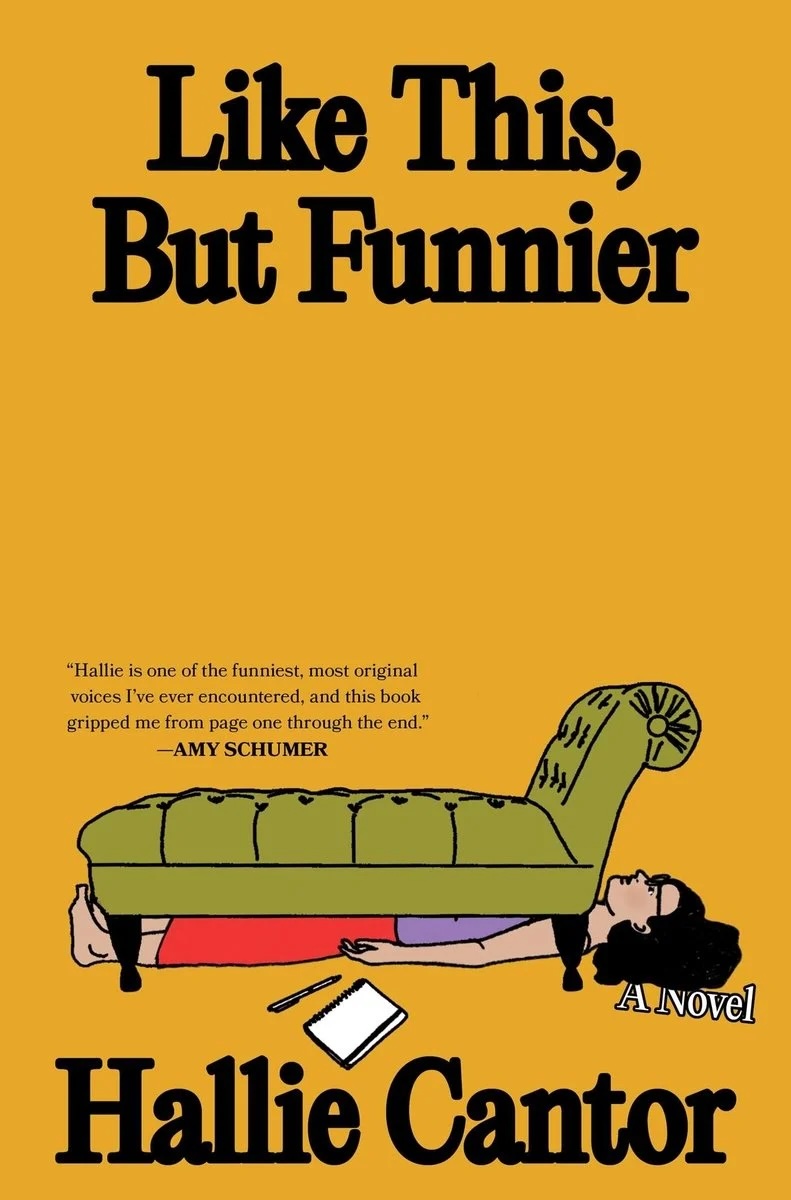
From Like This, But Funnier by Hallie Cantor. Copyright © 2026 by Hallie Cantor. Reprinted by permission of Simon & Schuster, LLC.