Letter from Minnesota: When Home is Away from Home
Su Hwang on the Hard Realities of Chaos at a Distance
I woke up thinking about fire—the element of unbridled power and absolute mayhem. How it annihilates indiscriminately and without prejudice.
I’d circled the date, January 7, in my pocket calendar to mark the one-year anniversary of when deadly infernos ravaged the Pacific Palisades and Altadena neighborhoods in Los Angeles, unaware this day would usher Minneapolis back into the national spotlight. On a familiar stretch of road close to where I live, fellow poet and Minnesota transplant Renee Good was murdered in her maroon Honda Pilot with her sweet dog in the backseat and her wife nearby as the masked shooter strolled away muttering, “fucking bitch.”
Seventeen days later, on Saturday, January 24, the morning after the historic statewide general strike and march, Alex Pretti, an ICU nurse coming to the aid of another peaceful observer, was summarily executed across the street from a beloved donut shop and a block from my favorite phở joint on Eat Street. A woman could be heard on the video wailing, “What the fuck, what the fuck did you just do?”
About thirty miles south of downtown LA in a gated retirement community called Leisure World, once the nation’s largest senior housing project built in 1962, I’ve taken up temporary residence in one of the cookie-cutter prefab homes. Designated zone: Mutual 2. Last January my mother was diagnosed with terminal lung cancer then suffered countless ischemic strokes the day before her first chemotherapy session.
Against all odds she’s been medically stable, but the world as I know it has atomized into a sequence of routines and rituals to care for my immigrant parents: doctor’s appointments, reviewing Medicare policies, shopping and meal prep, laundry, bedtime foot massages, waking up in the middle of the night to a cough or her walker skidding to the bathroom. Despite several trips back home to South Minneapolis, most recently in December, I’ve been scrolling the constant stream of horror on a loop between daily chores two thousand miles away.
My mom tells me to think happy thoughts when she catches me with my head in my hands. My parents have no idea what’s happening because legacy media is not reporting on anything worth a damn. To shield them, I say nothing of the stress and rage coursing through my body; they don’t get why I’m so grumpy. Out-of-town friends try to console or distract by messaging mundane stuff; I swat them away. When a Meals on Wheels volunteer or nurse at the infusion center asks how my day is going, I want to scream MINNESOTA IS UNDER SIEGE AND THEY ARE COMING FOR US ALL, but force a smile instead, say I’m fine thanks, and swallow the rest. Everyone around me seems obliviously content.
I am certainly not above reproach. Where was my fiery disdain when ICE invaded (and is still invading) Portland, Chicago, and Los Angeles last year? Did the murders of Silverio Villegas González, Keith Porter, and too many others in detention centers matter less because their deaths weren’t filmed? As my shame begins to spiral, my exhausted friends in the Twin Cities reach out offering grace. Life is hard. Caregiving for sick elderly parents is hard. Watching the tentacles of fascism spread like wildfire is hard.
With the exponential rise of deranged talking heads, private prisons, Amazon-like concentration camps, Cop City, local police trained by the Israeli Army, and AI technology to develop inconceivable weapons, the apocalypse does not appear far off.
Our mammalian brains cannot process this onslaught of trauma here and everywhere; we are not wired to be in constant fight or flight. Desensitized by Hollywood propaganda, video games fetishizing war, and livestreamed atrocities like the ongoing genocide of Palestinians, we have grown weary and unfazed by mass murder while deeply lulled within the extractive cogs of capitalism, of empire. The psychic and physical toll of white supremacy, sustained cruelty, imprisonment, famine, poverty, depression, grief, or illness constricts one’s depth of imagination and movement. When forces beyond our control exert their authority, like a tyrannical government or metastatic cancer, we seek the things that bring us comfort. For many, survival means accepting the status quo or simply tuning out—but for the rest of us, we don’t get to exercise that privilege.
As I sit here in balmy, 70-degree weather, all I envision is ice: frozen shards flecked onto eyelashes of brave souls standing guard at the Whipple federal detention center near MSP Airport or marching downtown on Washington Avenue; curbside patches near abandoned vehicles with hazard lights flashing like Morse code; rime-coated windshields smashed into smithereens; roving bands of masked assailants decked out in their camo fatigues and mismatched Velcro badges wreaking havoc in the name of so-called “immigration enforcement.”
Exiled from my home city in a kind of surreal, disembodied purgatory of nowhereness, I’m consumed with a soul ache akin to fear, anger, solidarity, and pride clenched into a fist. Diversion is not an option. I keep watching through the screen because looking away feels like betrayal. I watch to mitigate the guilt for not being there to help my dear friends and neighbors fight for our collective humanity. I watch because bearing witness is the form of caregiving I can offer.
I manically post into the echo chamber of social media owned by the billionaires investing in our doom, give what I can to the endless litany of worthy GoFundMes, connect this amazing helper to that amazing helper. None of it seems enough. Even with my constant vigil, I realize I’m only seeing a fraction of what’s truly happening on the ground.
The relentless din of hovering military helicopters has yet to invade my dreams.
I recently attended a virtual observer training hosted by organizers in Chicago who learned valuable lessons from Operation Midway Blitz to support the resistance efforts of Operation Metro Surge; there were four thousand people on the Zoom call. Esteemed civil rights organizer, Eric K. Ward, gave a rousing speech at the start of the hour, reminding everyone that “to bear witness is not weakness.” He acknowledged the collective feeling of utter helplessness and the stark disparity of being armed with phones and whistles against semiautomatic rifles and flagrant depravity, but he insisted that nonviolence was the antidote and urged for us to not mirror the language of authoritarianism.
The etymology of “martyr,” from the Greek mártys and marturia, translates to “witness.”
Last time I was invited to write a letter from Minnesota, “Why the Rebellion Had to Begin Here,” we were grappling with the murder of George Floyd and the reckoning that awakened under the knee of yet another modern-day slave patroller. In that dispatch, I questioned the word inflection to describe what was unfolding on the global stage under lockdown as parts of Minneapolis erupted in flames.
Outside agitators roamed our neighborhoods leaving half-emptied petrol cans in alleyways and unmarked trucks with tinted windows trailed while I walked the dog. Perhaps confluence, I reasoned, better captured the braided strands of warped racist history, centuries of unhealed wounds, and the sundry contradictions of the Twin Cities, of the so-called united States.
I recognize my naivety when I wrote that missive, wanting desperately to believe that concrete steps toward abolition seemed within reach. The pendulum of persecution, however, has swung the other way with greater momentum. With the exponential rise of deranged talking heads, private prisons, Amazon-like concentration camps, Cop City, local police trained by the Israeli Army, and AI technology to develop inconceivable weapons and surveillance tools while pillaging the environment, the apocalypse does not appear far off.
Thousands of Liam Ramoses remain in filthy cages. And now masked Proud Boys can cosplay their paramilitary fantasies, shatter our Constitutional rights, and disappear humans while the federal government flippantly threatens its citizens with the Insurrection Act and Aliens Enemies Act.
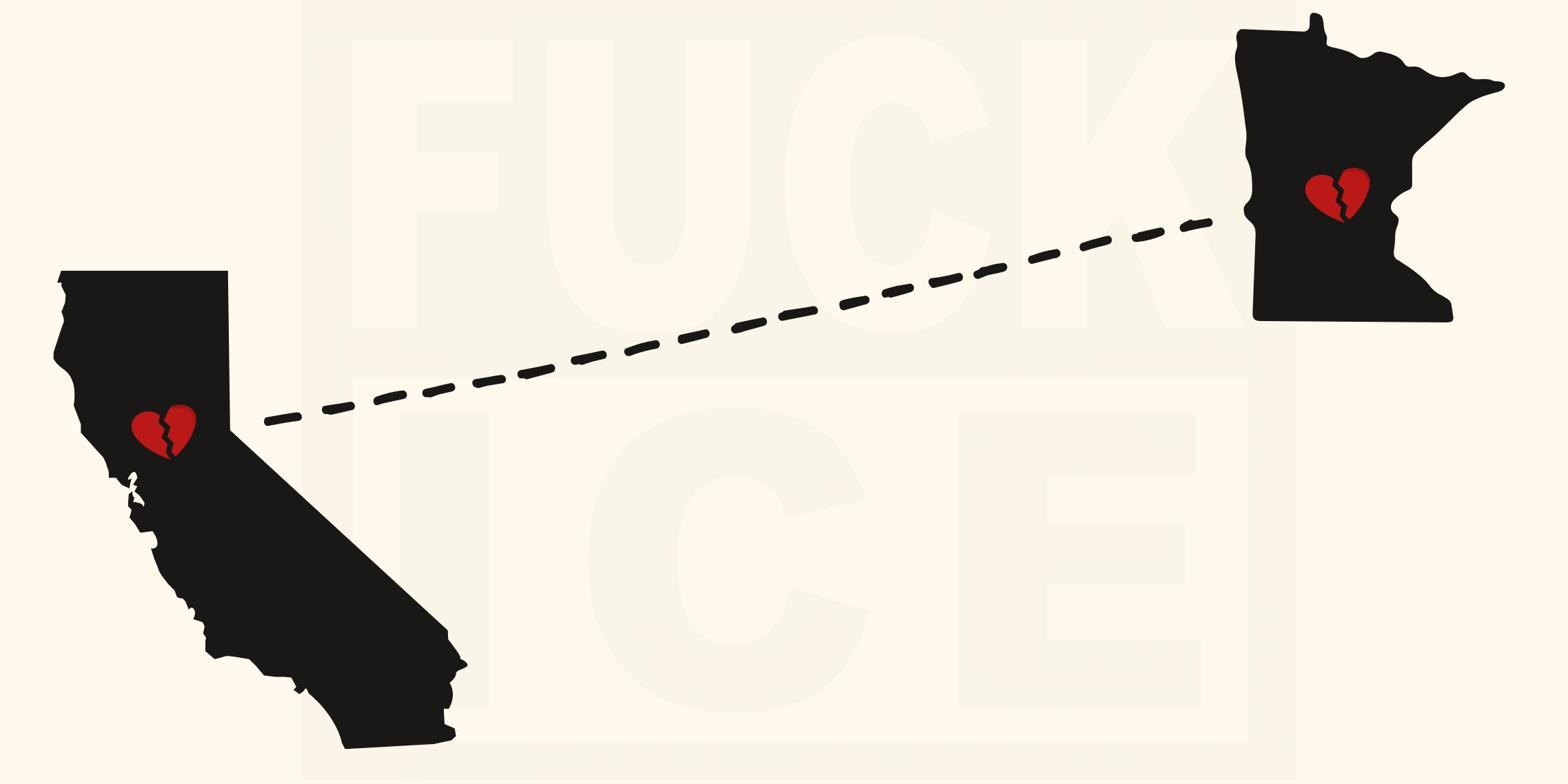
In this split-screen world of here and not-there, I am always thinking two hours ahead. I think about the arbitrariness of time zones, borders, laws, money, racism—invented human constructs that can be unmade then remade.
I was eight years old when my family immigrated from South Korea in 1982 during the height of President Chun Doo Hwan’s authoritarian regime known for its “social purification” policies. His rise to power was preceded by Park Chung Hee’s sixteen-year militarized dictatorship before his assassination in 1979. The Gwangju Uprising, which took place over several days in May 1980, challenged Chun’s coup in a series of student-led demonstrations, but civilian protests were violently suppressed in a sadistic massacre.
Just last year in April 2025, then-President Yoon Suk Yeol was impeached by the South Korean parliament for his attempt to declare martial law. All of this on the heels of the Japanese Occupation from 1910-1945, and the US-backed Korean War from 1950-1953, when my parents were young children. The peninsula continues to host the American military’s most extensive consolidated overseas base.
From time immemorial bad men have attempted and will continue to usurp the will of the people; the cycle of the oppressed becoming oppressor is catholic.
I became a naturalized US citizen when I was in middle school. My memory is fuzzy, but I remember people of all stripes crying during the ceremony and feeling uneasy. Cavalier racism by white people had made me a stoic kid. I was too immature to appreciate the public displays of emotion and symbolism: hands over hearts clasping tiny American flags while pledging allegiance as incantation to conjure covenant into form—that maybe, just maybe, a better life could be carved out of blood, sweat, sacrifice, and pure will. Maybe living in the heart of the imperialist beast could afford a modicum of protection and safety through proximity to whiteness. Maybe this flawed notion is what people of color who join ICE cling to as they fall into a deep slumber.
Binary absolutes are lazy, but it’s hard to ignore the satirical nature of contrasts right now: good vs. evil, courage vs. cowardice, hero vs. villain, right vs. wrong, right vs. left, righteousness vs. debauchery. The absurd distortions of domination and repression by the Trump administration would be laughable if it weren’t for the very real cost that this unrelenting campaign of hate is having on families as well as the human spirit.
As winter frost slowly begins to melt, federal and local officials have declared the end of ICE operations in Minnesota days before Valentine’s Day. It’s crystal clear that this is a fiction, a smoke screen. Mainstream media repeats this false narrative so the American public can move on and those in power can continue their abuses covertly. We have morphed from the bravado of Bovino to the quiet insidiousness of Homan, as agents of chaos find ways to blend in, adapt, and proliferate in our communities like a tumor. We know in our bones that Minnesota is not the endgame but ground zero.
The word conflagration circles my thoughts as we begin the year of the fire horse. BURN IT ALL DOWN.
The gears of what bell hooks called the “imperialist white supremacist capitalist patriarchy” are finally being exposed for their hypocrisy, pedophilia, greed, and inhumanity. The ruling class can no longer gaslight the public about their crimes. Just as chemo destroys healthy and cancerous cells alike, if we want to build a just world where everyone is truly equal, everything we’ve known must be put to the pyre. We’re living through an extinction burst, or as Antonio Gramsci put it:
The crisis consists precisely in the fact that the old is dying and the new cannot be born; in this interregnum a great variety of morbid symptoms appear… now is the time of monsters.
I am not a mother, but as I mother my mother, I want to believe humanity is writhing in this painful interregnum so that a different, more beautiful paradigm can be birthed. In the biblical sense, the refiner’s fire not only destroys, but purifies the slate clean for novel growth.
In this split-screen world of here and not-there, I am always thinking two hours ahead. I think about the arbitrariness of time zones, borders, laws, money, racism—invented human constructs that can be unmade then remade. I think about how we could solve our country’s housing crisis and provide universal healthcare instead of funding state-sanctioned kidnappings and incarceration. I think about Star Wars fans who say: Stormtroopers, cool, sign me up! I think about deep time and our place in the cosmos. I think about the migration songs of sandhill cranes and humpback whales, and the elegiac rites of elephants. I think about my mom dying, and death, how it comes for us all.
Every day brings another terrible headline, another tear in the social fabric of our own design, but shouldn’t we try spending our limited time on this hunk of rock hurtling through space with reverence, if not love? Teetering on the edges of despair, I choose hope against hope, for mercy, then a little more, until everyone is free. Aren’t rebellions built on hope?
You have been telling people that this is the Eleventh Hour, now you must go back and tell the people that this is the Hour. And there are things to be considered: Where are you living? What are you doing? What are your relationships? Are you in right relation? Where is your water? Know your garden. It is time to speak your Truth. Create your community. Be good to each other. And do not look outside yourself for your leader. Then he clasped his hands together, smiled, and said, “This could be a good time! There is a river flowing now very fast. It is so great and swift that there are those who will be afraid. They will try to hold on to the shore. They will feel they are being torn apart and will suffer greatly. Know the river has its destination. The elders say we must let go of the shore, push off into the middle of the river. Keep our eyes open and our heads above the water. And I say, see who is in there with you and celebrate. At this time in history, we are to take nothing personally, least of all ourselves. For the moment that we do, our spiritual growth and journey come to a halt. The time of the lone wolf is over. Gather yourselves! Banish the word ‘struggle’ from your attitude and your vocabulary. All that we do now must be done in a sacred manner and in celebration. We are the ones we’ve been waiting for.”
–The Hopi Elder’s prophecy, June 8, 2000, Oraibi, Arizona

Su Hwang
Su Hwang is a poet, stargazer, and the author of Bodega, which received the 2020 Minnesota Book Award in poetry and was named a finalist for the 2021 Kate Tufts Discovery Award. Born in Seoul, Korea, and raised in New York, she currently lives in Minneapolis, the unceded ancestral homeland of the Dakota and Ojibwe people. A recipient of the Jerome Hill Fellowship in Literature, she works with the Minnesota Prison Writing Workshop and is the cofounder of Poetry Asylum with poet Sun Yung Shin.