Letter From Minnesota: Waiting For the Barbarians to Get the F*ck Out
Zeke Caligiuri on Coming Home, and Finding Pride in His City
When I came home from prison in 2022, I moved back to the Powderhorn Park neighborhood where I grew up. I was 21 years old when I left, I was 44 when I returned. It was supposed to be a much different neighborhood than I had left. My parents and grandparents had all passed away during my incarceration, so there wasn’t a family home to return to. Because housing is often the most difficult resource to acquire when you come home, I felt fortunate to find a small upstairs apartment in Powderhorn, only a few blocks from the house I grew up in and the park where I learned most of my seminal lessons.
So many of the people I grew up with expected me to be overwhelmed or disappointed by all that had changed in the city; new developments, burned-out cultural legacies, gentrification, a new drug epidemic rivaling what crack had done to my generation. I was struck hard by the human bodies on corners and intersections with signs, asking for something, anything. The city’s nomadic encampments of unhoused people constantly jostled and disrupted. There is a man who I observe walking up and down 38th Street every day from as early as six in the morning until as late as midnight. I am heartbroken by these scenes of what I don’t completely understand.
I love this city and my neighborhood. I love them so much that even after over a decade away from the Southside I decided to write my first book about growing up here. It was necessary for me to come back, retrace my steps, make amends, absorb some of the destruction I had been a part of, and to absorb some of the destruction I had created.
I learned how to stand up for myself at Powderhorn Park, made many of the friends I still know in these neighborhoods, the same neighborhoods my father went through similar rites of passage. In seventh grade my best friend and his family moved to a distant north suburb of Minneapolis. There was a surge of white flight in the early 1990s. My family faced the question of whether to leave the city as violence, drugs, and brutal race-based policing impacted our neighborhood. My dad was clear and adamant that his choice was to stay in Minneapolis. Being here was important to him and he had a responsibility to care for the city that raised him.
Prisons and their processes are structured around a communal principle of division. The cellular division of a prison is meant to separate us from each other so that it is difficult to align our self-worth with each other.
I know what a cell feels like. I spent most of my adult life in a cell—it’s where my childhood education was tested. When I was gone, I did my best to rebuild and transform my life through language. We built collectives to support each other as artists and writers. Reading was my bridge to an understanding of so many of the ways human beings harm each other. My understanding of incarceration as a system of oppression was shaped by personal experience but was contextualized for me by literature.
I often go back to the poem “Waiting for the Barbarians,” written by C.P. Cavafy in 1898, and the novel of the same name, written by J.M. Coetzee in 1980. The concept shared by these two works is the idea that colonial and authoritarian societies are held together through the presence of a scapegoat (The Barbarians) whose existence justifies the need for all the tools a society uses to build and maintain control. It is the principal mechanism in the function of modern American prisons, because the people and systems that operate those places don’t have to offer description or explanation for their treatment of the prison population, a population legally and socially denied the right to a voice.
I work in South Minneapolis now, advocating for lives that are still stuck in carceral spaces and for homecomers trying to live productive and creative lives. I have worked on voting rights restoration for formerly incarcerated people and built commutation strategies to bring home other incarcerated creatives. Alongside other justice-impacted members in the community, I have helped shape and move policy to make the people in those places and on our streets be seen as human beings and not scapegoats for law enforcement or for a growing surveillance industry to propagate. Anybody who has spent significant time in a cell can tell you what it feels like to be used as justification to perpetuate these systems.
What living in Minneapolis feels like during the occupation is a lot like how it felt to live in prison. Years of lockdowns and impending pressure. Years of being siloed under vastly disproportionate power. An invasion of militarized workers with guns and masks feels eerily like when the Special Response Team would be deployed at one of the prisons: staff we saw every day now dressed in all black, wearing masks, and carrying bean bag guns.
People I was incarcerated with have told me the ICE agents in our city remind them of the worst corrections officers they’d encountered during their captivity: just another militarized brotherhood empowered under the law enforcement umbrella. Like these other “collectives,” ICE is widely supported by people who believe in the division of people, who believe their purpose is more important than the lives of people we live with, share our city with. They are not collectives like the writing and artist collectives my colleagues and I built during our incarceration to support and uplift each other.
Prisons and their processes are structured around a communal principle of division. The cellular division of a prison is meant to separate us from each other so that it is difficult to align our self-worth with each other. If an action is taken by a single individual, the entire prison population wears that burden in the shape of lockdowns, continued separation, loss of programming, and a reconstruction of prison policy that will further impede humans from gaining agency towards their own transformation.
I have always known the people in this city to have a sense of communal responsibility, to possess awareness in the presence of injustice.
I watched the uprising from a prison cell. Cried genuine tears of surprise joy when I watched the third precinct burn. I wished my mom, who had died two and a half years earlier and who had been a vehement advocate for incarcerated families had been alive to see what happened to George Floyd at the hands and knees and indifference of third precinct officers so that she could understand just what it was like to grow up in that neighborhood with the specter of cops surveilling our young lives. I lived in a box physically, but also professionally. I was a prison writer and what was happening at home in my neighborhood in Minneapolis in 2020 wasn’t about prison, but was framed instead as an issue of policing, as though these two systems didn’t share roots, have the same purpose. My tears were tinged with agony and regret that I couldn’t be home to help my city heal.
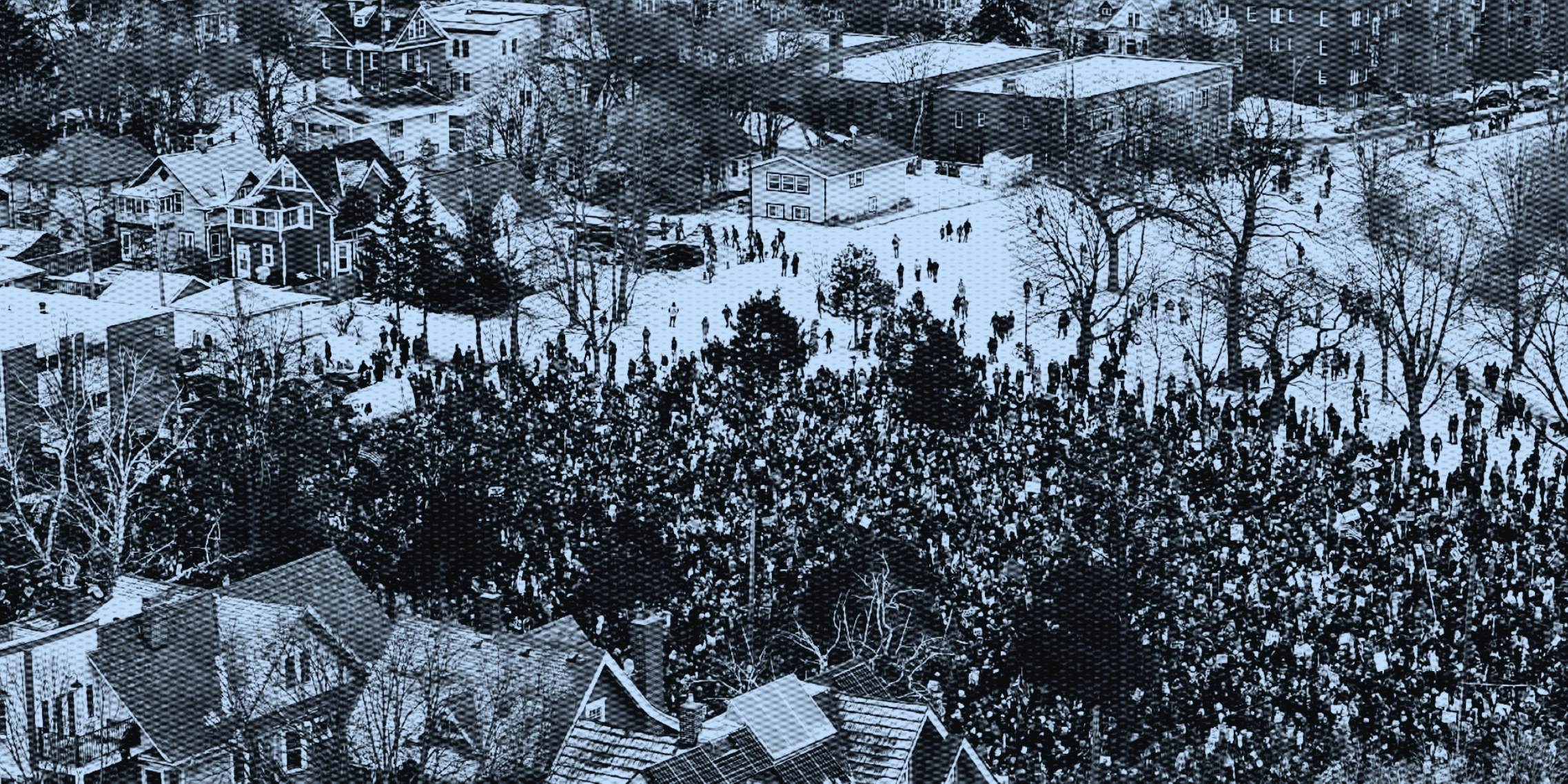
I am home now and watching my neighbors support each other in response teams, in mutual aid distribution, people working shifts for small businesses whose employees are too vulnerable to come to work, and a general resistance to being occupied by an army that doesn’t hold the same values for the human beings in our community. I have always known the people in this city to have a sense of communal responsibility, to possess awareness in the presence of injustice. What we are seeing now is the concrete practice of those values and instincts by a community that knows what is right. I am proud of this in ways I never expected.
Much of incarceration is living without access. Being suppressed. The world can do what it wants with your image, your words, just as the criminal legal system is able to move and manipulate our bodies as units of financial and political value that should belong to us but are instead leveraged and used against us; scapegoats for every harm and offense that has ever occurred. You can’t justify policing or surveillance or a federal invasion without scapegoats, without “barbarians” whose alleged choices—sometimes made decades ago—are used as reasoning for occupation today. Without barbarians how will the capitalists convince us that they are not the monsters arriving with state-supplied weaponry and an apparatus of confinement?
The unspoken part of divisive rhetoric and propagandized fear is how much work the presence of barbarians—real and imagined—does to solidify the status quo. In a nation created and defined by the theft of land and by violence done to countless bodies, it is disturbing but not surprising to see state power use alleged criminality to justify a racial purge. The “others” Cavafy is referencing in Waiting for the Barbarians are “the solution” that this administration—and governments for centuries— have used to control the hearts and minds of its people. Even our own neighbors (and allies) have succumbed to posting comments online that measure the value of certain community members over others, often based on a court-imposed criminal status. There is little mention of due process or debts being paid, agreements and treaties being broken, contracts and legal boundaries being dissolved. The many nuances of legal language have traditionally been used as a tool to suppress the voices of certain populations.
Our language matters and the ways we speak about each other matters; it shapes how we really think about each other as human beings in our community. We are all criminals when we understand how this government has used us to shape its version of the future.
Zeke Caligiuri
Zeke Caligiuri is a writer from South Minneapolis. His memoir: This is Where I Am (UMN Press), was a finalist for the Minnesota Book Award. He is co-founder of the Stillwater Writer’s Collective, and an editor and contributor to the recent anthology, American Precariat: Parables of Exclusion published by Coffee House Press. He is directly impacted by over two decades of incarceration and currently works with the Minnesota Justice Research Center helping to empower system-impacted people and reinvesting in the humanization of those still stuck within the captivity business. He is an MFA candidate in Creative Writing at the University of Minnesota. He was named as an inaugural Haymarket Writing Freedom Fellow.