Letter From Minnesota: This is Our
Fight Response
Susan Raffo on Holding Space For Humility in the Midst of Radical Change
Right now Minnesota is in the middle of a fight response. This is the gift of our ancestors, the capacity to turn towards a threat and engage with it as part of the strategy of disarming it. A fight response is partially what happens when we embody the word NO! But it is not only this. A fight response is also the movement towards what we want to protect and claim. It’s a fierce and loud YES: this we love, this we will fight for, holding it close to our heart and weaving it tightly into our lives so that we can track and protect our neighbors, our beloved kin.
A fight response is physical, meaning it is not a thought but it is a physical response to a situation. The body relies on the electricity of neural charges combined with the fluids of hormones so when the fight response engages, both in the NO and the YES, there is a gathering of force, an electrical charge that rises up in our bodies as our adrenalin increases, as our heart rate accelerates so more oxygen can pump up our muscles for action. We ARE a fight response, we don’t do or have a fight response.
When electricity or energy like this rises, especially when it is collective as it is right now in Minnesota, that energy has to go somewhere. This is what it evolved for: to move our body towards some kind of action. For the fight response, that means engagement, as opposed to the flight response which moves us away from the potential threat. Most of the time, even after we have engaged—gone on a march, showed up on patrol, started blowing our whistles or filming a kidnapping—there is still some of that charge left.
This also happens when we are living the yes: giving someone a ride, delivering boxes of food while we watch our rear view mirrors. When these actions are complete, the readiness to engage is still flowing through our blood, keeping us feeling fast-fast inside even if the outside has slowed down. And this energy has to find a way to dissipate, to be discharged like electric sparks shooting off a moment of friction, so that we can integrate what we just experienced. That, after all, is how wisdom is born, through integrating moments of challenge and struggle. Without that release of sparks and integration of experience, our body assumes that the fight is not over and so will continue to look for ways to engage. Again and again.
For this piece, I am going to talk to those bodies whose lives have in some way been protected by these systems that are, right now, turning on our neighbors. I am going to talk about what happens if these protected bodies don’t find ways to release that charge, to integrate this experience into wisdom and to then stay steady inside of connection.
*
Did you know that the white folks who fought hard for abolition before, during, and after the Civil War, became the exact same white folks who, immediately after, created a series of strategies to force-assimilate Indigenous people to farming and Christian family ways? Cathleen Cahill writes about this at length in her book, Federal Fathers and Mothers: A Social History of the United States Indian Service, 1869-1932.
She describes these exultant white abolitionists who, after the passage of Emancipation, looked around, rubbed their hands together, and cried out, “What can we fix next?” They attempted to replicate the same strategy used for abolition, a strategy in which 40 acres and a mule, the land package “given” to white homesteaders, was supposed to be given to freed Black people, a strategy which never materialized.
This is a conversation about what we do, meaning the choices we make, but it is also about who we become as neighbors in a connected community. Not only in times of crisis but also in times of, please god, someday, peace.
Those white Christian abolitionists believed that one size fits all. That land ownership and farming were the key to freedom and the self-sufficiency they believed defined it. They built programs to support Indigenous families to turn away from traditional collective ways towards individual farms. When Indigenous folks weren’t interested, they expanded their strategies, eventually creating the boarding school system where they forced Indigenous children to leave their families and learn farming and needlepoint. Those white abolitionists believed they had answers for people they had never met and so they created Indigenous boarding schools, locations which became more about abuse and coercion than education.
I keep thinking of that history in this moment, where so many white beloveds are gathering together with a clear fight response, the mix of the yes and the no, to protect and care for our neighbors. I am humbled by what I am seeing, truly humbled, and I don’t want to minimize the pride and glory I feel about this.
At the same time and without contradiction, I am also listening as our ghosts are gathering around and whispering: remember, sometimes when we’ve thought we were on the side of good, we’ve ended up royally fucking things up. We have often become the ones to take control as soon as that control seemed available, doing what we believed was right in the moment and which future generations now study with horror in their hearts.
Sometimes when I bring this up with my white Christian kin, not as the tired old binary of “good” versus “bad” white person but as a moment of linking arms—beloved one, let’s talk about how our people have often turned these moments into a place where we get to be the star of the show and how you and I might be doing that right now—I get push back. It’s the kind of push back where I sense my words are pissing people off, even as they try not to show it.
Dear kin, beloved kin, if we can’t be proud and feel the glory of this moment and, at the same time, hold the truth of how our people have created the conditions that made this moment possible, then it increases the likelihood that we are going to become a problem up ahead.
These are the things I want us to talk about, and many of these things are applicable to more than white folks because many bodies are protected in many different ways. I want to talk about the ways in which our privatized health care, social security and other safety nets, through the financial ecosystem of the stock market, means that we are paying the salaries and research budgets of those who are kidnapping our neighbors at the same time as we are paying money into mutual aid funds.
I want to sit down and look directly at the fact that some of us get to choose how deeply we engage with this moment and that this will always set up a dynamic of charity and saviorism, even when we resist it, until all resources are truly shared equitably. I want to talk about the generational-cultural lines that habituate so many white Christians to lean towards and rely on control and validation and a sense of ownership. I want to talk about how we are not always aware when it rises in us and how dangerous that can be.
It is likely if you are reading this that you already know this. I link arms with you and say that knowing a thing is not the same as being a thing. This is a conversation about what we do, meaning the choices we make, but it is also about who we become as neighbors in a connected community. Not only in times of crisis but also in times of, please god, someday, peace. It’s about how we extend the ferocity of this moment to continue the unraveling and the risk-taking, even when ICE is no longer filling our streets. Nothing is individual; everything is collective. Every single resource, whether dollars or private property, is only loaned to you and if it is parceled off from the rest of the heave of life, it will start to die inside.
This is a spiritual moment as much as a political one. It is a cultural moment as much as an economic one. It would be arrogant of me to assume that I—or anyone else—has an answer to the depth of inequity that this country was built on. I do know that if my people, my white Christian kin, cannot hold with humility and truth-telling all of the ways that our lives are protected at the cost of other’s lives, then on the other side of this siege we will see the emergence of another version of what we had before. I know you want more than that. In this moment, it is so much easier to feel how much more we want and to feel how much we want to risk to move towards this change.
That is energy. That is electricity. That is the physical expression of collective love. Let’s watch what we do with this energy. Let’s watch how and when we integrate it, who we learn from, and how much we are willing to reshape. This moment can truly change who we are together, not only now but for the long term.
But to do that demands that we look at our dangerous selves as much as our glory.
_____________________________________
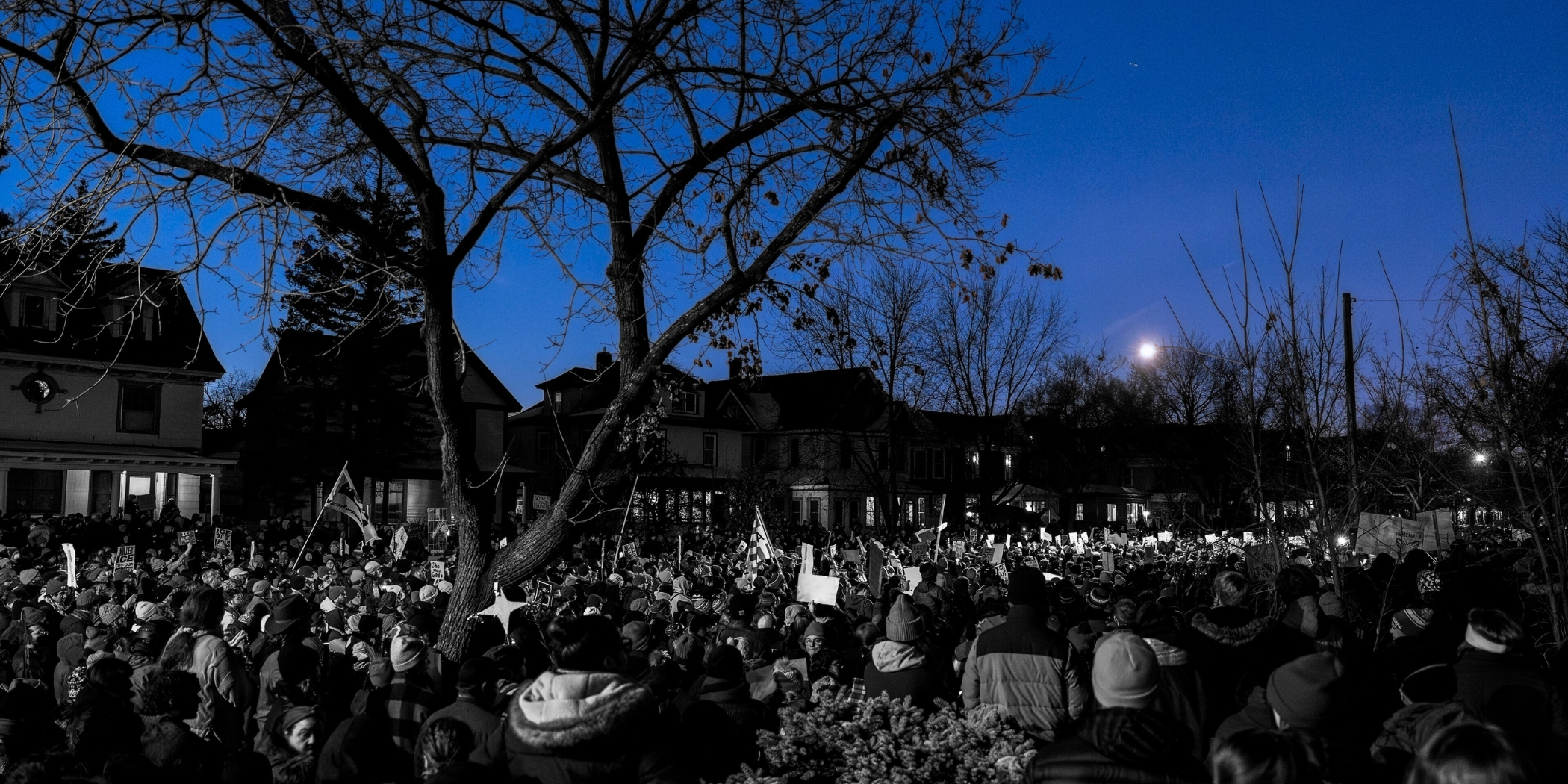
Feature image adapted from Chad Davis’s photo of a vigil for Renee Good on the day of her murder by ICE agents. Courtesy.

Susan Raffo
Susan Raffo is a bodyworker, cultural worker and writer who focuses her work through the lens of healing justice. You can find out more about her work here.