Letter from Minnesota: The Season of Los Helados
Gabriela Spears-Rico on the All-Too-Familiar Brutality of ICE
For Latinos, the fear of racist helado violence lives in our bones, as does our ancestral resistance
Los helados.
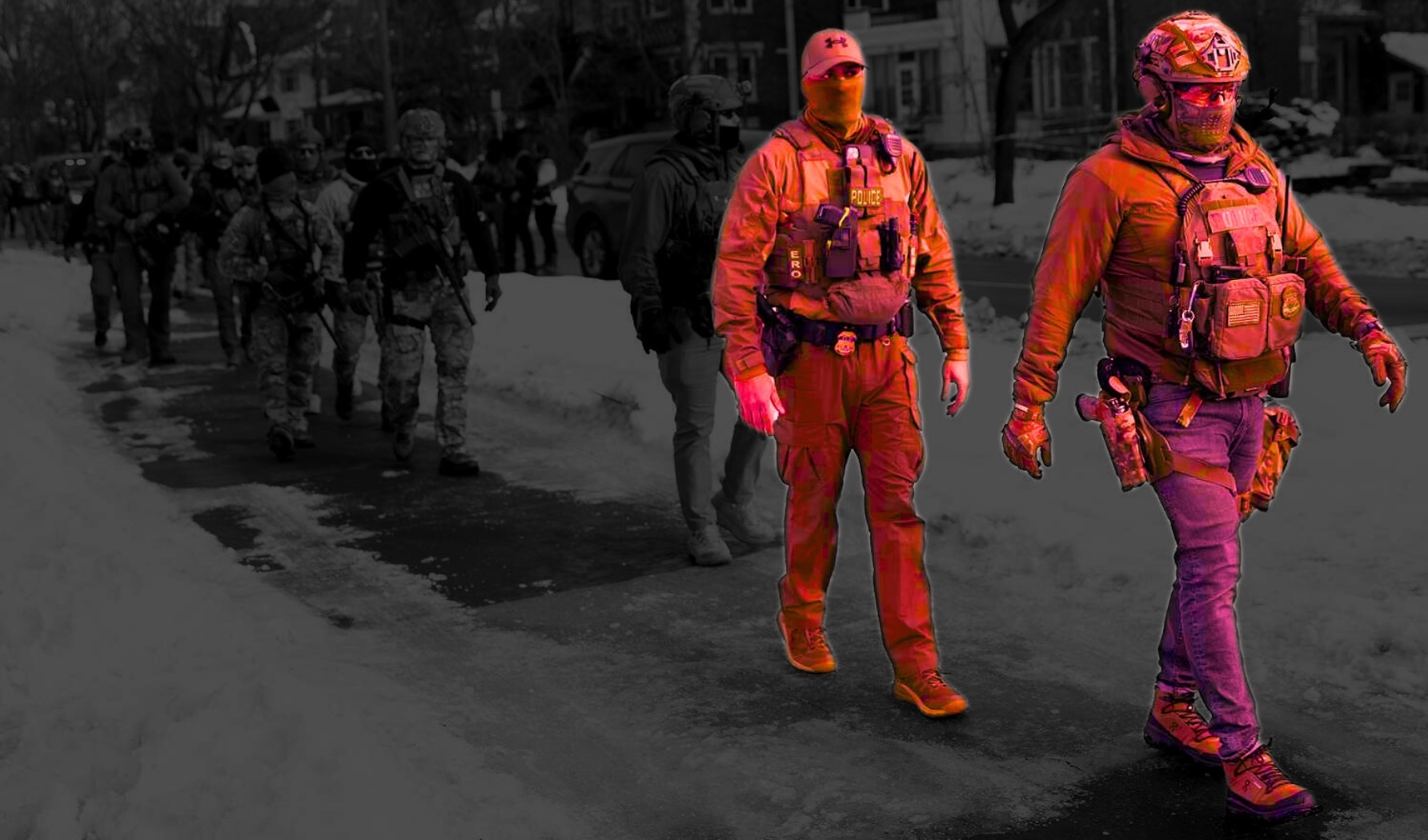
That’s what my community is calling ICE in Minnesota. The season of los helados. The cold-hearted cruel ones. The ones who will hunt you down, steal your children and beat you to a pulp without once considering your humanity. The season of snowy beauty that Latin American immigrants in Minnesota have embraced and adapted to, even though we come from very dissimilar climates, has turned into a season of terror brought on by the cruel vengeful politics of xenophobic politicians and their followers.
For Latinx migrants, the fear of racist helado violence is not new. It penetrated our bones on our journeys across the US-Mexico border through the desert, via air on tourist or student visas, or while walking through the Otay mountains. My generation bore witness to migra violence as all too common in the 80s and 90s. Growing up in a migrant farmworker community in central California, my tios spoke too nonchalantly about getting beat up by border patrol agents as if it were a rite of passage.
In those times, we were prepared and we expected to encounter border patrol agents and to be sexually assaulted or beaten at their hands. Perhaps, legalization aside, this is why my parents feel more settled this time around; they know how to hide and what to do even though their aging bodies would be less adept to bear beatings after shedding more than thirty years of flesh and sweat in the strawberry fields.
“You know how to hide, hija,” they remind me.
I do know how to hide. As an undocumented child, I used to hide from la migra with my siblings in closets and under the bed when migra raids happened in our migrant camps. As a third grader, it didn’t make sense to be able to align and identify with the hunted as we learned about the persecution of undesirables. It didn’t make sense, but my eight-year-old body learned how to clench up into a ball of nerves while remaining flexible enough to hide under the bed with my terrified toddler-aged siblings, hiding and crying too, even though they’d been born here. Latinos have been here many times before; our bodies remember, and, if we don’t, we take our lessons from the dozens of Latina/o migrants who have been killed by the border patrol or the thousands who have died during the crossing.
Latinos have witnessed our elders being beaten with their own gardening equipment, young women being flung head-first into concrete benches inside of hielera detention centers, babies being torn from their mother’s arms as they beg for reconsideration and mercy…
I realize that, now “legalized,” I hold the privilege of mobility along with the survivor’s guilt in this ongoing war of anti-Mexican violence. I name it as anti-Mexican violence because the US-Mexico border has always been present in filtering the racism deployed against Latinos in the US. Years ago, a white woman at a Burnsville thrift store reminded me that we are all rendered illegal regardless of status. “I don’t know what country you are from, but in Minnesota we don’t let our children act like that.”
Whoa, lady. I left my border state years ago, yet here I was reduced to the herida abierta of the border zone in front of my daughter, the boundary that splits, the open wound I can’t escape regardless of how far I travel or how many degrees I accrue.
The “Go back to where you came froms” recall the US-Mexico border as we traverse space in brown flesh, even as we inhabit the northernmost state. And, though I now have the privilege of mobility with papers, my body remembers the terror and sometimes renders me frozen under the cruelty of los helados.
And, even though I certainly did not think that the north star state would be ground zero for the staging of a horrifying federal occupation, this violence feels new but familiar too. I recognized the familiarity of the uneasiness that dwells in migrant Latinx bodies when, even as I rationalized that “we would be okay,” I’d break into uncontrollable weeping whilst witnessing the terror livestreamed in California last summer.
Latinos have witnessed our elders being beaten with their own gardening equipment, young women being flung head-first into concrete benches inside of hielera detention centers, babies being torn from their mother’s arms as they beg for reconsideration and mercy, our children being kidnapped in broad daylight and put into vehicles by masked strangers, Latinx teenagers being stalked outside of high schools, farmworkers and construction workers being pursued and falling to their deaths, male agents following Latina detainees into bathrooms, Latino and Chicano American constitutional observers being brutalized, some nearly executed, for defending their people, and fathers being rammed and killed in broad daylight by ICE vehicles after dropping children off at school.
Latinx people of conscience recognize our own tios, tias, primos, primas, mothers, fathers, sisters and brothers in the brown faces being livestreamed with blood and agony pouring into enraged mouths asking for help. Witnessing kidnappings by encapuchados for revenge or ransom are scenes we are used to seeing in our home countries. But here the encapuchados have an army and the US federal government promising them immunity as they exert as much violence as possible against unarmed people who carry but their IDs, a cellphone and a whistle. To say that we live our daily brown lives being triggered is an understatement.
Yet, just as we carry fear, resilience is also engraved in the ancestral DNA of our making. The ecosystem of Latinx resistance in Minnesota is resplendent enough to make you cry. Shop-owners are locking ICE agents out while posting community alerts, young students are calling for and organizing school walkouts and national strikes, civic leaders are leading rapid response trainings, every-day Latina/o citizens are volunteering to drive kids to school, volunteers with papers drop off groceries to families in hiding, and in my case, I wash vulnerable people’s laundry.
Ours is a recognizable network of solidarity sown throughout cities and towns in the Twin Cities and in rural Minnesota, dispersed and ad-hoc, yet woven into ONE like the verses of a poem. Most of us feel a cellular pull to protect and resist.
Days ago, I checked on Don Jose, an elderly disabled Mexican Indigenous community member who had been followed and threatened by ICE three times for engaging in community patrolling in East Saint Paul. “You should take a break, Don Jose,” I said, as we sipped coffee. Then, I wept as he spoke about being afraid of being beaten or charged with obstruction. “Una persona humilde,” he does not have money to fight legal battles or pay for hospital bills. But, in his broken body, is he retreating? No. He paused community patrolling and switched roles to delivering groceries in his old pickup war pony. “I have the time to drive as a retiree,” he told me. “I’ll never stop helping.”
Don Jose, a perfect example that for Latinos rooted in ancestral Mesoamerican and Afro-descendant mutual aid customs, helping is not a choice. We see ourselves in the suffering of our paisanes, vecines, and hermanes and we shiver from helado violence as we experience it in our bodies and watch it streamed on Minnesota’s media coverage.
I have seen the digitized image of Renee Good enveloped under the protective wings of an Angel de la Guardia saint image and the face of Alex Pretti encircled by the glimmering light of our Lady of Guadalupe votive candles. We mourn our white allies with ad-hoc Day of the Dead altars curated on snowy streets in the dead of winter, even though our own deaths at the hands of ICE agents go unnamed. In Minnesota, our neighbor Victor Manuel Diaz was abducted and flown off to Texas where he was found dead in a cell under suspicious circumstances.
Our glaring verdad is that ICE killings of Latinos started shortly after the DHS was founded with the public beating of Anastacio Hernandez whose widow never received justice. We count and claim our dead over the years, both the ones in our families who perished in the mountains or desert and the ones who were neglected, shot or beaten to death by border patrol agents in a country that offered no path towards legalization. Jaime. Silverio. Huber. Luis. Gerardo. Delvin. Pedro. Cipriano. Francisco. Javier. Y más… y los que no fueron reportados. We remember them. We say their names when no one else acknowledges the value of their brown lives or the silence of their brown deaths.
In Minnesota, we understand that if peaceful white people can get scraped off the concrete, staining the snow in hues of crimson that won’t melt the ice no matter how thick its consistency, the danger augments tenfold for us.
And, as the federal government announces a sundown of its occupation in our state, we will also call upon the endurance of our resilience. We know this is not the end. So many Latino families are still in hiding. So many have sold or packed up what little belongings they had and have left the state. Our businesses have shuttered or are on the brink of ruin. Our children are traumatized. My Latinx students are still missing from class.
There is a long road ahead, yet we have been here since before half of Mexico was annexed into the United States. And we will be here still. We are woven into the fabric of this country beyond the every-day consumption of the food that we produce and serve on your dinner tables, and beyond the irresistible cultural influence of Bad Bunny. And we will continue to protect each other from each cardinal direction of the continent.

Gabriela Spears-Rico
Gabriela Spears-Rico is a writer, a poet, anthropologist and a Professor of Chicano Latino Studies. Her first book Mestizo Melancholia and Colonialism in Michoacan will be released next year by the University of Arizona Press. Her work has been featured on Native America Calling and Latinx Talk. She has published articles in the Journal of Latin American and Caribbean Anthropology and in Chicana Latina Studies. Her poetry has appeared in Saint Paul Almanac, Minnesota Women’s Press, The Common and on various Saint Paul sidewalks. She is a former NDN Collective Radical Imagination artist and Mellon fellow. She lives in Saint Paul and works in Minneapolis.