Letter From Minnesota: If You Can Survive This, You Can Survive Anything
Michelle Zamanian on the Winter-Hardened Strength of Minnesotans
The winters I experienced growing up on the Kansas and Missouri border were filled with icestorms, bone-chilling cold, and constant temperature fluctuations. I didn’t know that snow could stay on the ground and become a permanent fixture for the entire season until my first winter in college, in Columbia, Missouri, a mere four-hour drive to the northeast.
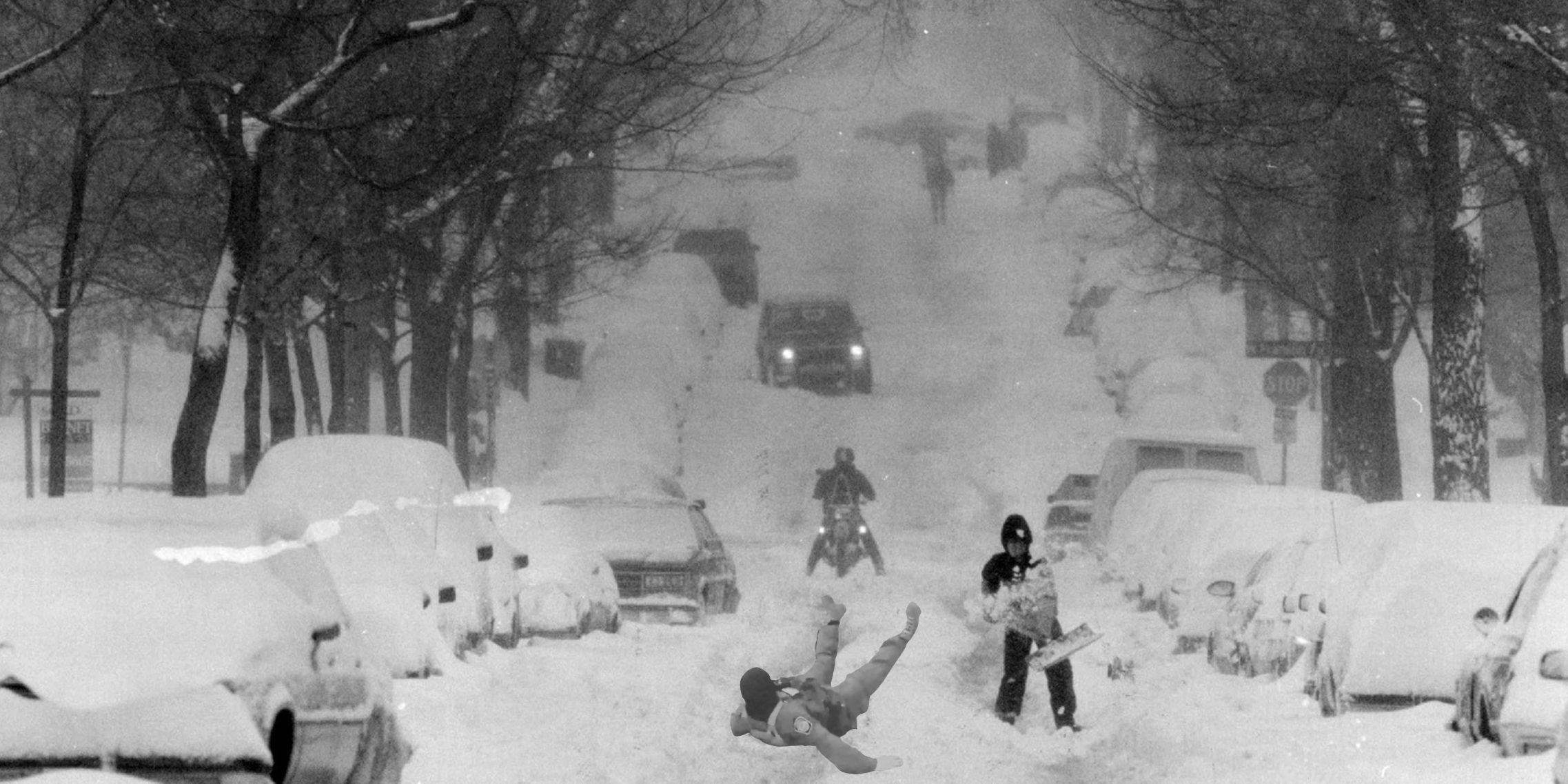
When I moved to the Twin Cities from Florida in 2013, and experienced what many called the quintessential Minnesota winter, many lifelong residents confided, “If you can survive this, you can survive anything.” We lived in Woodbury, a quiet suburb east of St. Paul, with my then boyfriend’s family, and I worked at the Mall of America, famous for its square footage and massive indoor amusement park. That winter boasted record snowfalls and over 90 days below freezing, but I never questioned my move to the north star state.
I still remember the morning commute when the roads were so treacherous our car spun around on the freeway like a wooden top, barely missing a semi-truck. It took many years to understand the ebbs and flows of winter and the seasons, and like the Halloween Blizzard of 1991, that some Minnesota winters can become the stuff of legend.
I’ve always wondered what winters were like in Iran, the place of my father’s birth. I’ve heard that they are not so different from here: the air gets bitterly cold, there is snow. Rich people go to expensive resorts and ski on mountains. I’ve read stories from Iranian writers who visited their grandmothers, detailing what their lives were like before their forced expulsion. I see images in my mind of the black-and-white cinematography of the Iranian New Wave film movement from the 1960s and superimpose brilliant colors—haunting shades of cerulean, crimson reds, shimmering metallic golds and silvers—onto the desaturated, reconstituted images passed down to me through media from a homeland I cannot visit.
I wish I could tell you I’ve had a lifelong connection to my heritage, that I can recount all the tales about my family lineage or what their lives were like in Iran. The truth is, it’s been a slow unraveling, and much of what I know about being Iranian I’ve learned on my own. Not too long ago, I came across the phrase “fire jumper,” a derogatory reference to Iranians in legal documents, books, and films. I discovered that the term likely originates from the holiday of Chaharshanbe Suri, the Wednesday before the Iranian New Year, known as Nowruz, which coincides with the Spring Equinox. It has been celebrated in various forms for thousands of years by many peoples across parts of Asia to usher in the renewal of spring and new life.
The most fascinating part of Chaharshanbe Suri is the practice of jumping over bonfires—a ritual that involves a chant while leaping over flames to ask the fire to take away woes and offer good health and energy in its place. I’ve read that people who are unable to attend the bonfire festival can light a candle on the floor and hop over it, repeating, sorkhi-ye to az man, zardi-ye man az, your red will be mine, my yellow will be yours.
The tragedy seemed to ripple through every corner of Iranian life, but there were no check-ins or acknowledgement from anyone outside our diaspora.
In January 2020, while working at a bookstore in Minneapolis, I hid behind stacks of books while frantically updating Twitter to figure out what was going on in Iran. My grandmother was still alive, living alone in Tehran. I thought of her, always quietly grieving never having known her. Did the war begin—the one that is always dancing on the edge of a knife? The US assassinated an Iranian general with a drone strike, and a coworker had to talk me down from a full-blown panic attack.
Five days later, a passenger plane, Ukraine International Airlines Flight 752, was mistaken for an incoming cruise missile and was shot down by the Islamic Revolutionary Guard Corps, killing all 176 people on board. The majority of the passengers were Canadian Iranians, and the tragedy seemed to ripple through every corner of Iranian life, but there were no check-ins or acknowledgement from anyone outside our diaspora. I was no more than one or two degrees of separation from most of the people on that passenger plane, and it was shocking to realize just how small we were—how few of us there really are. In the public consciousness, these acts of violence were swept away because of the pandemic, and any prior events have faded into a hazy dream of American apathy.
Six years later, on January 7th, Renee Good was murdered in broad daylight while looking out for her neighbors in South Minneapolis, two miles from my home. She was a fellow writer, a poet, and a new community member. Hours later, I learned about the protests happening in Iran. According to reports, millions of ordinary citizens took part in nationwide protests that were followed by an internet blackout. It was reported that the state murdered tens of thousands of civilians—men, women, children, the elderly. It’s unclear which sources to trust.
When I close my eyes, all I see are bodies in black bags piled into mountains. Then I see the anonymous figures wrapped in foil blankets in overcrowded detention centers. I want to weep. The decades-long suffering of Iranians at the hands of their own government and the international community is so complex, I hardly know where to begin, but the sanctions against the country have affected ordinary people and the economic strains have long been past the breaking point. The people’s need for freedom has always been vocalized through protest, and the echoes of what’s happening there and what’s happening in Minneapolis are eerily similar.
Last winter, I went on a Caribbean cruise with a large group of friends. The husband of one friend is an academic, a fellow writer, and part of the Southwest Asian/North African diaspora. We had a lot in common and shared the usual gripes about academia and our experiences as SWANA creatives. As we walked along the promenade of the ship, past bustling bars and restaurants, we spoke frankly about the state of the world. He asked how I was doing, how my community was doing, the implication being: How are we functioning in a society that is largely ignoring genocide in Palestine? I answered matter-of-factly, “We’re not okay. It seems like half of us are immunocompromised and the other half is riddled with anxiety and depression.” I gestured at myself, “I’ve been drinking too much.”
I can no longer filter between grief for my community in Minnesota and the loss of life in Iran.
As our friends approached we quickly changed the topic like an unspoken rule of engagement. Most people, even the ones who love us, do not want to hear about the struggles of where our families come from. I have some empathy for people who don’t have the emotional capacity to understand the complexity of what it means to be an immigrant or a child of immigrants, but I also have anger. More and more, I realize I have to be discerning about where I spend my energy.
At the start of my thirteenth Minnesota winter, I was invited by Mizna, a local Arab arts organization, to read at Baba’s Hummus House with a couple of other poets. I was worried because I heard ICE was ramping up their vicious surge in the Twin Cities against our Somali neighbors, and I didn’t want anyone to get hurt or taken while coming to the event. The sidewalks were already frozen slick early in December, and my body was rigid from the jagged cold. It had been years since I was invited to do a reading, and the familiar feeling of performance anxiety crept over me.
When I walked inside the bustling venue, however, I was immediately greeted with hugs and good wishes from friends and acquaintances. There were makers setting up their wares for sale; one vendor displayed enamel pins featuring a black cat holding a slice of watermelon and another offered wonderful smelling candles. The atmosphere was warm and supportive, and the people who filled the restaurant were beautiful and full of life, and I remembered why I love living here.
This winter has been difficult and at times claustrophobic. Many people still cannot leave their homes or send their children to school. I am unable to process all of these tragedies at once, so I compartmentalize my emotions and try to focus on survival. My mind is always at my front door—the thin barrier between safety and the terror lurking outside. The act of performing normalcy during an occupation has carried a high price with the emotional and physical health of everyone I know, and in this moment of prophecy, I am on the precipice of an immunocompromised-related diagnosis.
Sometimes my needs and external forces are too much for the body, my body, to handle. I can no longer filter between grief for my community in Minnesota and the loss of life in Iran, and the increasingly dire situations our governments have put us in. The calculus of devastation is beyond my comprehension.
My partner’s birthday was the first week of February, and he wanted to support local businesses affected by the ICE raids, so we drove to Nicollet Avenue for the first time since Alex Pretti’s horrific murder. A cop car was parked on the sidewalk facing the memorial and two police officers observed everyone who solemnly gathered to pay their respects. I assumed we were being filmed so I wore my KN95 mask, my hot breath shortening with each inhale. I couldn’t tell if I was numb from head to toe because of the cold or fear or rage.
We stood there among the wilted flowers, heartfelt handwritten signs, a community of candles, some lit and others burnt out, and for a moment I was transported to the bonfires of Chaharshanbe Suri, jumping over the flames to take all of the grief away. I let the emotions pass through me for a minute before realizing the restaurant we wanted to support was closed. The sign on the door read “Ice Out.”
This winter has been long. Unrelenting and brutal. Some of us did not survive to see spring, but the fierce resistance by my neighbors has been life-giving. “If you can survive this, you can survive anything.” I keep repeating this to myself like a mantra and wait for the frost to melt and reveal new growth. Even if we do not make it, that day will surely come.

Michelle Zamanian
Michelle Zamanian is an Iranian American writer living in Minneapolis. She is a graduate of Minnesota State, Mankato's MFA program and was an editor at The Rumpus for six years, creating and managing the We Are More column that published SWANA writers. She is currently working on a creative nonfiction project that focuses on weaving together pop culture and personal stories.