Letter From Minnesota: “If They Take Me and Leave the Children...”
Kao Kalia Yang on Preparing For the Worst in the Face of ICE’s Occupation
Today is Tuesday, January 27th, 2026. I got gas for the first time this year by myself. The gas station was mostly empty. I drove into the station, heart thudding in my chest. I did everything as fast as I could. The few people around, the dark-haired man putting air into the tires into his truck, the white woman who came into the station behind me, each of us quietly doing our business as fast as we can in the cold. I dared to venture out because ICE murdered Alex Pretti this Saturday—just as ICE showed up on our block and went to the house of one of my Karen neighbors, and because I know that Greg Bovino is leaving and Tom Homan is coming, and this is a period of transition, a little break from the escalating pressures pushing us down.
On Sunday, my white husband and I, a Hmong woman, talked to our three children: what happens if Mommy gets detained? If the children are with me and they are taken with me, then we try to stay together as long as we can, hold tight, don’t cry. If they take me and leave the children (as they left the other children on the east side of St. Paul when they took the parents away), then if the oldest of the children has her Gizmo watch and if it is able to make a call, she should call her father (my husband is a teacher and when he is in school, reception is not guaranteed), and if that doesn’t work, she should call one of her aunties, the one who answers her phone the most. If the Gizmo watch doesn’t work, if they are not home, they should go to the nearest gas station or an adult with a whistle and ask to use a phone. They should call the police. At the police station, they should tell the police that one of their aunties is a judge and give the police her name, and if that doesn’t work, then the children should give the names of their white grandparents and tell the police officers that the couple live in the senior co-op close to the lake. The children are scared. My ten-year-old sons put on brave faces. One looks only at his feet. The other has sucked in his lips so that his mouth is a line of folded flesh. The welling of liquid in my eyes fall from my twelve-year-old daughter’s. I tell the kids, “It’s not your job to save mommy or to protect her. I want you three to stay together and be safe. I’m the adult here. I’m a US citizen. I’ve no criminal record. I am… afraid, too.”
I am afraid because I am a naturalized US citizen. I came here at the age of six. I came as a refugee child whose whole world was a refugee camp right up until leaving for America. At forty-five, I am still the size of a child. Easy to shove, to push, to take. In my community and around me, I see ICE taking other naturalized citizens…
One, a grandfather, without a shirt or pants, just a pair of shorts and slippers, a man who has done nothing wrong. The snow white on the ground. The house, small, typical of the Hmong east side houses I’m surrounded by. The neighbors gathering, shouting, whistling, screaming for help… help that is a message of love but like all love powerless to prevent the hurt from happening. A grandchild’s blanket thrown over his bare shoulders to keep the cuffed hands hidden, the Minnesota cold from biting into shoulders that have been pushed down by too many hands, too much force. Two agents on either side.
I find myself wondering if I still have a home here in Minnesota, in America, in the world of the people who get to decide who is valuable and who is not.
I remember a story my father told me about the moment he and my mother, with their month-old baby strapped to her front, walked into Thailand, after the crossing of the Mekong River and the years of starving in the jungles of Laos after the Americans had withdrawn their troops from a war the world had declared over, how shreds of his skin fell from his sides like ribbons (because in the crossing, he’d tied the whole family to cuts of bamboo so that he could drag them, and the currents had been strong and the bamboo had sliced through his flesh), how he had on no shirt, no pants, no shoes, just a pair of underwear… How the Thai farmers on the road had gathered to look at the thin man and his thin wife and the baby that looked like a burlap sack in her arms, brown flesh sagging off bird bones, how one threw an old t-shirt at him, how it fell to the ground and how he picked it up, dusted off the dirt, and tried to put it on, and then walked to the fenced compound where the Hmong were to register as refugees of war, how at its gate, his feet halted, and how a Thai soldier punched him and how he fell to the ground.
My father had said to me,
My heart hurt more than my body—the flesh can take blows, the heart suffers them. It was the first time I felt that there would be no other place like Phu Khao, the village where I was born. The soldier who hit me was an older man. I was like a prisoner. I stood still, and then I walked into the place they would keep me. And I kept thinking: I was a man, too. I had a wife and a child. But it didn’t matter because we had no home anymore.
All my life, I’ve carried these words. Born a stateless child in that place where they kept my father, my mother, my older sister, and countless other refugees. For the first six years of my life I thought the whole world was a refugee camp. I saw people come in. I saw how we couldn’t leave. I saw how those who did never returned. I used to ask the adults around me where home was. With their words, they painted mountains far taller than I knew to imagine. With their words, they paved pathways across oceans to a place called America…where a little girl like me could go to school, become educated, and do the work of building a better world.
All these years, that has been my goal. As a writer, I’ve tried hard to tell the stories of my people and others who have fled their homes in search of safety and a future, and now all these years later, I find myself wondering if I still have a home here in Minnesota, in America, in the world of the people who get to decide who is valuable and who is not, who belongs and who does not, who lives and who dies.
So, today, now bright with frigid sunshine, I sit in the eerie silence of my house on the east side of St. Paul—alone until I sneak out to pick up my children from school—and hope to return with them once again. There’s gas in my car but I’ve nowhere to go, so I sit here, and I try to do what I’ve always only ever done: look toward the far distant horizons for the rise of mystical mountains of my people, for the invisible arms of my ancestors, to keep me steady for one more day.
I find myself thinking: each day is another day for my three children to grow up a little more, for the one boy to learn how to wash his hair better, for the other boy to be able to put lotion on the eczema patches on his arms and legs, and for the girl to grow her arms a little bit stronger so she can hold her brothers—if there should come a day when I won’t be here to hold them all close, to pull their bodies into mine, to whisper to them, “You are safer here than anywhere else in the world because the arms that love you the most are holding you tight.”
I write the words I believe to be true even as I know how terribly strong the arms pulling us apart are, and how love, even the most powerful kind, cannot protect, how it bears witness only, how it remembers and carries the words on, until our breaths are no more, until the homes we’ve been looking for our whole lives open their doors and invite us in.
Kao Kalia Yang, Mother
St. Paul, MN, USA
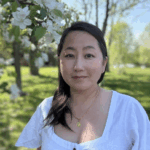
Kao Kalia Yang
Kao Kalia Yang is an award-winning Hmong American teacher, speaker, and writer. Her work crosses genres and audiences and centers Hmong children and families who live in our world, who dream, hurt, and hope in it. Yang’s writing and speaking are concerned with the plight of refugees from around our world, ideas of belonging, and the depths of the human experience. She holds an Honorary Doctorate of Humane Letters from Carleton College, was the 2024 Star Tribune Artist of the Year, and is a Guggenheim Fellow. Kao Kalia Yang lives in St. Paul, Minnesota with her family. Learn more at kaokaliayang.com.