Letter From Minnesota: How We Get Through the Darkest Nights
Molly Beth Griffin on the Defiance of a Neighborhood
I am white and I was born in Minnesota, and because of that, there is a lot I don’t know, a lot I can’t ever truly understand. But I am here, and I am terrified and furious. We all are. The Powderhorn neighborhood of South Minneapolis has been my home for 20 years, and Renée Good was murdered by federal agents just on the other side of the park from me.
The park, where yesterday ICE agents teargassed morning dog walkers, between the playground and the skating rink.
The park, where I spent countless long days with my kids when they were small, and maybe Renee did too. Maybe our kids played together and maybe we said hi, each sipping our strong iced coffees from the hippie café around the corner while we pushed little people on swings. I don’t know if our timelines matched. (And I don’t know how many moms’ names I asked, how many moms’ names I forgot. I can’t go back and ask again.)
There is a lot I don’t know.
But I am a queer person, like she was, and as a queer person, here’s something I do know.
I know that for us, family is something you build for yourself. From scratch, usually. With decisions and intention and a stupid amount of paperwork.
I know that for us, community is entwined, entangled with family, knit together, that community is an active seeking, a constant reaching out toward people who are reaching back.
In this neighborhood, home of driveway puppet shows and pollinator gardens, parades of stilt walkers and tall bikes, ice skating parties with loud music and sledding festivals where we cheer for each other’s weird cardboard creations as they hurtle down the hill—in this neighborhood, there is a queerness to everything.
I do not know why Renee Good moved to this neighborhood, but I can guess that it had something to do with being a poet and being a queer person and feeling at home here.
By that I mean a deliberateness, an openness, a questioning, a throwing off of tradition, an embracing of something wild and silly and irreverent and delightfully bizarre.
We cheer those homemade sleds—we cheer when they are beautiful and we cheer when they are ridiculous, we cheer when they make it down the hill intact and we cheer just as hard when they fall apart along the way. Maybe even harder.
Because it’s ok to fail here. It’s ok to fall apart.
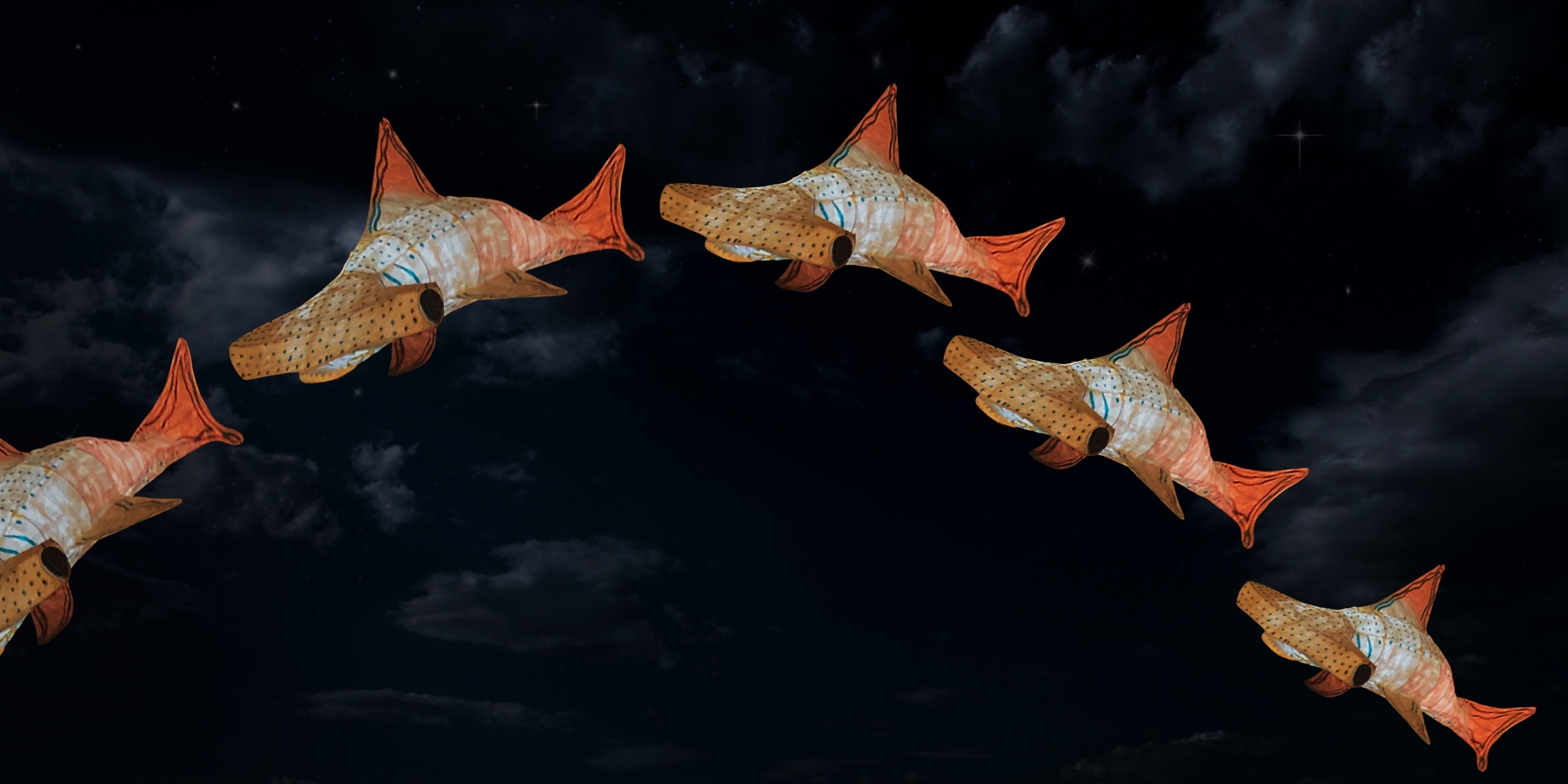
We’re all remaking ourselves all the time, with art, with drums, with poetry. With giant animatronic dinosaurs and paper lanterns shaped like hammerhead sharks.
(Of course, our neighbors just say, and shrug, of course there are hammerhead sharks and they are lit up from the inside and that’s how we get through the darkest nights. Fierce and glowing.)
I do not know why Renee Good moved to this neighborhood, but I can guess that it had something to do with being a poet and being a queer person and feeling at home here, just like me. It is devastating that she died here, murdered by masked government thugs because they felt threatened, because they were “scared.”
But I hope that our light and our joy continue to terrify people who do not understand community, who cannot appreciate the beautiful defiance of a whole neighborhood saying NO, all these children are OURS and we built this family for ourselves, entwined and entangled, knit together.
Here, we are lit up from the inside and that’s how we get through the darkest nights.
Fierce and glowing.

Molly Beth Griffin
Molly Beth Griffin is the author of many picture books including Ten Beautiful Things, Just Us, Rhoda’s Rock Hunt, and Rings of Heartwood: Poems on Growing. She has also published a YA novel, Silhouette of a Sparrow, two poetry chapbooks, and a series of beginning readers. Molly is a teaching artist at The Loft Literary Center and a graduate of Hamline University’s MFA program in Writing for Children and Young Adults. She critiques manuscripts, visits schools and libraries, and hosts a monthly Picture Book Salon in Minneapolis, where she lives with her partner and their two children.