Letter From Minnesota: Going From the Nightmare to the Poem
Kara Olson on the Struggle to Make Meaning From Chaos
Living in Minneapolis right now feels like a waking nightmare.
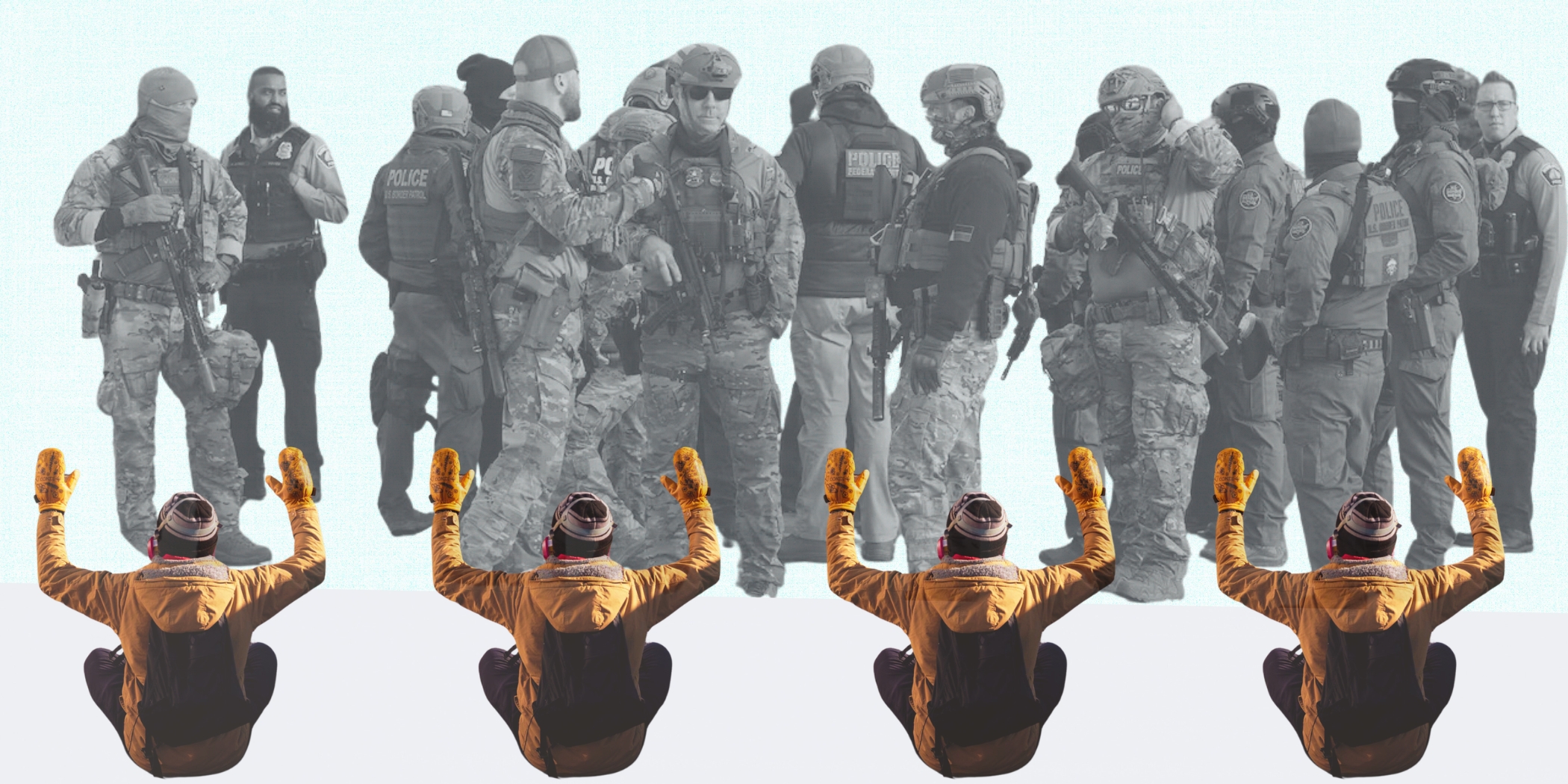
I write this on Friday, February 7, 2026, one day after I witnessed an active abduction on the 46th Street bridge over 35W Interstate. I had just dropped off my dogs at daycare when I heard whistles and car horns at the interstate intersection. Five masked men were rampaging a utility van. I was stopped at the stoplight. A handful of observers where recording from a distance. Within minutes, those agents had snatched a man from the van and fled the scene in their fleet of vehicles, heading south on 35W, presumably to the Whipple Federal building. I immediately texted my rapid response chat, reported what I could see. They relayed it to the proper channels. I drove away with my hands sweating on the steering wheel. I am still processing this horror.
A few months ago, I saw scholar Alexis Pauline Gumbs in conversation with writer Erin Sharkey at the Loft Literary Center. They were discussing Audre Lorde’s legacy. I jotted down notes, which I’ve returned to this week. Audre Lorde kept track of her nightmares and talked about going from the nightmare to the poem. Gumbs said Lorde was interested in making the nightmare a profound moment others could feel: “Lorde’s work shows us how to be present in the infinite power we have in every moment.” I know so many poets right now in Minnesota are called to do the same thing. We won’t unplug. We know what we’re seeing.
Today, I was able to get to my neighborhood watch shift, which is outside an adult day center for Somali elders. For much of my morning shifts, I’m intermittently opening the door for the elders while checking license plates for out of state SUVS in the vetted signal chat. The elder women call me hoya, a term of affection. When I put on my whistle before walking out the door, I feel like I’m putting on my neighborhood armor, wearing the collective over my heart. Mornings like these, when my shift partner and I have sweaty hands from hypervigilance and wrecked nervous systems, I find myself nearly crying at the beauty of being with my neighbors so closely and somewhat regularly. This poem grew out of that experience.
*
“Whistle”
after Hua Xi
You slip the whistle’s cord necklace over your head and neck,
unsure of your singular voice,
even though you are the wind howling.
While evergreens across the city share intel through their roots,
checking license plates in the vetted signal chat,
six hundred wool hats
spell out SOS on frozen Bde Maka Ska.
You must blow your high pitch trilling
if the pine on your block signals a threat,
if the poem becomes a nightmare.
You run from your home half-dressed,
if you hear the call.
You’re so familiar with your neighbor’s sound,
like one large animal
shrieking in the woods,
you carry it down the avenue
past the city parks, beyond the river’s shore.
You carry the ferality of the peoples’ heart
like the snow who refuses to individuate
after falling to the ground.
In paradisal winter light,
outside the park’s rec center,
you signal when an observer is snatched.
When out of state SUVS swarm
the daycare on the corner, the lake cries
louder than the helicopters overhead,
though it does not make any waves.
It is too frozen and numb.
You are torn through shattered car windows.
You eat stealthily delivered groceries in hiding.
You shiver, barred from seeking council, detained in shackles.
Still, the masked agents
waking in their own vomit
forget you are wind.
You are held in the mouths of 80,000 neighbors.
You have carried the screaming whistle in your every cell.
Those drowning know its sound.
*
Reading and thinking about Audre Lorde during this time also had me thinking about how we dignify a person in response to slaughter, especially after what my neighbor Becca witnessed and experienced alongside her wife Renee. When my friend Junauda Petrus, our current Minneapolis Poet Laureate, called to see if I could help her put together poetry for Renee’s service, she told me Becca was unaware of the writing that was pouring out of our community—Becca, and her son, and her son’s school, were overwhelmed with being slandered and attacked. I felt a need to find language and a praising form, like the psalm, that would dignify Renee, a poet herself, and Becca. The opening lines came from this urgency to wrap love around them, to make their loving nature visible in the face of horror. By this point in DHS’ siege, I could feel the rage and grief in our streets transforming into something bigger than any one of us.
*
“For the Goods, a Psalm”
Do you know how lovely you are?
I want to say to my neighbor,
Becca, who I wish I could return
her loving wife, Renee, to.
You are so human-holy, I want to say
to Renee, who,
Becca says, was the kind of person
who would forgive her killer.
I can’t stop seeing you two
holding hands
for the entire six-hour drive here
to make a better life.
You are lovely and you are crying.
You are those mothers who know
the photo of the detained is always
someone’s baby. Here,
where breathless nurses
run into the fields beyond
Whipple, searching for our neighbors
left harrowingly in arctic woods,
Renee, you are beaming, you are
glimmering over our shoulders.
Here, where we can’t tell
our bodies from one another,
Minneapolis is falling
like love the world over.
Kara Olson
A recipient of The Sewanee Review poetry prize, Kara Olson's work has appeared in Grist and other publications. Her debut manuscript, The Order of Blooming, was a finalist for the 2025 National Poetry Series. She lives in Minneapolis.