Letter From Minnesota: Finding Reverence in the Face of Brutality
Ed Bok Lee on the Courage of Alex Pretti and His Fellow Minnesotans
So far this year, in Minneapolis, there have been three homicides, two of them by ICE.
Eat Street in the Whittier neighborhood, where Alex Pretti was gunned down Saturday morning, is historically the closest thing to a “Chinatown” in the city, though really, it’s much more diverse. Mexican, Vietnamese, Chinese, Japanese, Jamaican, Greek, German, Irish, East African, Mediterranean, Malaysian, Tibetan, etc. restaurants, grocers, and other businesses reflect some of the best aspects of Minneapolis, on many levels of community—the rawness of its arts, music, and culture; the diversity and hungry American bustle; the high number of transitional housing units, shelters, churches, non-profit agencies.
As one of the most diverse neighborhoods in Minneapolis, Whittier is home to some 25 languages from 30 countries. For a good decade, I lived, worked, and had a writing office all right on Eat Street (Nicollet Avenue).
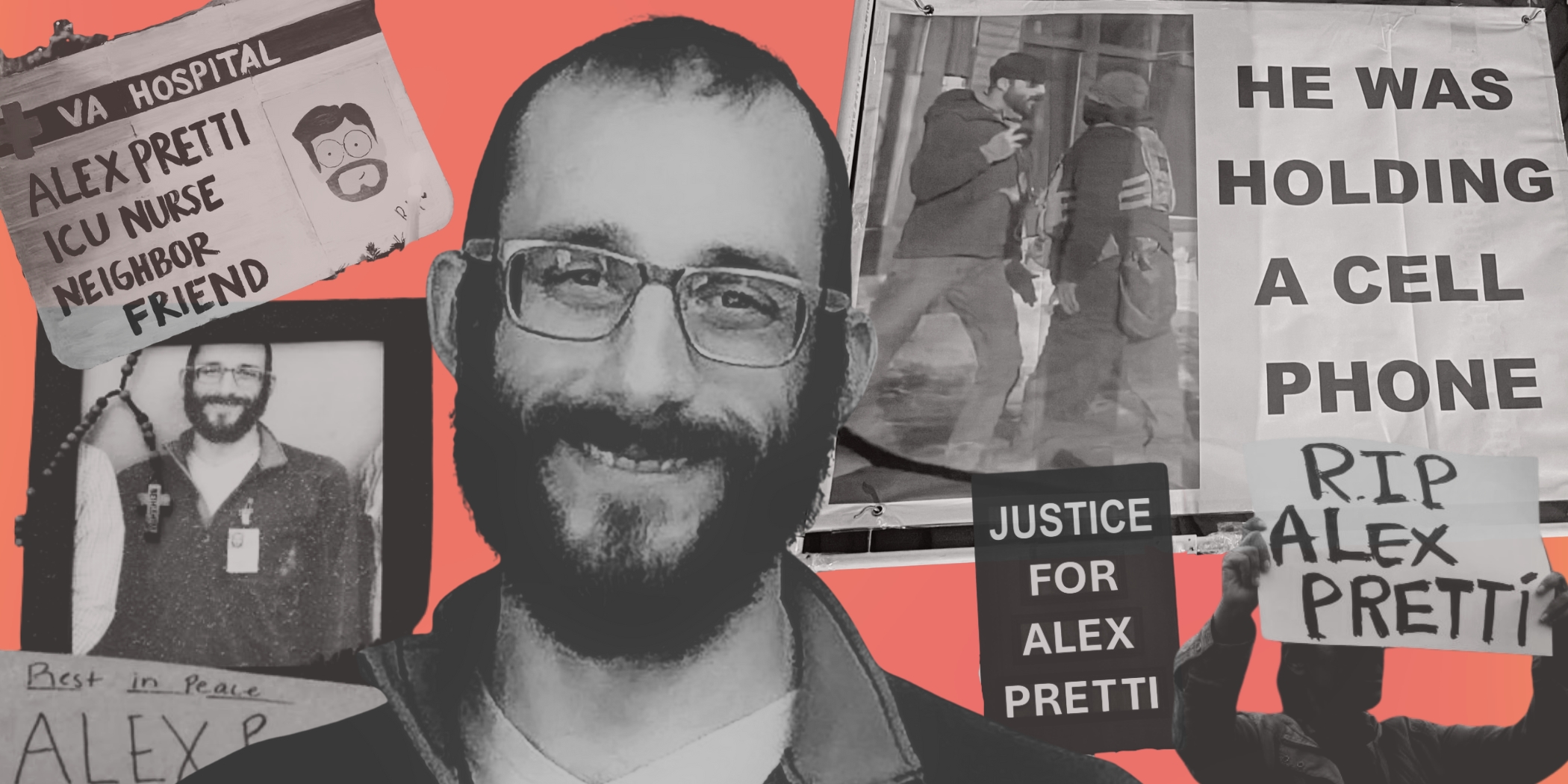
If one word had to describe the feeling on this first night of the new year’s second killing by ICE in South Minneapolis, it would be this: Reverence.
You could say the future lives in Whittier. Literally, aside from being one of the most racially and economically diverse, it’s a Midwestern neighborhood with one of the highest populations of folks 18 to 34 in the city. On the night after Alex Pretti’s brutal and brutalizing killing, long into night, amid -9 F cold (with a -20 F windchill), many hundreds of folks (coming and going), mostly zillennials, kept vigil late into the night, setting up tables for hot soup and coffee, chanting, holding space for Mr. Pretti’s and one another’s spirits, and keeping shops open. b. Resale, a women-owned, LGBTQ-friendly curated secondhand clothing boutique, stayed open so the vigil keepers could sit and thaw, or get a free, extra pair of tube socks, or hand warmers, or bottles of water. Meanwhile, next door at Glam Doll Donuts, right across the street from the scene of the killing, mourners warmed up with free coffee and hot chocolate.
For the hour I could lay a flower down and pay my respects at the memorial site on the sidewalk in front of New American Development Center before my toes in my heavy boots went numb, our call and response never ceased:
“Say his name!”/“Alex Pretti!”/“Say his name!”/“Alex Pretti!”
Near the memorial site of hundreds of flower bouquets and candles, a few controlled fires raged, warming fingers, noses, and lips. The mood was somber, glowing, and peaceful. But if one word had to describe the feeling on this first night of the new year’s second killing by ICE in South Minneapolis, it would be this: Reverence. Reverence for Mr. Pretti’s intentions and actions. Reverence for all the others in recent—and distant—memory gunned down by the law, or, in one recent murder of the state’s DFL Speaker of the House of Representatives, Melissa Hortman and her husband, gunned down in their pajamas this past summer by someone impersonating the law.
Amid the call and response on Eat Street last night, many names began to mix in my head.
“Say his name!”/“Alex Pretti!”
“Say her name!”/“Renee Good!”
“Say her name!”/“Melissa Hortman!”
“Say his name!”/“George Floyd!”
“Say his name!”/“Amir Locke!”
“Say his name!”/“Daunte Wright!”
“Say his name!”/“Philando Castile!”
“Say his name!”/“Jamar Clark!”
“Say his name!”/“Fong Lee!”
And the list goes on.
Yes, it’s true. Minnesota, and especially Minneapolis—in recent years, the nation’s epicenter of violence—is deeply traumatized. There are layers and layers of trauma here. From the very beginning with the government’s brutal policies toward Indigenous peoples, to Dred Scott, to a bloody history of labor crackdowns, to vigorous redlining, to uncommonly high Korean adoptee and Southeast Asian, Somali, and other refugee populations leading to anti-Asian and anti-African sentiments, to being a sanctuary city, to some of the highest levels of racial, economic, and educational segregation in the US to this day, there is no shortage of collective traumas to reckon with.
Since Covid, the traumas have outpaced many of our personal capacities to productively process this history and our present society. To this day, you see and feel it in the still-shuttered storefronts in the once lively Uptown area, and well beyond; the still-closed, burnt-down Third Precinct Police Station; the ongoing, ever-shifting human encampments; the many struggling restaurants; the long carlines outside at the food shelves; the curtains drawn in conspicuously ICE-monitored neighborhoods; and, yes, the shuttered daycares and other services, some of which are, or were, as is repeated over and over by the right, run by immigrant and refugee businesspeople currently under investigation for wide-scale fraud by the government.
Daily I witness folks compelled to do something when they see that people, including many women and children, are frightened, trapped, and suffering. Mr. Pretti exemplified this.
Still and nevertheless, as with George Floyd’s murder and the many Minnesotans who showed up in 2020 to make sure justice was served, last Friday’s massively unprecedented and peaceful Ice Out march through downtown seems to mark, among other things, yet another evolution in Minnesota’s attempts to reckon with American history. Maybe, as a curious conservative, in reading this you think we’re all crazy. Or why be so sanctimonious? Or, on the other hand, maybe, on the far left, you know the depths of this nation’s bloody history and think it’s not enough.
But for the tens of thousands, by some accounts 50,000-plus people, who marched in Ice Out just one day before Mr. Pretti was killed, it was something. Whistle-blowing the state-sanctioned brutality collectively is something. And whatever the influence on federal policy all this does or does not have long-term, this anti-ICE resolve has already influenced similar movements in New York, Boston, Portland, Seattle, Austin, El Paso, Philadelphia, and Washington DC, among other cities, who are all attempting to reckon with their own city’s past for the sake of their people’s future.
Daily I witness folks compelled to do something when they see that people, including many women and children, are frightened, trapped, and suffering. Mr. Pretti exemplified this. Despite mutterings to the contrary, it is inaccurate to characterize ICE Out as being about “wacko liberal sheep” drunk on Blue Kool-Aid, as many on the right would have America believe. An ICU nurse with a permit-to-carry does not fit that lazy characterization. The tens of thousands of people who marched on Friday in subzero temperatures—some raising Release All the Epstein Files signs, or Dads Against Dictators signs, or God Sees All signs, or Corruption Kills signs, or Not Like This signs, amid all the Fuck ICE signs—do not fit that lazy characterization.
The government, along with much of purple and red America, pound the message that ICE in Minnesota is all about state corruption and criminality. What they and their supporters do not seem to understand is that ICE Out has little to do with whatever level of corruption there may or may not be in the government, state and/or federal. In fact, to give perhaps the most deserving example, I would argue that anyone with the depth of Mr. Pretti’s conscience and, by the accounts of those he worked with, moral rectitude, is well aware of the corruption among many politicians; and is certainly aware that our two-party system is not just broken, but is on fire, due to corruption.
What much of America doesn’t understand is that with trauma, layers and layers of trauma, can also eventually emerge self-awareness, insight, a free and open reliance on community, and, finally, perhaps a new, however strange-seeming, kind of reverence.
Maybe Minnesota, at the end of the day, will prove to be thick with corruption.
Maybe Minnesota will prove to be the state where our politicians worked the hardest, lost the most face, while trying to hold the now ubiquitous ideology of violent American capitalism at bay.
Maybe, in the end, Minnesota will have been the canary in the coalmine of a much worse future curse to one day visit all Americans at authorized gun point.
Or, maybe, our first night of vigil for Alex Jeffery Pretti, will be a kind of wavering candlelight in the deep, dark moral and ethical power outage that is America, for so many near and far.
“Are you okay?” Mr. Pretti reportedly uttered—his final words to a fellow citizen, as he himself was being pepper sprayed.
The resounding answer is, “No. No one is okay.”
On both sides in America, whether silently stewing, shouting, obsessively checking the market, fighting, blowing whistles, making art, or just sleeping more than usual, no one is okay.
Reverence, however, is still out here in sub-zero temperatures, day in and day out.
Reverence. I know it’s a funny word.
The other week, on our drive home from my fourth-grade daughter’s school in Whittier, two blocks away from what would later become the memorial site of Alex Jeffery Pretti’s death, I mentioned, in passing, that the Minneapolis police we’d just passed on the street, in contrast to the ICE agents, were standing around, assisting people, and behaving with an odd kind of reverence that I hadn’t personally ever seen in their behavior. From the backseat, she asked me what the word reverence even means. In the moments to follow, I struggled with how to define for a child the word without any reference to any formal religion or church, which we do not attend. But I tried my best, all the while recalling, silently, Plato’s words, or warning:
Let parents bequeath to their children not riches, but the spirit of reverence.
After turning off Eat Street, she finally said from the backseat, “Is it kind of like. . . dignity?”
“Kind of,” I said, switching lanes. “But maybe for others. Like when you do something so that not just you, but so that others can be sure to have it, too.”

Ed Bok Lee
Ed Bok Lee is the author of three books of poetry and prose, including Whorled, and Mitochondrial Night. Lee’s poems have been translated into French, Italian, Korean, Chinese, and Spanish; other honors include an American Book Award, an Asian American Literary Award (Members’ Choice), a Minnesota Book Award, a PEN/Open Book Award, and two McKnight Artist & Culture Bearer Fellowships. With a background in local journalism and political theater, he teaches at Metro State University in Minneapolis/St. Paul.