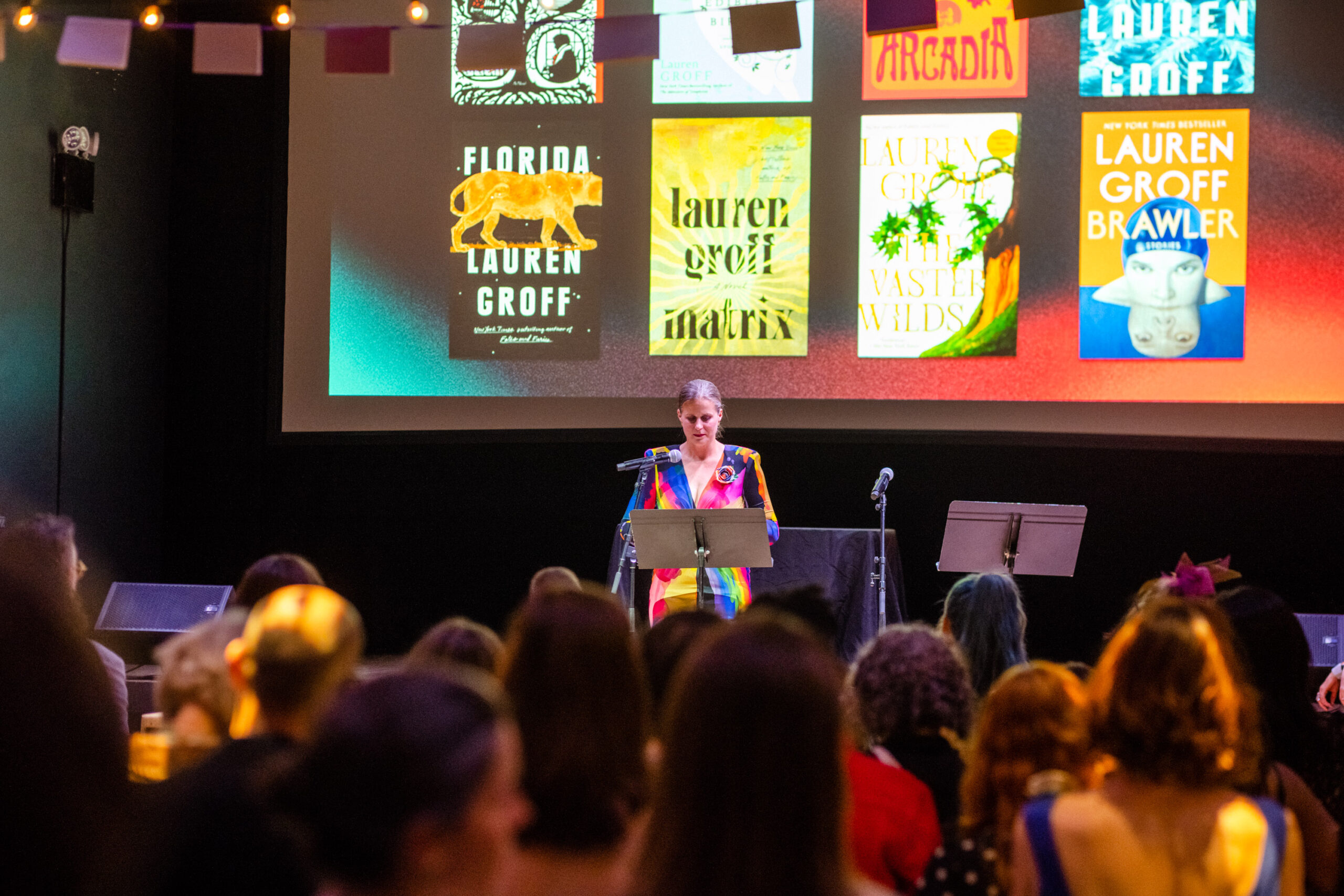
Lauren Groff: There is No Such Thing as Boredom, Only Noticing
From Her Speech at the 2026 One Story Debutante Ball
My soul is so full that we are here together tonight. Thank you, Hannah and Maribeth for your loving, clear and steady vision for One Story. I can’t believe it has been eighteen years since I had the giddy delight of publishing, “Sir Fleeting,” in your pages. Over the years, the joy you have brought me, and everyone in this room, is profound. Thank you Senaa Ahmad, Lily Berlin Dodd, Stephen Fishbach, Cay Kim, and Lior Torenberg, for being so brilliant. Thank you, mentors, for lending your wisdom to help these writers come to their fullest visions more quickly. Thank you, guests, for supporting one of the greatest short story institutions in this country.
I’m going to tell you about something that happened this past week; or, perhaps, something is the wrong thing to call it, and we can think of it as an enormously generative nothing. For context, you should know that for the past little while, I’ve been pretty blue. Cerulean, navy, midnight blue. Crying in my bathtub while listening to the Telepathy Tapes blue. For one thing, when extremely evil people never seem to get their righteous and fiery comeuppance, my rage can curdle a bit. For another, no matter how much I love one of my books, no matter how nicely it emerges into the world, I always feel a little empty in the months after publication.
There’s a cognitive dissonance between the utopian hope and love in which a story is created, the gift economy for which it’s intended as a sort of sacred offering, and the materialist reality of publishing, with sales figures and publicity, et cetera. Don’t get me wrong, everyone I’ve met who works in publishing is a good and noble soul, and the utopian is always predicated on the material, but there is a strange chasm that occurs when a book comes out and it’s a chasm that no writer, no matter how punk or anticapitalist, has ever been able to leap intact.
For another, no matter how much I love one of my books, no matter how nicely it emerges into the world, I always feel a little empty in the months after publication.
Reading, my normal medicine, wasn’t helping. Exercising until I dropped wasn’t helping. The blank page laughed at me. My family got sick of my moping. At last, I went to a woman whom I consider to be a witch in the most glorious of ways. She listened and made an emergency prescription: I was to do nothing. Specifically, I was to take a pillow and a blanket, go find a little spot of nature, leave my phone behind, and just sit there for roughly an hour without filling the space and time with any intentional action or thoughts, not even a formal practice of meditation.
I would never deny a witch her will. One day, I went to a hill in Alachua, Florida, under a live oak, next to a fence overlooking ten acres of black grazing cows, on an afternoon when the sun poured down in thick gold over the grasses and the trees gently swayed with Spanish moss. I was, immediately, profoundly uncomfortable. Even in April, Florida is hot, and I hadn’t checked for fire ants, which bit my ankles, until I took their hint and scooted away. All creatures have the right to firm boundaries! In any event, stillness is hard.
My thoughts spun and whirled, I made lists, I worried, I gnawed at everything I was failing to do, I embroidered indignation, I engaged in l’esprit de l’escalier, I fell into elaborate hypochondria. It was not going well, at all, at least until I clocked a subtle movement from the corner of my eye, and turned my head to see a giant black rat snake pouring out of its hole in the ground only two feet away. There was a silent boom; in the thrill of the snake, everything unnecessary fell away. The snake weaved, shining like mercury, down the hill, and was gone. In the aftermath, I could suddenly see.
I saw the way each cow was accompanied by its own egret, a tiny white pal, like a personal avian hype-man. I saw the cloud of sandhill cranes touch down and walk, stately and slow across the grasses as the dinosaurs they are. I saw the dazzle of sun on the crows’ wings, I saw the ants’ adorable curiosity as they motored down there in what to them were vast jungle thickets of the grass stalks. I saw how there were layers of flowers everywhere, knee-high phlox, calf-high dandelion and daisy, rice-sized flowers I’d never known existed, buttery cups smaller than a baby’s fingernail, tiny pale suns, white constellations. With all this noticing, there was a slowing, a thickening.Time itself stopped mattering. How worthy it all was of wonder and of love. All of this dazzling richness had been there all along.
I ended up sitting on that hill for two hours. I came home slower, lighter, maybe not less sad, but with a little more green and gold mixed into my blue.
I tell you this because I find myself yearning to give you the things that I so urgently need to tell myself over and over again, these same things that I have forgotten and had to rediscover many times during these thirty years that I’ve put writing at my center. Primary among the things the hill in the sun that day reminded me of is that in order to return to a creative space, I need to bow and touch the hem of emptiness. That, if one is willing, there is no such thing as boredom, only noticing. That there is no need to fill consciousness at all moments with the artificial urgencies of screens, of emails, of texts, of social media; the real urgencies of the bright-eyed woodpecker above my head will always be vastly more interesting. That we can only learn by being unable, but trying anyway. That concession in advance, knowing that one will fail and therefore not even trying is the only kind of failure that is unforgivable, because it is a failure of the moral core, of the courage and the soul. That gauging one’s goodness or worth by the rubric of productivity is a capitalist lie. That it is the process that we must celebrate, not the product. That, like the field, humans require periods of rest, of fallowness, because the fallow gives rise to the fertile. That before one can sing, one needs to understand the power of silence.
Gauging one’s goodness or worth by the rubric of productivity is a capitalist lie. That it is the process that we must celebrate, not the product.
It is so easy to let the opposites of these truths seep in, to get ground down and cynical and burned out. The project of literature, which everyone here tonight is engaged in, is not in any way an easy project. But what glories it contains, how worthy it is to devote the span we get on this plane to the earnest, hopeful, loving embrace of it.
Even if it were possible that one’s entire life in writing be composed of galas like this, one gala after another, you looking so shiny in your suits and dresses, your work celebrated every single night in the way that it should absolutely be celebrated, I wouldn’t want it for you, or for me. Instead, my wish is that we embrace all the other things that make us good artists and good humans: the doubt, the fear, the empty feelings, the longing, the uncertainty, the dry spells, the discomfort, the anger, the dissatisfaction, the feeling of radical skinlessness and vulnerability.
When these darknesses happen to us—and have, and they will—know that we’re not alone in them. George Eliot is right there with us, Toni Morrison, Lady Murasaki, James Baldwin. Every good writer has struggled immensely. And thank the goddess for the difficulties. The green and gold of this gala is so extraordinarily beautiful.But (remember this!), so is the deep blue.
_____________________________________
From Lauren Groff’s speech at the 2026 One Story Literary Debutante Ball. Photo by Aslan Chalom.
Lauren Groff
Lauren Groff is The New York Times–bestselling author of the novels The Monsters of Templeton, Arcadia, Fates and Furies, Matrix, and The Vaster Wilds, and the celebrated short story collections Delicate Edible Birds and Florida. She has won The Story Prize, the ABA Indies’ Choice Award, France’s Grand Prix de l’Héroïne, and the Joyce Carol Oates Prize, and has been a finalist three times for the National Book Award. She has held fellowships from the Radcliffe Institute for Advanced Studies, the American Academy in Berlin, and the Guggenheim Foundation, was given the Howard D. Vursell Memorial Award by the American Academy of Arts and Letters, and was named to Time Magazine’s 100 Most Influential People list in 2024. Her work regularly appears in The New Yorker, The Atlantic, and elsewhere, and has been translated into thirty-six languages. She lives in Gainesville, Florida, where she and her husband own the independent bookstore The Lynx.