Language Play(s): Ensemble, Chorus, and the Redistributed Lyric
Soham Patel on the Poetics of Language, Form, and Situation
When Parag invited me to the American Poetry Museum in Washington D.C. to read, he had imagined a site-specific activation of The Daughter Industry (Nightboat Books, 2026) rather than a traditional poetry reading. The book is a poetry collection structured in three acts with seven players, each assigned a color of the rainbow and an apparition’s name, each of whom needs an audience to fully exist. For Parag’s vision to be realized, we had to rely on the shape of the room, who showed up that day, and how. Outside, it was about to rain. People drifted in and out of the museum, some clearly drawn more by the free wine and empanadas. The site itself, though, had a devoted cast of regulars who arrived with a beautiful curiosity and patience for poetry.
I came carrying a canvas tote stuffed with seven sarong props. They were a gift from family, and each are a presence, symbols for the lives lost to gender violence and the hopeful power each survivor holds.
The ghost called Sidhangana, who acts as chorus, is the rainbow. As for the ensemble: Sai is blue. Shasha is orange. Suvali wears green. Sasmita laughs wrapped in the yellow like the sun sarong. Sajani is purple and Sarah’s sarong is a light purplish, close to indigo. Sheetal is red.
I stood there in awe of everyone’s willingness and care, watching the room take on a life of its own.
I started the reading in a more conventional fashion, on the stage, reading mostly through the prose poems in the book to the audience. The room received the work with laughter, snaps, and occasional utterances of that satisfied poetry moan. Finally, I said I’d read one more poem and then we would do something else.
First, we cast the ghosts into the room. Jake became Sai without hesitation. Sajani was claimed with an enthusiastic, “Oh that’s me!” as Zoe’s arm lifted to take the purple sarong Parag so carefully then handed over from my heavy tote bag. Suvali took longer to be claimed and eventually Ethan was volunteered by the room and accepted with grace. The person sitting between Sajani and Suvali, Reshma, stepped up to be Sasmita. When Shasha/Sheetal’s turn came up Maunica, speaking for her and her two children said, we’ll all three do it!
Sarah’s name was last on the list. I locked eyes with someone seated in the second row, behind a row of seven empty chairs. She said she wasn’t a Pisces, like Sarah is, but soon they smiled and said, “But I am tall, so I can do it.”
I asked the now ghosts to cold read three poems with me. Everyone stayed where they were sitting. Each person held their sarongs in different ways, over both shoulders or draped on one, around their necks, balled up in a fist, placed neatly on a lap. It was surreal to hear the children in their soft and confident high voices so easily followed their lines’ prosody even as they staggered through unfamiliar mouthfuls of words and word orders, like “in gravidity” and “during centurion procedures.” In a few instances players found humor in lines I didn’t yet know were funny. I stood there in awe of everyone’s willingness and care, watching the room take on a life of its own.
Poets Theater has been described as improvised, communal life-art (Buuck) and as a loosely structured poetic engagement with theatrical form (Durgin). Poets Theater foregrounds the participatory, shared attention, and the societal conditions under which audiences come to recognize themselves. This dynamic between speaker and spectator is important in chorus-based theater when ensemble voicing and audience’s cognizance of itself shapes the work in real time.
Amiri Baraka’s 1967 play SLAVE SHIP: A Historical Pageant, gathers voices including the captain and sailor, African slaves, and the plantation owner (aka eternal oppressor). It also includes strong olfactory elements and sounds of heavy chains, insistent drumbeats, banjo music, a ship’s rocking and water splashing against the sea, guns and cartridges that all combine in one act that culminates in his audience getting pulled onto the stage in the end to dance with the actors. The demand is a layered witnessing instead of a distanced, more passive interpretation. This use of the collective is different from The Daughter Industry in that the demand on it is less gentle. Because it risks more, it has a reward system that’s more immediate. Baraka’s play presents utterance as a shared medium to confront onlookers with historical racial violence and the resilience of Black Americans.
At the dawn of the Black Arts Movement, a term coined by Larry Neal describing the revolution that celebrated black identity and advanced civil rights, in July 1965, Baraka manifestoed that The Revolutionary Theatre “should force change, it should be change.” The type of theater he proposed “is shaped by the world and moves to reshape the world” producing a heightened awareness of the social reality it both reflects and transforms. It is not always pretty. It denies supremacy, it attacks, and the move is a messy throughfare towards constructing the social anew as he does in SLAVE SHIP through joint production, immersive experience, and cultural reclamation.
My first experience of for colored girls who have considered suicide/ when the rainbow is enuf was with Toi Derricotte in Pitt’s MFA. Our workshop acted out parts of Shange’s text on the first day of a spring semester class in 2010. Performing the text transformed poetry for me from expression to event. Voice moved across bodies. We were awkward and deeply vulnerable. Uncoordinated, clumsy, but still we were inventing a polyphonic texture even if only for the moment. That experience left me with a persistent question I wouldn’t take up seriously until years later: how might a book be written to both accommodate and more importantly require more than one voice?
Ntozake Shange’s choreopoem, for colored girls who have considered suicide/ when the rainbow is enuf (first published as a book in 1975 by Shameless Hussy Press) is told by vocal exchange as testimonial while it takes on topics of race, class, gender, and survivance in the U.S. Shange spotlights communities formed with and by Black women. The title announces the work’s playfulness immediately: enuf/enough, the word shortened as it resists phonetic spelling. She continues this subversion throughout: waz for was, cldnt for couldn’t, yr for your, writing the poem in messenger language long before mobile phones.
Look at lady in blue’s (she’s outside manhattan) lines in the poem titled “abortion cycle #1” : “tubes tables white washed windows/grime from age wiped over once/ legs spread/ anxious/eyes crawling up on me/eyes rollin in my thighs/metal horses gnawin my womb/dead mice fall from my mouth/i really didn’t mean to/i really didnt think i cd/just one day off…/get offa me alla this blood/bones shattered like soft ice-cream cones.” (22) Shange’s simile grinds bones into a soft powder. Each line encourages a body to shift when uttered or even when read silently to oneself.
If experimental and vanguard poetry is set on fragmenting the lyric I, verse plays and poet’s theater redistribute it. Shange manages to replace singular poetic voice with a group of players. They speak without hierarchy, sometimes in unison, in spaces where stagings rely on intimacy with the audience to complete the text.
I am drawn to poetry that is as thoughtful as it is frivolous, privileging invention, risk, and discovery over closure or resolution.
The first staging of for colored girls who have considered suicide/ when the rainbow is enuf was in December 1974 at a Bay Area bar called the Bacchanal. Shange describes the night as having been both improvisational and in process for years. She “had begun a series of poems, modeled on Judy Grahn’s The Common Woman, which were to explore the realities of seven different kinds of women. … the women were to be nameless & assume hegemony as dictated by the fullness of their lives.” (xii) Shange describes the Bacchanal as familiar and minimal.
About twenty patrons were there in the room while all around them five players were dancing, making music, acting, and singing poetry. Shange’s rainbow assemblage manages to be confrontational and conciliatory through a confessional accumulation that collapses poetry, movement, and ritual into a single and ever-changing event.
In her 2008 work Mirror Play, San Francisco Poets Theatre Beloved’s Carla Harryman employs a field of speakers as an engine for organizing meaning between interior perception and exterior reality. Mirror Play advances a third ensemble logic through a built schema for distribution. Refusing the unisonic testimonial altogether and relying more on cacophonic simultaneity, Harryman explores with a polyphonic troupe how outside social forces inform the inner psyche. While Mirror Play is playful (it’s performed with many voices, in many languages, accompanied by a variety of instruments) it takes on the serious topics of class, military and state violence, and the dangers of unreliable media narratives reductively constructing social identities.
Mirror Play performs a reversal; structure replaces order as it begins with the epilogue and is presented backward towards its prologue. In certain instances she might start in medias res and say she’s just going to play around and see what happens, as you can hear her do in this PennSound clip from her Segue Series Reading in 2006. In Harryman’s Mirror Play, the chorus is a method for finding coherence rather than a fixed form. It produces something different every time depending on the room, the players, and whatever the performance inherits from its conditions.
Baraka, Shange, and Harryman taken together can articulate distinct and convergent approaches to multivocal necessity. And while I can’t synthesize cleanly these inheritances or imitate any of them without missing something essential, I am still interested in the generative friction and groundwork they provide as I construct this poetics designed to mirror a durational loop like a yoga common session is meant to be done daily, ideally each morning, soon after waking.
From Apollinaire’s Calligrams to Carolina Ebeid’s video poems, I’m drawn to poetry that treats language as a live medium. I am drawn to poetry that is as thoughtful as it is frivolous, privileging invention, risk, and discovery over closure or resolution. I like poems where a serious idea is rendered in a space that is completely aware that it is in a poem.
In The Daughter Industry, poetry functions as a live situation rather than a private instance, but it also can be both. Close attention to form lets the language travel through many speakers without losing its anchor on the page. The Daughter Industry embeds a decentralized cast into its structure, and each poem is allocated for (an)other to embody or for all to embody at once as when they are Sidhangana (the rainbow).
This impulse toward shared voicing and relational meaning is what attracts me to the verse play as a form. A single speaker wasn’t enough to apprehend the global and generational crisis of gender and reproduction the book takes on. I wrote The Daughter Industry to be both deeply personal and wholly everyone’s, which is how the chorus became at once a structural necessity and an aesthetic choice. Who speaks? Who stands in for whom? How do specters enter the room? What room?
Writing for ensemble demands a particular kind of precision: the language durable enough to be carried, repeated, and altered without collapsing. Authority is temporary and shared equally among seven voices. The spectral figures, marked by their sarong colors, imagined Zodiacs, doshas and more, operate haunto-structurally. They manage to index loss and resilience while navigating an array of performance conditions. Each staging (and reading) of The Daughter Industry produces newly imagined selves, contingent upon the environment, how attention circulates in it, and the players’ sensibilities around what risks can be taken. The poem persists both as a series of occurrences and as a solid object.
The seven empty chairs in the front row of the audience at the American Poetry Museum had been reserved all along for the ghosts, a space saved for voices not yet present. I read the empty chairs as audience but was wrong. They were an invitation. The Daughter Industry remains open, complete and unfinished, awaiting anyone willing to take a seat and speak through voice, song, breath, and/or dance with it.
__________________________________
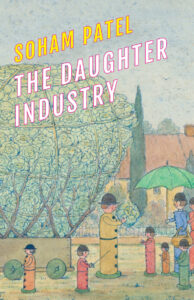
From The Daughter Industry. Used with the permission of the publisher, Nightboat. Copyright © 2026 by Soham Patel
Soham Patel
Soham Patel is the author of The Daughter Industry (Nightboat, 2026), as well as all one in the end/water— (2022), ever really hear it (2018), winner of the Subito Prize, and to afar from afar (2018). They live in Blacksburg, Virginia where they teach at the MFA at Virginia Tech.