Language as Resistance: Camonghne Felix on the Liberatory Potential of Poetry
“We can go to poetry to mark the design of the world we see and the world we desire to conjure.”
A poetic education is premised on the assumption of creative agency, on the idea that each reader has the ability to imagine illusion, to see illusion, to articulate illusion. The training is in learning to qualify it within the line. Said famously by James Baldwin in his book Nobody Knows My Name: More Notes of a Native Son, “This illusion owes everything to the great American illusion that our state is a state to be envied by other people: we are powerful, and we are rich. But our power makes us uncomfortable and we handle it very ineptly. The principal effect of our material well-being has been to set the children’s teeth on edge. If we ourselves were not so fond of this illusion, we might understand ourselves and other peoples better than we do, and be enabled to help them understand us.”
The poet is the first to understand that safety is an illusion that power constructs. We learn through metaphor. For instance, in Atlanta a man self- immolated in front of the Israeli embassy. Police showed up at the scene almost instantly. They pointed guns at him while onlookers cried out for water. They pointed their guns at him as he was burning alive. This image says more words about safety than I can afford. He was unarmed. He posed a threat only to himself in an act of protest. The police pointed their guns at him as he protested for life with his life. This image is a metaphor for the way imperial colonial power pervades every inch of American democracy.
Poetry most uniquely asks us to imagine the surreal, to imagine the hyperreal, and to help us organize and identify the complexity of emotions that make every moment an organizing moment.
When we organize we are taking imagination beyond its limits, attempting to materialize, through the strength of numbers, what has been made impossible by a few. We approach the poetic in order to articulate those realities that we organize against, we can go to poetry to mark the design of the world we see and the world we desire to conjure. In the labor movements of the thirties, the civil rights movement of the sixties, and the Grenadian revolution of 1979, the poem has always been a collaborator in the work of creating and sustaining movements. Books in general have the power to do this, but poetry most uniquely asks us to imagine the surreal, to imagine the hyperreal, and to help us organize and identify the complexity of emotions that make every moment an organizing moment.
It matters, though, that community organizers are the ones who can help shape those choices at the local and federal levels so that community wins center people’s most pressing daily needs. The wins, then, are not partisan, but personal. Every person is touched by the current of the win when the win is personal.
I learned some of this later than I should have, but it doesn’t take away from the fact that I had to. It was inevitable. I am the child of organizers who have fought against imperial regimes for most of their lives, putting their bodies on the line against the connecting oppressions that shaped their world and the world we inherited from them. Eventually I would have to confront the world I’d been running away from and the responsibility that is my birthright. Perhaps it’s because I didn’t want to sacrifice anything, or maybe that I wasn’t ready to.
What I know about the world is cumulative. I take each fact I learn and build on it with a new fact, building and building until I begin to see the shape of the problem, like a puzzle. Often, at the start of a puzzle, you have pieces floating astray in the outline because their place hasn’t yet been revealed. Sometimes my collection of knowledges feels like rash splatters of matter floating with me. Then I stumble on that one piece, that one missing magnetic link, that pulls all these floating, isolated facts together, clarifying the image. That happens with time. That happens with the humility that comes after you realize you’re wrong, which also takes time to develop, which is an unending project for me. I had to find out through experience that I had been thinking wrongly. I had to trust that the intuitive nature that was waking up inside me existed in others, had to let myself be inspired by the thinkers who came before me to be truly brave in my intellectual ambitions. It’s one thing never to have invested in power in the first place—it’s another to accumulate power and then realize too late that you must divest.
In every part of the world, someone is whispering in the ear of someone else that justice is near and that the fight is upon them. In every part of the world, someone is pursuing the activation of imagination on behalf of everyone else.
In the poem (or song, or both) “The Revolution Will Not Be Televised,” written by then teenage college student Gil Scott- Heron, we are offered a praxis. We are told that revolution requires something practical of us, that we cannot participate passively, that we cannot be lured by the images of change that are being sold to us, that it has to come from somewhere inside, that it has to be cultivated in the privacy of one’s mind.
“So when we said the revolution would not be televised,” Heron told filmmaker Skip Blumberg in 1991, “we were saying that, like, the thing that’s gonna change people is something that no one will ever be able to catch on film, it’ll just be something that you see and all of a sudden you’ll realize ‘I’m on the wrong page,’ or ‘I’m on the right page but I’m on the wrong note and I’ve got to get in sync with everyone else to understand what’s happening in this country.’ ”
Our job, as poet thinkers, is to hypostatize the imaginary, to ask the poem to say what we need it to say, to be the ones to proclaim freedom and to document it and then to get in sync with the other thinkers and imaginaries who need to be with each other to build the mass movements that create change and usher in peace. The poem can be a peaceful poem when it needs the reader to find peace. But peace can be unsettling too, which the poem can capture.
I started teaching college students in both undergraduate and graduate study in 2023. This was full circle for me—I had started by teaching young students how to write, both critically and creatively, during my time at Harlem Children’s Zone. Those same students would have been in graduate school by the time I started teaching in higher education. It was as if I had grown into this profession, as if everything about me led to this.
In the fall semesters of 2023 and 2024, I taught a class called Rites of Passage, originally taught by the poet, teacher, singer, and activist Sekou Sundiata in 1988. The class asked my undergraduate students to “consider the role of the Challenge, the Vision Quest and the Initiation in rites of passage.” These are all stages of awakening in which the subject is able to chart her evolution and map out a vision for the future that will guide her in her life’s work.
In my classrooms, especially in my poetry workshops, I ask my students to write a sonnet for the end of the world. The most literal thinkers approach the prompt apocalyptically. They want to write about romance in the face of war, about the blue wraith of gun smoke. I have no expectations when I offer this prompt—there is no right answer—and I wouldn’t tell them even if I did, but always there is a poem with a turn at the end that begins the poem anew, or a poem fixated on incorporeal death with a turn that comes alive, and I am always delighted to hear it, to see it, to live in the imagination of a poem that wants to be somewhere other than where it is. It is an ungovernable poem, a poem outside its limits, a poem outside the poet’s limits, an adynaton.
When I ask them to imagine the end of the world, I am asking them to practice a kind of ungovernability, to pursue an ending—or beginning—that abandons conventionality and seeks a turn that is inherently unfamiliar, ugly in its rarity. The poems that stick with me most are the poems about wrestling freedom away from a predetermined fate, about surviving the end, about living again. By imagining a world that departs from this one, they are choosing to shape how the future might look and work and choosing to determine their own fates, their own deaths, their own chances to come alive again.
We are doing this work of imagining from within the project of the academy. We are, by simply engaging with the experiment of imagination, challenging the academy’s resistance to play, resistance to desystemizing discovery. Doing this kind of work requires the urgency of ungovernability, and requires that we challenge the constraints of the project in order to escape its insistence on order and the replication of order.
My role as a professor is not to guide, but to make space for self- guidance. My job is to teach my students to think for themselves. So when they write, I am asking them to consider the ending as the beginning. I am asking them to investigate and approach nonlinearity as a way to consider how history functions—in literature and, naturally, in the present of our lives.
What does a poet have, and what does the poem allow for the poet? It allows for flight, for departure, for return. It allows for the defamiliarization and disruption of the factory of everyday language, and the factories of rhetoric. When I ask the end a question about the beginning, language returns to me a fact. When I ask a question about ambition, poetry responds with possibility. This is true for the good poets, and the bad poets—we set the terms of freedom.
Our job, as poet thinkers, is to hypostatize the imaginary, to ask the poem to say what we need it to say, to be the ones to proclaim freedom and to document it.
We are well past the days of encampments in universities across the country as I write this, and well into the days of a terrifying but familiar episode of authoritarian repression in which students are being abducted in plain sight by a fascist regime headed up by Donald Trump. Following threats of federal funding cuts, universities like Columbia, which receives most of its funding via endowments, have begun to concede to the demands of the Trump administration, which include empowering campus security to arrest students and to change the leadership and function of the Institute for Israel and Jewish Studies and the international affairs school to address unsubstantiated and baseless claims of antisemitism from pro-Palestinian and anti-imperialist activists.
Journalists on the ground in Palestine, who have been systematically exterminated by the Israeli military, risked their lives and the lives of their families to tell these stories. And they were targeted because they were able to offer to the world narratives that tell the truth about what is happening on the ground in Gaza. Their commitment is not just a reflection of their integrity but a reflection of their commitment to the Palestinian movement for liberation. And their steadfast commitment has had an infectious influence on the work of U.S. student journalists and student activists across the country who work day and night to tell the stories on the ground, stories that defeat the claims of the fascist imperialist state. It’s those same students who’ve been combating mainstream media’s complicity, who have been doubling down on competing narratives that highlight Palestinian resistance, who have been reshaping the stories that the world is being told about Palestine.
I saw these students write some of the best press releases I’d ever seen in the entire decade of my political work. I’ve seen them give interviews that are more strategic and more compelling than all the interviews I’d done in the entire decade of my political work. Not only do I honor these students, but I recognize the poetics of their praxis. It is rooted in an understanding that language can tell the truth, or it can tell a lie. The poem is an empty slate, void, until we decide its intention. What the poets do with that neutrality is good. They make the point of poetry good. The political is personal. And the personal is poetry.
The colonizer’s poetry has no bones next to the lyric of ours.
In the backyard of my grandmother’s home, a passion fruit tree grows, its fruit falling with the weight of a small apple; in its insides, however, the taste of something yearningly tropical and godly. It grows deliberately, without permission, nourishing itself with its waste, with the song of the sun, with the rainwater of hungry, earthly complexity, with the fact of its long life. “You know what this is?” My uncle stands above me, holding a spoon to the open cup of the fruit. I shake my head. “It’s passion fruit. It grows right back there, on our land. You can eat it.”
At the end of the world is a freedom that begins in the mind.
__________________________________
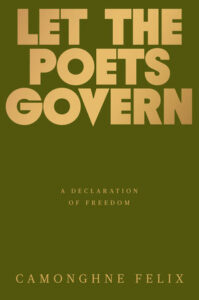
From Let the Poets Govern: A Declaration of Freedom by Camonghne Felix. Copyright © 2026. Available from One World, an imprint of Random House, a division of Penguin Random House, LLC.

Camonghne Felix
Camonghne Felix, poet and essayist, is the author of Build Yourself a Boat, which was longlisted for the National Book Award in Poetry, shortlisted for the PEN/Open Book Award, and shortlisted for the Lambda Literary Awards. Her poetry has appeared in or is forthcoming from Academy of American Poets, Freeman’s, Harvard Review, Lit Hub, The New Yorker, PEN America, Poetry Magazine, and elsewhere. Her essays have been featured in Vanity Fair, New York, Teen Vogue, and other places. She is a contributing writer at The Cut.