Langston Hughes: Novelist, Poet, Activist and... Translator?
Ricardo Wilson II on the Writer’s Experience in Mexico and His Struggle to Bring Mexican and Cuban Writers to American Audiences
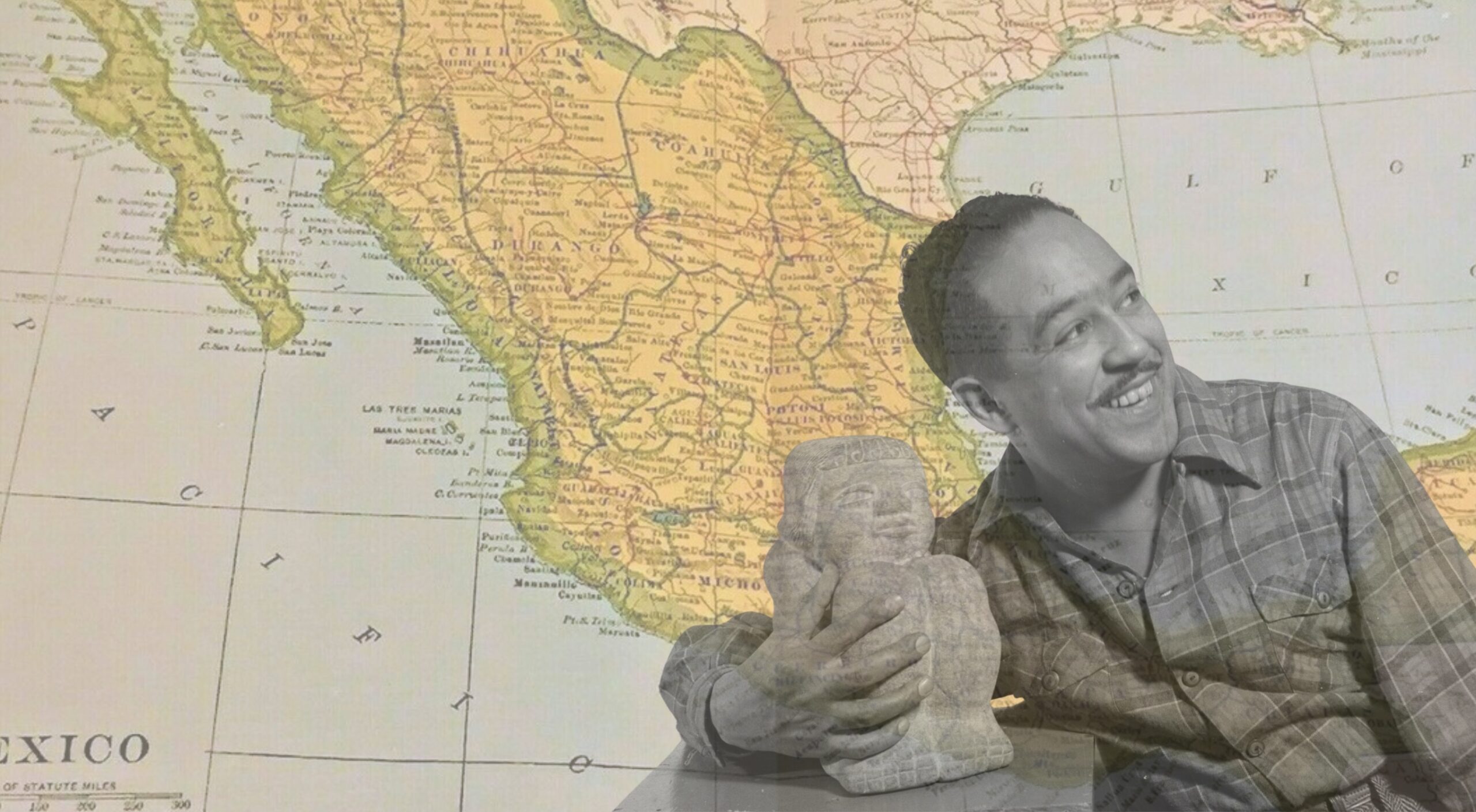
In late 1934, Langston Hughes, already established as a leading voice of literary Black America, traveled to Mexico City, where he stayed for more than five months and began translating short fiction by prominent Mexican and Cuban writers, including Rafael Felipe Muñoz, Nellie Campobello, Lino Novás Calvo, Luis Felipe Rodríguez, Germán List Arzubide, Pablo de la Torriente-Brau, and Juan de la Cabada. The writing depicted Mexico in the wake of its revolution and Cuba in the years between the brutal regimes of Machado and Batista. Troubled Lands presents Hughes’s translations of these stories together for the first time as he originally envisioned.
For Hughes, Mexico was a presence almost from the beginning. He himself tells us this in the early pages of The Big Sea, his first of two autobiographies, recounting how his father, James Nathaniel Hughes, abandoned his mother just as Langston came into the world, first venturing to Cuba and eventually settling in Mexico. James, according to his son, had hoped he “could get ahead and make money quicker” without the presence of Jim Crow laws and the sinews of systemic racism that strangled such possibilities for so many in the United States.
In 1907, when Langston was six, he and his mother and grandmother joined his father in Mexico City as his parents tried again to make a life together. Soon after their arrival, however, as if directed by the supernatural, the earth literally shook with an April quake, and they quickly returned home to the familiar surroundings of Kansas. Langston would not see his father, or Mexico, again for more than a decade.
As one encounters the archival ephemera related to Troubled Lands, it is clear that Hughes remained committed to publishing these stories years after he returned from Mexico.
Stateside, stable ground proved a hard thing to come by. Hughes would spend the next seven years of his life in Topeka and then Lawrence, Kansas, largely in the care of his grandmother, subsisting on short visits with his mother, who had moved to Kansas City in search of a more energetic life. He was fourteen when his grandmother died, and he found himself briefly living with family friends before reuniting with his mother, first in Lincoln, Illinois, then in Cleveland, Ohio. But his mother soon left her on-again, off-again relationship and moved to Chicago with Hughes’s younger brother, leaving Langston in a rented room and dependent on the kindness of benefactors as he attended Cleveland’s Central High School.
Unbeknownst to Langston, in these intervening years his father had risen to be the primary manager for the Sultepec Electric Light and Power Company in Toluca, Mexico, and acquired agricultural and real estate business interests of his own. In 1919, business dealings with the American-owned power company brought James Hughes back to the United States and face-to-face with his son for the first time since 1907, when the occupants of Mexico City had fled the shaking buildings, rushing into the streets.
Langston Hughes, curious to understand this man, and against the protest of his own mother, accepted the invitation to live with his estranged father in Mexico for the summer after his junior year of high school. As he put it, the absence of his father had been the “one stable thing in his life” and something that he needed to explore. Though this visit did not disprove his mother’s negative portrait of James Hughes as a cheap, money-hungry man who resented the underclass, Langston very much enjoyed immersing himself in the Spanish language. He was drawn to the experiences of the marginalized communities his father so despised, and found some maternal warmth from the three Patiño sisters, friends of his father who looked after his business in Mexico City while he was in Toluca. After graduating from high school in 1920, Langston returned to Mexico for a year, hoping to convince his father to pay for an education at Columbia University, where he aspired to matriculate.
While his late-teenage pilgrimages to Mexico, perhaps predictably, did not bring Langston much closer to his father, they did spark his literary productivity. He famously composed his first major poem, “The Negro Speaks of Rivers,” at the age of nineteen while on the train to visit his father in 1920. The poem would be published in the June 1921 issue of The Crisis. In fact, Hughes’s relationship with W.E.B. Du Bois, the founding editor, and Jessie Redmond Fauset, the literary editor, began earlier with the publication of his first two poems, “Winter Sweetness” and “Fairies,” in the January 1921 edition of The Brownies’ Book, the short-lived children’s magazine also helmed by Fauset and Du Bois. Fauset encouraged Hughes to produce a report on children’s games in Mexico, which would appear alongside his poems in the magazine’s “Playtime” section.
In April of the same year, The Brownies’ Book published Hughes’s “In a Mexican City,” an account of the Toluca he had come to know. These initial publications provided the stepping stones to Hughes’s relationship with the Black literary establishment. In a few short years, his work would be featured in the March 1925 Survey Graphic number Harlem: Mecca of the New Negro, edited by Alain Locke, and in Locke’s closely related anthology The New Negro: An Interpretation, which followed later that same year. The Weary Blues, Hughes’s first collection of poetry, was published in 1926, with cover art from the Mexican caricature artist Miguel Covarrubias and the rest, as they say, is history.
Despite a desire for Langston to pursue a degree in what he considered a practical subject, such as engineering, and perhaps to study abroad in Europe, James Hughes was sufficiently impressed by his son’s literary progress that he agreed to send him to Columbia University, provided that he apply himself rigorously to his studies, account for the money spent in a timely manner, and begin to make something of his life in a way that would make his father proud. Beyond badgering his son with letters to ensure that he adhered to those conditions, James would also write to the university administrators to check up on Langston.
In one exchange between James Hughes and Dean Herbert Hawkes, in Langston’s second year, the dean praises Langston’s admirable work while subtly trying to curb James’s unproductive pressure, suggesting that “it would be better not to hurry him [into selecting a field of study] but to give him at any rate a few more months before urging a decision.” But Langston, tiring of negotiations with his father, soon decided to leave Columbia for the real-life experiences, in New York and beyond, that would nurture him. And when his father suffered a stroke soon after, Hughes did not go to his side as he recovered. He would not return to Mexico until 1934, and would never see his father again.
By the mid-1930s, Hughes was already a literary star. Following The Weary Blues, he published another poetry collection, Fine Clothes to the Jew (1927). His other prominent writings from this period include his first novel, Not Without Laughter (1931); Popo and Fifina (1932), a young adult novel centered on Haiti, cowritten with his friend Arna Bontemps; and The Ways of White Folks (1934), his first short story collection. His interest in translation and left-leaning activism were also solidifying at this point in his life. In 1932 and 1933, Hughes traveled to the Soviet Union with a group of Black artists and activists and became interested in translating the poetry of, among others, Vladimir Mayakovsky, Louis Aragon, Gʻafur Gʻulom, and Xiao San (also known by the pen name Emi Sao).
Hughes’s time in Tashkent, the capital of Uzbekistan and a hotbed of Communist thought for those interested in the concerns of both people of color and nations belonging to what we now understand as the Global South, was particularly generative for his radical literary imagination. It is not surprising, then, that August 1933 found Hughes in Carmel, California, taking advantage of the patronage of Nöel Sullivan, a singer and philanthropist with a leftist circle of friends. He first met Sullivan in 1932 and was drawn not only to the offer of financial support but to the community of radical thinkers (both Black and white) in Northern California. Much of the revision of The Ways of White Folks took place in a cottage Sullivan provided to Hughes, and Hughes dedicated the book to his patron.
Amid all of this production, and despite his fame, Hughes was still sorting out the future direction of his career. In particular, he had not succeeded in selling his more left-leaning writing. His manuscripts “Good Morning Revolution” (a collection of radical poetry), “From Harlem to Samarkand” (a Soviet-centered autobiography based on his travels to the region), and “Blood on the Fields” (a labor-centered play) were languishing without interest. Fiction was unquestionably top of mind for Hughes at this time.
In 1934, at the urging of Blanche Knopf, the editor who had supported Hughes’s career since the publication of The Weary Blues, he pitched a sequel to his first novel on his application for a Guggenheim Fellowship. Hughes was vacationing in Reno, Nevada, taking a break from his writing life in Carmel and attempting to reconnect with the lives of the underclass that so interested him, when he found the inspiration for “On the Road,” a Depression-era tale of a poor Black man’s hallucinatory interaction with Jesus Christ and what he called “one of his best stories.” It was also where, after returning a few months later, Hughes received the news of his father’s death and returned to Mexico for the reading of the will.
Hughes arrived in Mexico City shortly before Christmas in 1934, buying a ticket with a six-month expiration. He was held up at the border due to the agents’ surprise that he was “colored,” something not noted on his permit for travel. He joked on a Christmas card to Matt and Evelyn “Nebby” Crawford, close friends and committed Black radicals from his time in Northern California, that the delay lasted only four days, because in the end he simply “pulled a Jean Toomer on them and said my papa was an Indian anyhow, so they put me down as mixed!” He would spend a little more than a month living in seclusion with the Patiño sisters, the “three Catholic old maids [who were] spoiling me terrible, waiting on me hand and foot.” Though his father’s will left him nothing, the Patiño sisters insisted he take a portion of the money his father had willed to them, which Hughes reluctantly accepted. He was processing the death of his father and, as he revealed in his correspondence with Matt and Nebby, enjoyed “doing quite as I please, with nobody asking me to make a speech, or attend a tea, or read their manuscripts, or make a statement.” To Sullivan he would likewise comment that it was “a great relief not to be known.”
The value of Troubled Lands has only grown as the decades have passed, especially now as we find ourselves living within a burgeoning authoritarianism.
By February, however, Hughes had reconnected with his friend José Antonio Fernández de Castro, a Cuban journalist and important literary figure who was working at the Cuban embassy in Mexico City. Hughes, who had first made a brief trip to Cuba in 1927, met Fernández de Castro on his second trip to the island in 1930 thanks to a letter of introduction from their mutual friend Miguel Covarrubias. Fernández de Castro, who had a strong interest in Cuban and global Black literature, had admired Hughes’s work and, in 1928, was the first to translate his poetry into Spanish, publishing his translation of Hughes’s poem “I, Too” in the popular Cuban magazine Social. He also further introduced Hughes to the Cuban literary scene with an essay in the March 1930 issue of Revista de la Habana and, in the same magazine later that year, translated an excerpt from Not Without Laughter. While in Cuba, Fernández de Castro made sure Hughes was acquainted with the leftist literati, and this moment in Mexico was no different.
The anonymity Hughes had enjoyed quickly disappeared as he was swept up into the bohemian Who’s Who of the Mexican cultural elite, and he soon left the Patiño sisters to room briefly and explore the city with two new acquaintances, the poet Andrés Henestrosa and a young Henri Cartier-Bresson. Fernández de Castro would once again employ the press to call attention to Hughes’s presence and help to frame the writer for a new audience, orchestrating, among other articles and photo opportunities, a “personal impression” of Hughes under the headline “Langston Hughes, Poeta Militante Negro” in the March 3, 1935, edition of El Nacional.
Despite the increased social distraction, Hughes’s eye, as ever, remained on writing. At the end of March, he wrote to Sullivan about his translations of “some Mexican short stories” and his desire to explore, with Fernández de Castro, some of the coastal towns with “perfectly jet black” “Mexican Negroes” that he noticed on occasion in Mexico City. By May 1935, buoyed by the acceptance of his Guggenheim application, he decided to rent an apartment in the building where Fernández de Castro lived, the posh and newly constructed Edificio Ermita, in order to focus on the translations.
In a May 20th letter to Marie and Doug Short, friends from the same Carmel circle, Hughes excitedly described his collection of now Mexican and Cuban short fiction as speaking to “the revolutions and uprisings, sugarcane, Negroes, Indians, corrupt generals, American imperialists—mostly all left stories, because practically all the writers down here are left these days.” It is clear from this letter that Fernández de Castro helped to source the stories, introduced Hughes to some of the authors, and, to some extent, aided in their translation. These authors included Rafael Felipe Muñoz, Nellie Campobello, Lino Novás Calvo, Luis Felipe Rodríguez, Germán List Arzubide, Pablo de la Torriente-Brau, and Juan de la Cabada.
On the same day, Hughes would write to Matt and Nebby, thanking them for the small amount of money they were able to send, and telling them that he was “up to my neck as usual, having translated some thirty Mexican and Cuban short stories this last month to make an anthology They are swell. Lots of Indian and Negro characters. Almost all the authors in these countries are left. And some are even lefter than left.” This work not only mirrored the changing nature of his own literary output but very much aligned with the politically active life he had been leading—from his public and vocal defense of the nine Scottsboro Boys falsely accused of raping two white women in 1931 to his consistent campaigning for the jailed Communist Haitian poet Jacques Roumain.
*
However, despite being a bona fide passion project for Hughes, Troubled Lands, as the collection of Mexican and Cuban stories soon came to be called, would not see the light of day until now. After Hughes sent his literary agent, Maxim Lieber, a selection of the translations, Lieber responded that “not a single one of these people, judging by the work you have sent me, can hold a candle to you.” Lieber expressed disbelief that Hughes’s selections represented the best of Mexican and Cuban fiction at the time, and with that, Hughes lost a potential champion for a book project that he believed could help make legible the concerns of the masses of these two nations.
As one encounters the archival ephemera related to Troubled Lands, it is clear that Hughes remained committed to publishing these stories years after he returned from Mexico, even sending a young Ralph Ellison a batch of six for consideration in May 1942, when Ellison was the editor of the Negro Quarterly.
But as McCarthyism came to dominate the social and political climate, Hughes, perhaps for his own psychic and physical safety, became increasingly hesitant to draw attention to past work, including his translations for Troubled Lands, that might be considered subversive. For example, in “I Wonder as I Wander” (1956), his follow-up autobiography that covers the 1930s, his more radical work is muted. And he chose not to include some of his Communist-leaning poetry in his 1959 Selected Poems. Clearly, many factors combined to cultivate an environment that has allowed Troubled Lands, a tremendous undertaking with the potential for wide-ranging impact, to remain a relative footnote in one of the more studied literary careers of the twentieth century. Nonetheless, despite and perhaps because of this then-missed opportunity, the value of Troubled Lands has only grown as the decades have passed, especially now as we find ourselves living within a burgeoning authoritarianism.
__________________________________
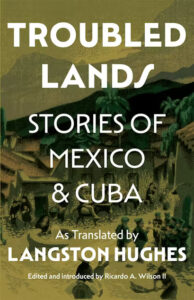
From Troubled Lands: Stories of Mexico and Cuba as Translated by Langston Hughes, edited by Ricardo Wilson II. Copyright © 2026. Introduction Copyright © 2026 by Ricardo Wilson II. Available from Princeton University Press.

Ricardo Wilson II
Ricardo A. Wilson II is a creative writer and scholar. He is associate professor of English at Williams College and founder and executive director of The Outpost Foundation, a residency and arts advocacy organization for writers of color from the United States and Latin America. He is the author of An Apparent Horizon and Other Stories and The Nigrescent Beyond: Mexico, the United States, and the Psychic Vanishing of Blackness.