Labor of Love: On Editing and the Rewards of Collaborative Effort
Genuine Human Connection Was the Not-So-Secret Ingredient in Samantha Paige Rosen’s Debut Anthology
From July to December 2024, Adam Vitcavage and I sent 68 emails back and forth. We were collaborating on a project that was a big deal for both of us: my first book, the anthology Living, Together: Reimagining Community in the Age of Disconnection, and Adam’s first personal essay, about how living with his sister in his 20s helped him go from—his words—“punk kid” to “semi-functioning adult.” Looking over this impressive email chain, I can see how much we wanted to please each other: I told Adam I knew he had what it took to write the piece and encouraged him to try an alternative form he was excited about. He offered to completely rewrite it if necessary (it wasn’t) and assured me that nothing would hurt his feelings in the editorial process.
Adam has written about books, TV, and music for over a decade, most recently as founder of the digital media outlet Debutiful, but felt less at ease writing about himself. As a fan of Debutiful, I was thrilled to be part of launching his career as a personal essayist. I also had a standard I wanted to uphold for the editorial experience I was offering Adam and the book’s 21 additional contributors, no matter where they were in their careers: one of genuine connection, trust, and discovery. I hoped this project—which stemmed from my experience moving back in with my parents shortly before I turned 30 and enjoying it so much that I stayed for six years, as well as my desire to show readers (and myself) more expansive paths toward housing, community, and interdependence—would feel as meaningful to my contributors, if for no other reason than the editorial relationship I was creating between us.
Of course I had my own vision for the book: that it include as many perspectives as possible, across living scenarios, identities, geographical regions, and topics, and that the stories feel accessible and illustrative of contributors’ approaches to communal living and community. I wanted it to serve, perhaps not as a blueprint, but as a source of hope and inspiration. At the same time, Adam and his fellow contributors’ desires for their pieces were as important as my own.
I’ve always been this into collaboration. In my senior year of college, I made a habit of walking my film studies professor home so we could bounce ideas for my next paper back and forth; I’d sprint back to my room, buzzing, and write late into the night. In my first full-time job as a writers’ assistant for a TV show, I remember sitting down with one of the writers during lunch to ask for edits on a piece of political satire, which became my first paid publication. In grad school, I think I wore my friends out asking for feedback on my essays for class, but I built a reputation with my teachers for being an exceptionally hard worker. In all of this, I wasn’t seeking external validation; I wanted to learn and grow.
Having long benefited from the art of joint effort, I knew I wanted my first book to be steeped in it. I made an editorial choice not to standardize the number of revisions; I gave each piece what I felt it needed, until both the contributor and I were content. Alongside the 68-email chain with Adam, there’s the 45-email chain and two Google Docs with Jake Montano, who writes about how his drag family influences his sense of self. My editorial email chain with Simone Gorrindo, whose essay recalls how she learned from a neighbor to turn outward instead of inward as a response to the loneliness she felt as a new military wife, is 35 emails long. I wasn’t sure what I had to offer the contributors with multiple books to their name, like Kim Stanley Robinson, Gabrielle Korn, and Kristen Arnett, but I faked the confidence and trusted my instincts. My communication with Kristen, whose piece illustrates how she and her chosen family provide acceptance and support for each other in all the ways her family of origin doesn’t, spans 25 emails, the penultimate of which is from her: “thank you again for all your extremely helpful edits—I appreciate all the time you spent on this piece! <3”
This collaborating and negotiating made us all so much smarter. I was thrilled when one of my writers had a better idea than I did. Elizabeth Hart Bergstrom shared their approach to white space—it doesn’t feel justified unless it’s done at least three times—which I applied to the whole collection. Rhaina Cohen improved my ability to land a one-liner. Hannah Grieco and Dani McClain modeled how to make the most emotional moments resonate.
Life can be isolating. This work is too hard to do alone. I find it more gratifying to share a goal, enhance an idea through discussion, hear someone stir in another room, consider a point of view different from my own, walk down the hall to ask a human being a question instead of the internet—just because I can.
At the beginning of this year, sociologist and writer Kathryn Jezer-Morton wrote in her newsletter for The Cut that recent technological advancements have nurtured an aversion to such “inconveniences” as reading, thinking, and dealing with unexpected reactions from other people. These things, she writes, are “usually not inconvenience at all but just the vagaries of being a person living with other people in spaces that are impossible to completely control.” The antidote, she determines, is “friction-maxxing”: deliberately exposing ourselves to things that feel “inconvenient” in order to better tolerate and eventually even enjoy them. “Maybe this is an opportunity to think more clearly than we ever have about what is interesting and essential about being human,” she says.
Editing this anthology was, in a sense, an exercise in “friction-maxxing.” It was 100% human effort, non-optimized, sometimes inconvenient, and most always challenging. The years-long effort that it takes to write any book contrasts with the effort-reducing goal of AI, and the collaborative approach to editing an anthology is even more distinguishable. But when we reduce human effort, we also lose the rewards of toiling, of collaborative effort.
I certainly couldn’t have written these essays without my contributors, but I also don’t think they could have written the same pieces without me. Many of the drafts I received were already, as Adam likes to say, bangers. But the conversational twists and turns, riffing off of one another in the comments, sending voice notes back and forth, occasionally hopping on a call when we knew the work would benefit from a real time discussion (imagine!) is what resulted in the versions of the essays that live in this book. I fought for my suggestions that I thought would make the essays land more with readers, from restructuring a paragraph to the placement of a comma, and I’m glad I did. Ultimately, we figured out the right structure, anecdotes, and language for each piece because we were able to expand upon one another’s ideas.
The fulfillment and joy I found with contributors expanded off the page. In Simone and Alex Alberto, I’ve identified editorial buddies for life. I could tell by the way we responded to one another’s suggestions that we pushed each other in the right ways. I suggested a major cut to Simone’s essay, praying she wouldn’t be offended, and she responded, “Yes, love it!” There were instances where Simone and Alex saw opportunities I hadn’t, which further opened up the essays for me and allowed me to offer more as editor. When Simone thanked me for “embodying the kind of editorial pickiness I adore” and Alex said my edits “always felt like collaboration,” I knew we shared something special that I hope we’ll share again.
The questions people have asked me most these past few years are: How did I live with my parents for six years in my thirties and why make an anthology instead of my own book? The details of these answers are different, but at their core, they’re the same. It’s also what Sarah Thankam Mathews highlights in her Living, Together essay “The Opposite of Loneliness.” Reflecting on the difficulties of creating and maintaining the mutual aid organization she founded six years ago, Bed Stuy Strong, she says, “Many of us are motivated to seek something other than a pure and bland ease… People are beautiful, damaged, powerful, tiresome, maddening, and, most of the time, worth it anyway.”
In many ways, it’s easier to live alone, limit interactions with neighbors to impersonal waves, or work solo on a project. In these instances, you don’t have to consider other people’s needs or opinions. There’s nothing to negotiate, no frictions to be had. But it’s so quiet, so uninspired. Life can be isolating. This work is too hard to do alone. I find it more gratifying to share a goal, enhance an idea through discussion, hear someone stir in another room, get the benefit of another person’s experience, consider a point of view different from my own, walk down the hall to ask a human being a question instead of the internet—anything that casually arises, just because I can.
This work of writing is human. It’s messy. It’s meaningful. And each essay in Living, Together is a product of engaging in this work, together(!). The anthology’s 22 writers span ages 25-91 and represent every region of the country as they cover topics including loneliness, friendship, aging, illness, parenting, chosen family, queerness, love, financial hardship, intergenerational relationships, sibling relationships, artist community, colonization, climate change, immigrant community, and, of course, housing. When author Emma Copley Eisenberg said the book made her feel “10 percent more hopeful about how we will possibly live now and 10 percent less dead inside,” I knew this collaboration had resulted in exactly what I set out to do.
Maybe these essays and my experiences don’t trace the easiest routes, but my time living communally—and writing about it, communally—has shown me that it’s a privilege to spend effort on worthwhile things.
____________________________________________
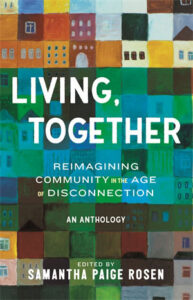
Living, Together: Reimagining Community in the Age of Disconnection, edited by Samantha Paige Rosen, is available via Beacon Press.

Samantha Paige Rosen
Samantha Paige Rosen’s writing on identity, culture, and the arts has appeared in the Washington Post, Harper’s Bazaar, ELLE, Slate, Them, Literary Hub, and elsewhere. She earned her MFA from Sarah Lawrence College and lives outside of Philadelphia, where she is a freelance writer and editor, a writing tutor and coach, and an amateur potter. Living, Together: Reimagining Community in the Age of Disconnection, is her first book.