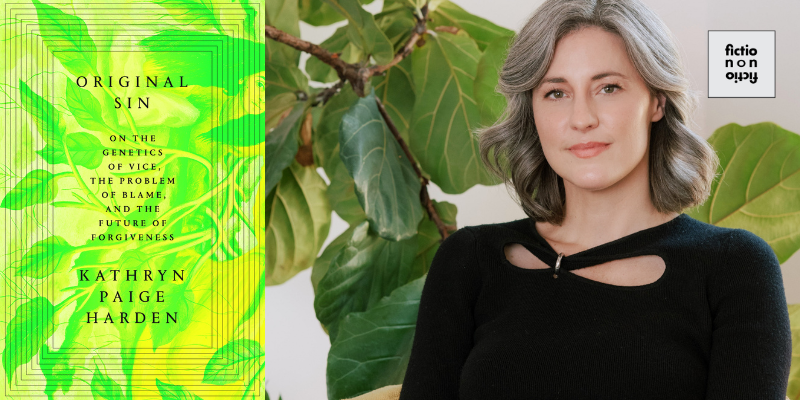
Kathryn Paige Harden on Behavior, Genetics, and Blame
In Conversation with Whitney Terrell and V.V. Ganeshananthan on Fiction/Non/Fiction
Psychologist, behavioral geneticist and writer Kathryn Paige Harden joins co-hosts Jennifer Maritza McCauley and Whitney Terrell to discuss her new book, Original Sin: On the Genetics of Vice, the Problem of Blame, and the Future of Forgiveness. Harden talks about the chemistry of human behavior, how society has shaped its views of different communities, the relationship between hereditability and perceived responsibility, and how those opinions shift as science unlocks more mysteries of the human genome. She also reflects on how her Christian upbringing has influenced her thinking and considers what influence new genetic information might have on our legal system. Harden reads from Original Sin.
To hear the full episode, subscribe through iTunes, Google Play, Stitcher, Spotify, or your favorite podcast app (include the forward slashes when searching). You can also listen by streaming from the player below. Check out video versions of our interviews on the Fiction/Non/Fiction Instagram account, the Fiction/Non/Fiction YouTube Channel, and our show website: https://www.fnfpodcast.net/ This podcast is produced by Jennifer Maritza McCauley, V.V. Ganeshananthan and Whitney Terrell.
Original Sin: On the Genetics of Vice, the Problem of Blame, and the Future of Forgiveness • The Genetic Lottery: Why DNA Matters for Social Equality
Others
The Divine Comedy – Inferno, Purgatorio, Paradiso by Dante Alighieri • “Criminal Complexity” – The American Scholar
EXCERPT FROM A CONVERSATION WITH KATHRYN PAIGE HARDEN
Kathryn Paige Harden: So the book is, in many ways, me wrestling with my own journey of being taught to believe in Heaven and Hell and inherit sin, and I’ve studied how what people inherit genetically influences their behavior. What do I think now? And it’s made me realize how much of my thinking is still very Christian, but Christian in a way that emphasizes grace and compassion.
Whitney Terrell: Now, both the Catholic and Evangelical Church might be very Calvinistic or Augustinian in the way that they think about sin, but Americans are a bit more on the Pelagius side of things, particularly when it comes to genetic ideas. As you pointed out, the idea of the gene has been around for 75 years, and the Human Genome Project began in 1990. I remember when they said they were gonna “we’re gonna map the whole genome.” You point out that for a lot of issues, Americans are willing to take the view that “[In the words of Pelagius’s supporter Julian,] ‘What’s natural cannot be called evil.’” In Pelagius’ view, you do inherit certain traits, and you’re not as morally responsible for them as you might have been thought to be at an earlier time. Could you talk about that a little bit?
KPH: The example of Pelagian thinking that we’re living through right now is how Americans attitudes around body weight and appetite are shifting in the wake of the obvious effectiveness of GLP-1 agonist drugs like Ozempic. We can see through research on people’s attitudes that the more a person thinks that body weight is biological or genetic or inherited, the less likely they are to think that body weight is a matter of willpower, or that people are morally weak or blameworthy in some way for having a larger body weight. When people see that if we intervene with a biological mechanism, you can change someone’s weight, you can change someone’s appetite, people’s attitudes tend to change such that they have less moral stigma around having a higher body weight.
WT: Which it used to be, because gluttony was on that list of seven deadly sins, right?
KPH: Exactly. Gluttony is a circle of hell in Dante’s Inferno. For many decades, there was good evidence that the type of drug that eventually became a GLP-1 agonist could be developed, and there was very little, ironically, appetite amongst pharmaceutical executives for pursuing that line of research, because they thought, “This can’t be something that we could intervene in biologically, because this is a matter of willpower, people, this is a lifestyle choice.” Once it was clear that the biological mechanism was so effective, people’s attitudes towards weight really shifted. We’ve seen similar shifts historically before. Autism Spectrum Disorders used to be blamed primarily on mothers.
WT: Those were caused by vaccines, right?
KPH: That’s a really interesting backlash. Now, many people have rejected the evidence that autism is a highly heritable condition, it’s primarily caused by genetics. They’re blaming it, against all scientific evidence, on vaccines. And what does that do? That relocates the blame in the mother. So it’s genetics or it’s moms making bad choices. And we’ve seen it with sexual orientation. There’s really good research that narratives around being “born this way,” or sexual orientation being biological, innate, inherent, really drove changes in attitudes towards gay rights, particularly amongst people who were already politically liberal in the 1990s.
We have across multiple domains, examples where genetic research or neuroscience research, research that locates behavior in the body somewhere as biological, has been really influential in reducing the moral stigma around those behaviors, reclassifying them as natural variation, not even a matter of moral concern, necessarily. So even though Augustine won this debate within the Christian Church, we still see this broadly Pelagian formulation of the relationship between biology and sinfulness for some things, but not everything. I think we still see evidence of this debate or this tension, because our attitudes and our interpretations of genetics can differ depending on the specific behavior we’re looking at.
Jennifer Maritza McCauley: So that’s fantastic and and yet, while we might give people a pass for being genetically predisposed to obesity or autism or depression, we don’t seem to feel the same way when it comes to crime, specifically violent crime. But your research suggests that there might be genetic factors that lead to aggressive behavior or other forms of criminality. Could you outline those factors?
KPH: So, if we’re looking at this scientifically, either we’re looking at it in terms of, how much do family members resemble each other for behavior? How much does something run in families? How much do children resemble their biological parents, even if they’ve been adopted away at birth and raised by different people? Or if we’re looking, like I described earlier, at specific measured genes, anti-social behavior and aggression is every bit as genetic, as body weight, as autism, as other mental illnesses, as sexual orientation.
There’s no clean distinction, scientifically, between “these are the behaviors that are influenced by biology,” and “these are the other ones that are not influenced by biology.” We see the same strength of evidence for genetic influence on all of these things, but people’s intuitions about how to interpret that really changes as soon as there’s an obvious victim or harm involved in a behavior. If we’re given evidence that sexual orientation is heritable, people tend to say, “Okay, well, then it’s not a moral issue. There’s no victim here. It’s just natural variation.” But you can’t reclassify aggression as not a moral issue because there’s an obvious victim involved. Or at least you can’t do that very easily.
People’s intuitions about the relationship between how biological it is or how genetic it is, and how much people are to blame for it, or how much they should be punished for it shift from this more Pelagian interpretation to this more Augustinian narrative, where inheriting something doesn’t get you off the hook, it actually makes you even more inherently damnable or blameworthy or punishable.
There’s a great study by the psychologist Susan Gellman and her colleagues where they give participants a bunch of hypotheticals about a sperm donor. They say, “Imagine you went to a sperm bank and you conceived a child, and then after you conceived the child, you learned various things about the sperm donor. What is the likelihood that the child conceived with that sperm would show these characteristics?” It’s a way to get at people’s intuitions about how inheritable something is, without talking about scientific concepts. You say, “Oh, the sperm donor is tall. How likely is it that the child conceived with that sperm will be tall? If the sperm donor speaks French, how likely is it that the child conceived from that sperm is going to, you know, speak French?”
And people are generally right. They’re like, “Well, the child won’t speak French, but it will be tall.” And then people really vary. If you say, “If the sperm donor committed murder, how likely is it that the child conceived of that sperm will also commit a violent crime?” Some people say no, they think it’s totally socially transmitted. Some people think it’s just as inherited as height. And there’s the whole variation. People who think that violence can be biologically transmitted, when they’re given the choice of “How much should someone be punished for a crime?” they actually say that person should be punished more for the crime. That might have to do with they think they’re more dangerous or less likely to be rehabilitated or less likely to change, but it’s a really clear instance that thinking that something is inherited doesn’t make us say, “Well, I guess it’s okay that they murdered someone, that’s no longer a moral issue.”
On average, it doesn’t soften our sense of how much that person should be punished. As a scientist, that was one of my onramps to this book. The science looks so similar across different domains, in terms of how much genetics matters, but our response to the science in the culture can swing really wildly from one direction to the other.
JMM: So in The American Scholar, Jill Leovy wrote a review of Original Sin that focuses on social causes of criminality. She argues that historical discrimination, the Civil War, segregation and policing controversies, combined with perennially low solve rates for violent crime are more important causes of incarceration rates among black men than genetics. How would you respond to that?
KPH: I would agree with her. When we’re talking about a behavior like crime, crime isn’t one thing. As a psychologist, I recognize there’s behavior, and then there’s “How is that behavior judged by society?” Some things are classified as crime. As a psychologist, I’m interested in, “What are people doing?” But all of those behaviors are incredibly complicated, and they’re not caused by just one thing. The most important causes might really differ for people who are being raised in different environments with different risk factors and different times and places. I’m a behavior geneticist by training. I’m writing a book about genetics because that’s what I know about. And race is not genetic. The differences between Black and White, those are social categories. Those aren’t genetic categories. Again, all humans are 99 percent genetically the same, regardless of race, and most of the differences between us are not bound by one racial category.
The toolbox that I have as a behavior geneticist can understand “What are individual differences in response to an environment?” But it can’t really explain differences in racial disparities. The problem that she’s pointing out in that review is such an important one: “Why do certain people, Black men, in particular, in our country, suffer from such a disproportionate burden of exposure to violence and also entanglement in this incredibly retributive, punitive criminal legal system?” That’s a really important issue, but it’s not one that I can shed light on with the toolbox of genetics, because, again, race isn’t a genetic category.
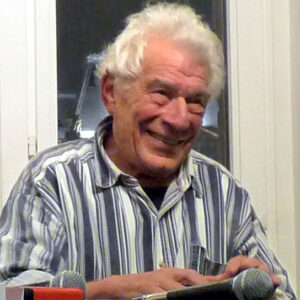
Transcribed by Otter.ai. Condensed and edited by Rebecca Kilroy. Photo of Kathryn Paige Harden by Bonnie Burke.

Fiction Non Fiction
Hosted by Whitney Terrell and V.V. Ganeshananthan, Fiction/Non/Fiction interprets current events through the lens of literature, and features conversations with writers of all stripes, from novelists and poets to journalists and essayists.