Jung Yun on Writing a Post-9/11 Cruise Novel
Jane Ciabattari Talks to the Author of All the World Can Hold
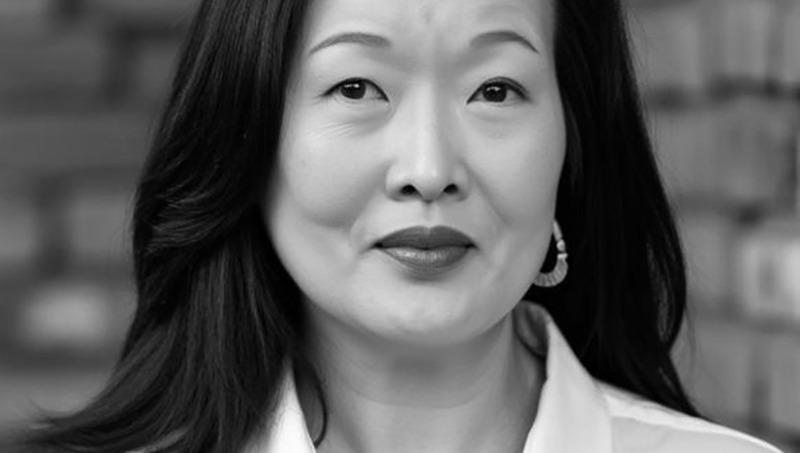
All the World Can Hold is both emotionally bold and granular, as it captures the experience of the 9/11 attacks 25 years ago. Jung Yun, author of Shelter and O Beautiful, drew upon personal experience to write it. “In 2001, I was living in Park Slope, Brooklyn and working on the redevelopment of Lincoln Center for the Performing Arts,” she told me in our email conversation. “I had just arrived at my office on the West Side of Manhattan when the first plane hit.”
The novel follows three primary characters, all of whom have much to regret, much to hope for, on a cruise ship departing for Bermuda five days after 9/11. Did she take a similar cruise?
I did, actually. I went on a cruise to Bermuda on 9/16 with my ex and former in-laws. Similar to the book, the ship was scheduled to depart from the Manhattan Cruise Terminal but was rerouted out of Boston instead. I started writing in earnest after 9/11, so I’ve always wanted to write a book related to this event, but for a long time, I resisted the idea of setting a novel on a cruise ship because it felt too intimate… I like a certain amount of distance. But once I finally decided to commit to the ship, this book that I’d been trying to write off-and-on for nearly 20 years suddenly started to come together in ways that I never could have imagined.
*
Jane Ciabattari: Did you travel on the Pacific Princess, the Love Boat cruise ship (in your book, the Sonata, the Starlight Voyages ship) on a reunion cruise? What was that experience like at that time?
Jung Yun: I did sail on the Pacific Princess. My former mother-in-law had been a big fan of the Love Boat series, so when she heard that Princess was retiring the Pacific, where most of the exterior scenes for the show had been filmed, she really wanted to sail on it. It turns out that when a company decides to retire a ship that probably cost over $100 million to acquire, it’s looking pretty dated. I felt like I’d gone back in time to the 1980s, which is what inspired the idea of a reunion cruise. I’ll add that being on the actual Love Boat was really helpful in terms of finding a structure for the novel. People who used to watch the show might recall that each episode was designed around three storylines–two dramatic and one more lighthearted–so a little Easter egg for the eagle-eyed is that the novel is structured in a similar way.
JC: In your novel, during the opening days of the cruise, communications are shut off, so for several days the passengers can’t get any news about the 9/11 attacks and their aftermath. This leads to frustration and other reactions (and also allows you to build back stories for your characters). Is that also based on real events?
The beauty of fiction is that I could turn this vague feeling into a pressure point for the characters and heighten the sense of containment that one already feels when they’re stuck on a ship.
JY: Honestly, Jane, I can’t remember. Memoirists often say that how people remember something can be just as interesting as what they remember. In my very fallible memory, I don’t recall being able to get to the Internet or watch TV or even read a newspaper while we were on the ship. That doesn’t mean the communications system was actually down. I think it just points to my sense of disconnectedness from the world in the moment. The beauty of fiction is that I could turn this vague feeling into a pressure point for the characters and heighten the sense of containment that one already feels when they’re stuck on a ship and they don’t want to be there.
JC: Franny’s Korean-American family is pulled in many directions during this voyage to celebrate her mother’s 70th birthday. Her marriage hits a major snag, she has lied to her husband about where she was on 9/11, she is haunted by painful memories of her father and brother’s death in a car accident when she was eight, and her mother’s ambivalence is particularly painful during the long awaited banquet dinner. How did you plot all these family divisions?
JY: Originally, I imagined Franny as a person who has lots of relationships–a marriage, a mother-daughter relationship, a sibling relationship, work colleagues, friendships from school–but she feels lonely in all of them. From there, I had to work backwards, thinking about why all these relationships are strained and why she’s willing to accept them in this state. The more time I spent writing Franny, the more I realized that she didn’t consciously accept less than what she wanted from people. It’s the forced togetherness of the cruise that makes her loneliness visible in a way she hasn’t fully been able to register in her day-to-day life.
JC: Doug was the star of Starlight Voyages in the 1970s-1980s, beloved by the fans on board. In reality he’s financially troubled, plagued with anxiety, focused on maintaining fifteen years of sobriety, after years of embarrassing drunken episodes. He has brought his nephew Gideon with him for company, which gives a generational perspective. How did this narrative unfold?
JY: I wanted Doug to be a person who’s lived a life of extremes–debauchery and substance abuse in his heyday, followed by near-monastic solitude in middle age. Doug carries around so much shame and grief about his past. Part of his penance is not letting anyone in or allowing himself to be seen or truly loved. It was interesting to craft a character like this–someone who’s worked hard to reform himself and then think about all the different things that would stress him out the most. The addition of his nephew as a travel companion was meant to be an incentive for Doug to be on his best behavior, but Gideon actually turns out to be just one more stressor.
JC: Lucy has come on this voyage as her wealthy roommate’s guest. She’s a PhD candidate at M.I.T. whose secret passion is being an artist. She has a series of glitches on board. Her baggage is lost, so her wardrobe is limited. She’s nervous about finding a job. She’s drinking too much. She feels out of place, seeing the cruise ship filled with mostly white people with more money than she has. She’s worried she won’t be able to find a telephone connection for a job interview at a weirdly named tech company (it’s early Google). Meanwhile, her roommate is having an affair with a staff member, which breaks the rules, and they are increasingly annoyed at each other. Was this the most explosive relationship of the group?
JY: In some ways, yes. Lucy and her roommate, Mariah, aren’t inhibited about showing their emotions once they finally reach full boil. But it takes a while to get here. Lucy’s been raised to be a polite young woman at all times, so she often reverts to silence or avoidance because she doesn’t know what to do with Mariah’s slights. Quite a lot of them build up over the course of five boozy days. Complicating her feelings of annoyance and frustration are all the challenges that Lucy experiences during the cruise–the feeling of being an outsider, a lost suitcase, seasickness, sunburn, her lack of connection from the world at a time when she needs it most. I really enjoy building long fuses in my writing. Everything seems so chummy when Lucy and Mariah are shopping for flip-flops together, but they’re already headed toward disaster.
JC: Your cast of characters also includes members of the staff of the Sonata, from Jimmy from Guest Service, who welcomes Franny and her husband Tom aboard in the opening scene, to Kevin Hanna, the British accented entertainment director who plays a “Jekyll and Hyde” sort of role, life of the party to passengers, authority figure to the in-house entertainers. How did you go about developing these characters?
JY: There’s always an “upstairs-downstairs” dynamic in any tourist environment, whether you’re talking about a resort or a cruise ship or an attraction. A couple of brilliant recent books that focus on the staff in these environments are Lara Williams’ The Odyssey and Cleyvis Natera’s The Grand Paloma Resort. I wanted the focus of this particular book to be the three passengers, so I tried to make crew members like Jimmy, the room steward, and Johannes, the head waiter, recurring secondary characters who cross from one main character’s experience of the cruise to another’s.
JC: How did you research details of your locations—the harbor in Boston, the guest rooms, the bar, the performance space, the dining room, the pool, the Bermuda destination?
JY: Thanks to the Pacific’s role in television history, it’s a surprisingly well documented ship. There are lots of books and websites dedicated to its various stages of life, so I had plenty of images to refer to. That being said, I wasn’t trying to recreate the Pacific, just using it as a jumping off point to design my own ship. All the spaces that you mentioned–the theater, the main dining room, the pool, etc.–are common to most cruise ships, and I enjoyed visualizing my own versions of them. At one point, I had to draw a map of each level to make sure the flow of all the spaces worked and I remembered exactly where I put everything.
Obsessions have an interesting way of creeping into my work, often subconsciously.
As for the itinerary, each section of the novel starts with a day and a location, like “September 16–At Sea.” In the beginning, those dates corresponded with the dates and locations of my actual cruise to Bermuda. The only difference is that I shortened the cruise to five days in the novel. Mine was actually seven very long days.
JC: What were your most surprising findings about the attacks on 9/11 during research trips to New York, Washington, D.C., and Shanksville, Pa.? What other research was involved in writing this novel?
JY: One of the things I learned while writing this book is that the interruption of the cruise created a strange before and after for me, kind of like a state of arrested development. I left New York five days after 9/11 and missed a very consequential week of rescue and recovery. By the time I returned from Bermuda, it felt like the city–while not back to normal yet–was definitely back to work, and I went back along with it.
As part of the research for this book, I watched hundreds of hours of news footage, and read all the major newspapers that I missed during the cruise–things that were actually easier to do in the 2020s than they were in 2001. I can’t point to any one particular finding that was surprising, only that this effort filled in a void for me that I think I’ve been carrying around for years.
JC: What are you working on now/next?
JY: I’m at my usual crossroads when starting a new novel–trying to decide between two seemingly different things that I’ll later discover are about the exact same thing. Obsessions have an interesting way of creeping into my work, often subconsciously. For now, it’s probably safest to say that I’m writing, chasing the trail wherever it leads me next.
__________________________________
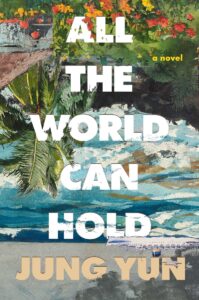
All the World Can Hold by Jung Yun is available from 37 Ink, an imprint of Simon & Schuster.

Jane Ciabattari
Jane Ciabattari, author of the short story collection Stealing the Fire, is a former National Book Critics Circle president (and current NBCC vice president/events), and a member of the Writers Grotto. Her reviews, interviews and cultural criticism have appeared in NPR, BBC Culture, the New York Times Book Review, the Guardian, Bookforum, Paris Review, the Washington Post, Boston Globe, and the Los Angeles Times, among other publications.